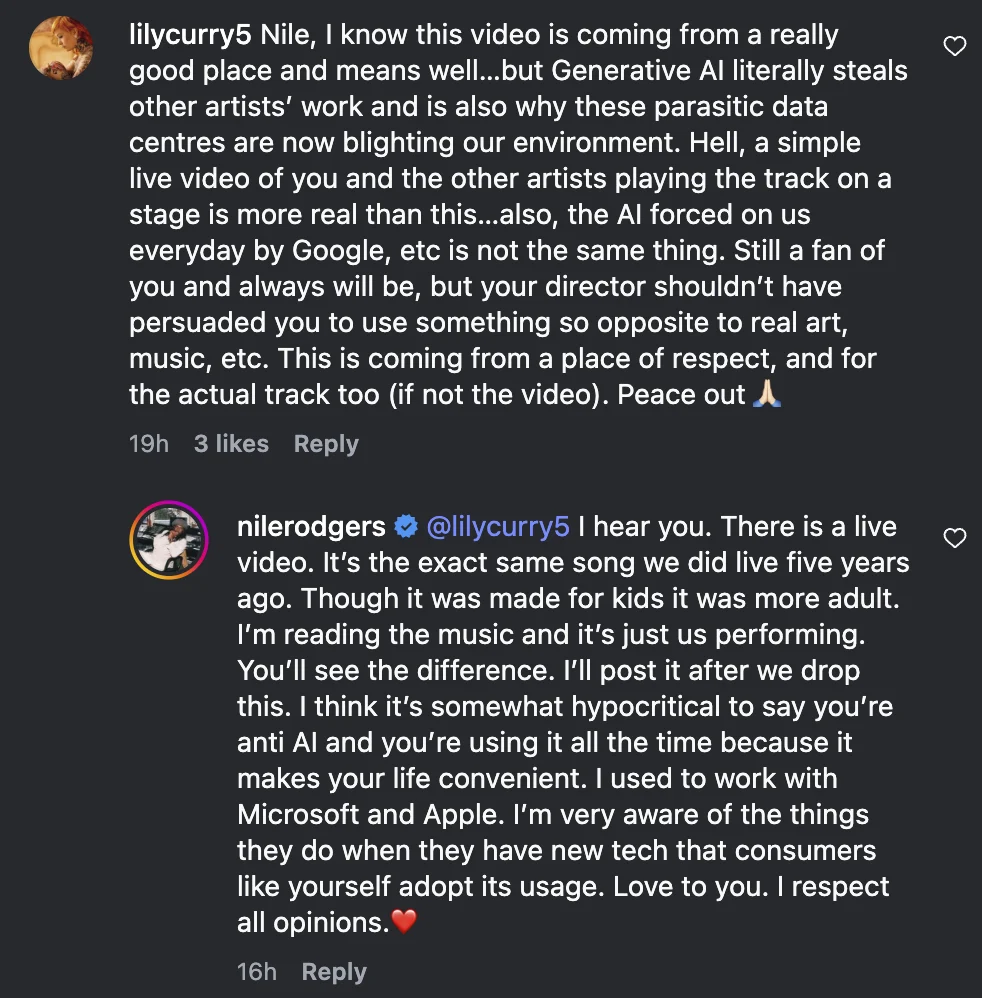
The integration of artificial intelligence into creative media has sparked a fresh wave of controversy surrounding Rock and Roll Hall of Fame inductee Nile Rodgers. The legendary Chic guitarist and producer, known for his pioneering work in funk and disco, recently faced significant public backlash after announcing the use of generative AI in the production of a new music video for "The Christmas Song," a 2020 charity collaboration with soul singer Rebecca Ferguson. As the industry grapples with the ethical implications of machine learning in artistic expression, Rodgers has emerged as an ardent defender of the technology, characterizing his critics as hypocritical.
The controversy began when Rodgers took to social media to share a glimpse into his creative process. Posting footage of himself within a high-tech photogrammetry rig, he described the experience as a "next level" art project. He cited a recent experience attending an Eagles concert at the Las Vegas Sphere—an immersive venue renowned for its cutting-edge visual technology—as the primary catalyst for his experimentation with AI. However, the reception was far from celebratory. Followers quickly condemned the move, with one user disparagingly labeling the output as "AI slop" and suggesting the technology was merely a novelty for an aging demographic.

A Chronology of the Digital Dispute
The tension escalated when Rodgers began sharing stills from the upcoming project. The imagery depicted stylized, uncanny versions of himself and Ferguson surrounded by a cast of indistinguishable, fuzzy creatures. Observers were quick to point out the characteristic artifacts of generative AI: inconsistent typography, strange 3D spatial geometry, and an overall aesthetic quality often associated with low-fidelity prompt-based image generation.
Rodgers’ response to the critique was immediate and confrontational. He questioned whether the detractors maintained similar disdain for traditional CGI (Computer Generated Imagery), suggesting that the audience was judging his work before its completion. As the debate migrated from simple disagreement to heated discourse regarding the ethics of creative labor, Rodgers defended the production’s intent. He maintained that his team had followed a rigorous creative process, utilizing mood boards, storyboards, and traditional filmmaking workflows, with AI serving as an execution tool rather than a replacement for creative vision.
The Economic and Creative Argument
One of the central pillars of the debate is the financial justification provided by the artist. Rodgers noted that the project would have cost approximately $100,000 had it been produced through conventional animation and cinematography methods. By leveraging AI tools, he suggested, he was able to achieve a complex visual result that would otherwise have been financially prohibitive.

This defense highlights a recurring tension in the modern entertainment industry: the trade-off between labor-intensive, human-led production and the efficiency offered by generative models. While Rodgers characterizes the technology as a democratizing force for independent or budget-conscious creators, critics argue that the "hollow" aesthetic and the displacement of specialized human animators represent a degradation of artistic standards. The debate is further complicated by the fact that the project is for a charitable endeavor, leading some to question the appropriateness of utilizing controversial technology for humanitarian outreach.
The Philosophy of Tool Utility
Nile Rodgers is no stranger to technological disruption. Throughout his career, he has been a vocal proponent of music technology, famously advocating for the use of drum machines and sequencers during the 1980s when many traditional musicians viewed such innovations as a threat to the integrity of live performance. In 2023, he dismissed concerns about the "fakeness" of generative AI, equating it to the early skepticism faced by electronic synthesizers.
His current defense relies on a distinction between "input" and "output." Rodgers argues that the user’s intent and the structure of the creative prompt are what define the artistry, rather than the machine’s role in generating the pixels. He has consistently pivoted the conversation toward the ubiquitous nature of AI in modern life, pointing out that his critics likely utilize AI-driven features—such as GPS navigation, social media algorithms, and even basic photo editing software—on a daily basis. He posits that singling out his artistic usage while ignoring the systemic integration of AI in daily life constitutes a double standard.

Broader Implications for the Creative Industry
The discourse surrounding Rodgers’ video reflects a larger, ongoing conflict within the creative sector. As of late 2026, the industry remains divided on the definition of "artistic labor." While some artists see AI as a sophisticated brush that expands the boundaries of what is possible, labor unions and industry guilds—notably those representing visual effects artists and illustrators—have raised concerns regarding copyright, the training of models on proprietary data, and the long-term impact on employment.
From a technical standpoint, the current state of generative video presents unique challenges. Critics often point to the "uncanny valley" effect—a psychological state where synthetic representations of life appear nearly, but not quite, human, causing a sense of unease. The images shared by Rodgers, which feature indistinct, living-stuffed-animal creatures, appear to have triggered this response in his audience. The juxtaposition of a legendary, human-led musical performance with machine-generated visuals has created a cognitive dissonance for fans who value the organic, soulful nature of his work.
Fact-Based Analysis: Utility vs. Artistry
When analyzing the technological divide, it is necessary to differentiate between utility-based machine learning and generative creative models. Algorithms that organize data for search engines or calculate optimal driving routes function through pattern recognition and task-based efficiency. Conversely, generative design involves the synthesis of new images, text, or sounds based on probabilistic models trained on existing human-made content.

The primary critique of Rodgers’ project is not necessarily that he used a machine, but that the current generation of tools often lacks the "human touch" required for nuanced storytelling. Even when an artist provides the "mood board" or the "prompt," the final visual output of current AI models is often characterized by a loss of intent-driven detail. The "illogical 3D depth" and "alternating text sizing" mentioned in initial reports are symptoms of the current limitations in spatial awareness and linguistic rendering within these models. While these issues may be resolved as the technology matures, they currently serve as a flashpoint for audiences who perceive a decline in quality.
Future Outlook and Industry Standardization
As the November 20th release date for the full video approaches, the industry will be watching to see how the public reacts to the final product. The incident serves as a case study for legacy artists attempting to navigate the shift toward a digital-first creative landscape. For Rodgers, the project represents an evolution of his long-standing commitment to embracing the tools of his time, regardless of the pushback.
The implications of this debate extend far beyond a single music video. As regulatory bodies in the United States and abroad continue to examine the legal frameworks surrounding AI-generated content—specifically regarding the "human authorship" requirement for copyright protection—the actions of high-profile creators like Rodgers will likely influence public perception and industry standards.

Whether or not the finished project successfully bridges the gap between his musical vision and the synthetic visuals remains to be seen. However, the controversy has already succeeded in highlighting the deep-seated anxiety regarding the role of human creative agency in an increasingly automated world. Rodgers’ insistence that his critics are being "hypocritical" touches on a fundamental truth: society has enthusiastically adopted AI for convenience, yet remains deeply protective of the sanctity of creative expression. The friction generated by this conflict is likely to persist as artists continue to test the boundaries of what is acceptable in the era of generative intelligence.
Conclusion
The case of Nile Rodgers and his use of AI in "The Christmas Song" is a microcosm of the wider cultural struggle to define the value of art in the 21st century. While Rodgers views the controversy as a misunderstanding of his process and a failure of his audience to recognize their own reliance on the technology, his critics see a fundamental misalignment between the warmth of his music and the cold, mechanical nature of the visuals he has chosen to pair with it.
As technology continues to advance, the distinction between "tool" and "collaborator" will become increasingly blurred. The success of future projects will likely depend not just on the efficiency of the production, but on the ability of creators to integrate these powerful machines in a way that preserves the human spirit—the very quality that has defined Nile Rodgers’ illustrious career for decades. For now, the debate continues, serving as a reminder that the path to the future is rarely paved without resistance.