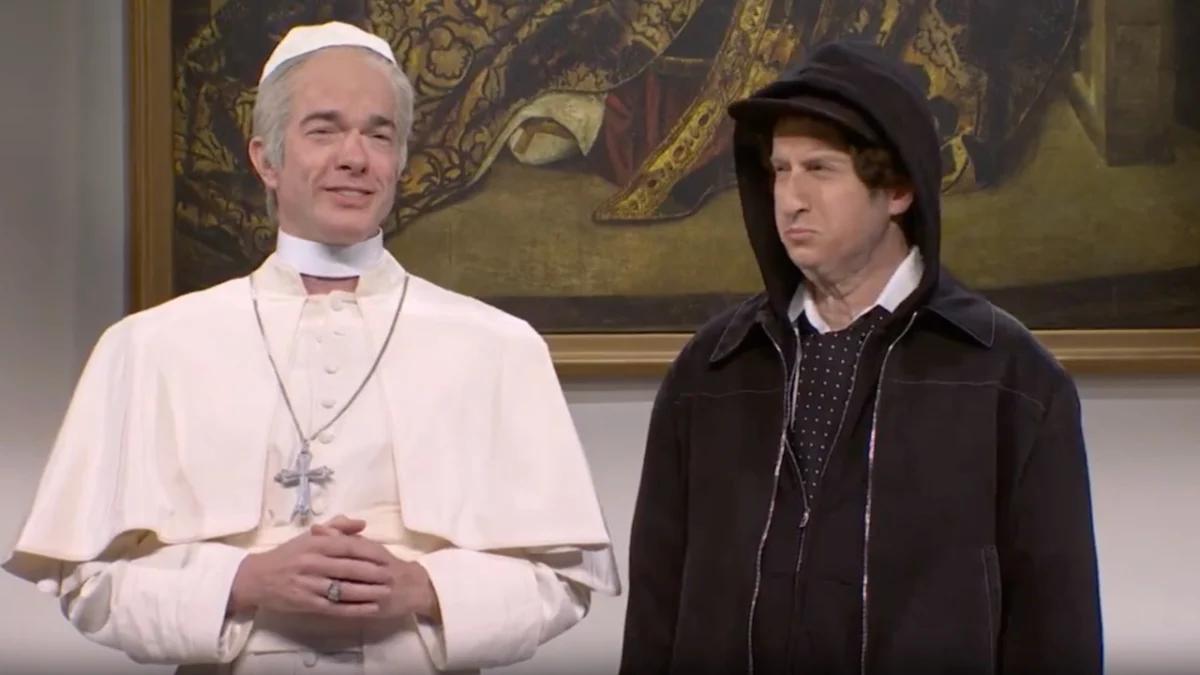
The recent intersection of high culture and late-night satire reached an unexpected zenith this past week when Saturday Night Live cast member James Austin Johnson brought his critically acclaimed Bob Dylan impression to a sketch that was ultimately trimmed from the live broadcast. The segment, which centered on a fictionalized meeting between the folk icon and Pope Leo, featured host John Mulaney as the pontiff. While the sketch was cut for time, its subsequent release via the show’s digital platforms has sparked a flurry of discourse regarding the intersection of celebrity, religious iconography, and the evolving nature of parody in the modern media landscape.
A Chronology of the Sketch
The premise of the sketch finds the Nobel Prize-winning songwriter sitting down for a private audience with the leader of the Catholic Church. What begins as a conversation ostensibly framed around “matters of great spiritual importance” quickly devolves into the idiosyncratic, rambling, and often absurd territory that has become the hallmark of Johnson’s portrayal of Dylan.
The chronology of the interaction, as scripted, moves from the grandiose to the mundane. Dylan begins the exchange by framing his presence at the Vatican as a pilgrimage of the soul, only to pivot within seconds to a detailed, dry explanation of his clothing choices—specifically, the provenance of his hoodie, which he identifies as an "Amazon Essentials" garment. The comedic tension is sustained through this juxtaposition: the weight of the papacy pitted against the mundane, hyper-specific fixations of an artist famously allergic to direct explanation.
As the sketch progresses, the dialogue highlights the surreal nature of the meeting. Dylan’s character maneuvers the conversation toward increasingly bizarre requests, including a pitch for a new hymn and a macabre inquiry into the availability of Mother Teresa’s remains for purchase. When the Pope attempts to steer the conversation back toward Dylan’s storied musical legacy, the songwriter dismisses the request with a claim of "complete Alzheimer’s" regarding his own past.
Supporting Data and Cultural Context
James Austin Johnson’s tenure on Saturday Night Live has been defined by his uncanny ability to capture the specific cadence and syntax of public figures, with his Bob Dylan impression becoming a breakout hit of the current season. This sketch serves as the latest iteration of his ongoing character study of the artist, which has previously surfaced in various sketches as a recurring, wandering figure commenting on contemporary culture.
The choice to parody the “Pope meeting a legend” trope is a well-worn narrative device in late-night television. However, the specific inclusion of Dylan—a figure whose own career is marked by a refusal to be pinned down—adds a layer of meta-commentary. Dylan’s actual history with the Vatican is not without precedent; in 1997, he performed for Pope John Paul II at the World Eucharistic Congress in Bologna, Italy. This real-world event, where the then-Pope famously quoted Dylan’s “Blowin’ in the Wind,” provides the necessary subtext for the sketch’s premise. By subverting this historical moment, the SNL writers lean into the discomfort of celebrity interaction with historical institutions.
Fact-Based Analysis of the Parody
The decision to remove the sketch from the live broadcast is a common practice at Saturday Night Live, where the “dress rehearsal to live” transition often requires surgical precision to meet strict time constraints. The fact that the sketch was deemed “cut for time” rather than “cut for content” is significant; it indicates that the network’s Standards and Practices department found no issue with the depiction of the Pope or the irreverent dialogue regarding religious figures.
From a sociological perspective, the sketch acts as a mirror to the current public perception of Bob Dylan. In the later stages of his career, Dylan has cultivated an image of the “grumpy old man” or the “enigmatic wanderer,” traits that Johnson exploits. The parody succeeds because it relies on the audience’s existing knowledge of Dylan’s public persona—his tendency to give non-answers, his interest in Americana, and his enigmatic shifts in artistic direction.
Furthermore, the sketch highlights the role of the “digital afterlife” of network television. In the past, a sketch cut for time would have disappeared into the archives, unseen by the public. Today, the immediate release of such content on platforms like YouTube allows for a broader audience engagement, effectively turning a “deleted scene” into a viral moment that may ultimately gain more traction than the sketches that actually made it to air.
Broader Implications and Reception
While there have been no formal statements from the Vatican or representatives for Bob Dylan regarding the parody, the sketch fits into a long history of musicians being depicted in the halls of power. The satirical tone is consistent with the show’s legacy of institutional critique, albeit one that is significantly more playful than the show’s more aggressive political sketches.
The implications of this sketch go beyond mere comedy. It underscores how the “legacy act” status of artists like Dylan allows them to become archetypes. By the time a performer reaches Dylan’s level of cultural saturation, they are no longer just a person; they are a character that can be inhabited, analyzed, and repurposed for satire. Johnson’s performance serves as a reminder that the public has a deep, almost proprietary, interest in the lives of aging rock icons.
The Evolution of the SNL Format
The inclusion of high-production, pre-taped sketches that are then repurposed for digital consumption marks a shift in how Saturday Night Live manages its intellectual property. The show is no longer a strictly linear experience; it is an omnichannel content producer. The fact that the “Bob Dylan meets the Pope” sketch was likely written to be a tentpole of the episode, only to be relegated to an online exclusive, illustrates the high stakes of the writers’ room.
The sketch also speaks to the endurance of John Mulaney as a guest host. Mulaney’s ability to play the “straight man” to the chaotic energy of Johnson’s Dylan is a dynamic that has proven successful across multiple seasons. The chemistry between the two performers, combined with the absurdity of the dialogue, ensures that even as a digital-only piece, the sketch maintains the high production standards expected of the flagship NBC program.
Conclusion: The Future of Celebrity Satire
As Saturday Night Live continues to navigate a media environment that prizes clips over full-episode consumption, the “cut for time” sketch has become a badge of honor rather than a sign of failure. The Bob Dylan/Pope Leo interaction remains a curious, highly specific piece of television that balances the reverence for a musical icon with the inherent absurdity of the celebrity-meets-authority dynamic.
Ultimately, the sketch will likely be remembered not as a stinging indictment of either the artist or the Church, but as a testament to the specific comedic vernacular of the 2020s. It is a snapshot of how we process our cultural idols, reducing the profound and the legendary into a series of punchlines about hoodies and forgotten memories. Whether the real Bob Dylan would find the depiction accurate remains a mystery, though given his history of self-deprecation and his own unpredictable nature, it is unlikely he would take offense at being cast as a rambling, hoodie-wearing pilgrim in the halls of the Vatican. As it stands, the digital release serves as a curious footnote to an episode defined by its own frantic, truncated energy.