
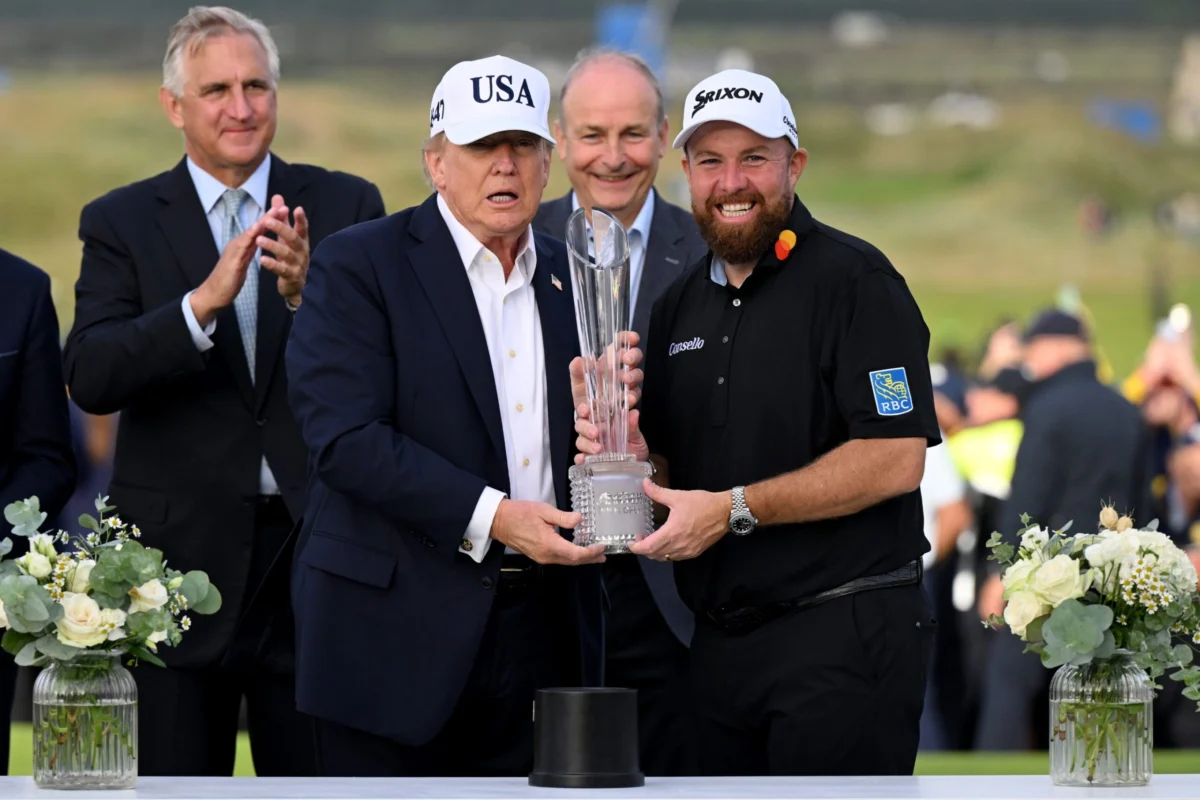
In a dramatic and unexpected announcement delivered against the picturesque backdrop of a championship golf course in Ireland, U.S. President Donald Trump declared on Sunday that his administration intends to completely eliminate the 10 percent tariff currently levied on Irish whiskey imports into the United States.
The declaration, made at the conclusion of the Irish Open golf tournament during the official trophy presentation ceremony, caught both spectators and trade observers by surprise. Standing before a large crowd of golf enthusiasts and international media, Trump revealed that the decision was heavily influenced by persistent lobbying from individuals he encountered during the sporting event, including professional golfers and tournament organizers.
“Everybody’s been bugging me to do it,” the Republican president told the cheering crowd, recounting the informal appeals he received throughout the weekend. “And I said, ‘On behalf of the United States of America, I am going to take the tariffs off’ Irish whiskey.”
The impromptu pledge marks a significant potential turning point for the trans-Atlantic spirits trade, promising relief for distillers across the island of Ireland and American importers alike. However, while the political announcement generated immediate jubilation from the spectators in attendance—who responded with loud whistles and cheers—formal details outlining the exact timeline and legal mechanism for lifting the tariff were not immediately made available by the White House or the Office of the United States Trade Representative (USTR).
Current Trade Landscape and the EU Tariff Framework
To understand the weight of President Trump’s announcement, it is necessary to examine the current economic and regulatory framework governing Irish whiskey exports to the United States. Under existing trade policies, Irish whiskey faces a standard tariff that was originally implemented as part of a broader set of U.S. duties on imports originating from the European Union.
This overarching tariff regime has seen multiple adjustments over the past year. Most recently, the duty applicable to Irish whiskey was reduced from 15 percent to 10 percent in July, offering a modest reprieve to producers. Despite this reduction, the remaining 10 percent levy has continued to act as a financial friction point for exporters navigating the lucrative U.S. consumer market, which remains the single largest destination for Irish whiskey globally.
Unlike spirits produced in England, Scotland, or Northern Ireland—which have already benefited from separate trade negotiations and exemptions—Irish whiskey producers based in the Republic of Ireland have remained subject to the EU-wide trade measures. Consequently, Sunday’s policy shift represents a potential decoupling of Irish whiskey from broader EU trade disputes, mirroring a diplomatic pathway previously utilized for British spirits earlier this year.
Chronology of Whiskey Tariffs and Diplomatic Developments
The road to Sunday’s announcement is rooted in a complex series of trade negotiations, royal visits, and industry appeals that have unfolded over the course of 2024.
The sequence of events highlights how diplomatic engagements and targeted lobbying efforts have successfully carved out specific exemptions within the broader U.S. tariff architecture:
- April 30: President Trump announces that he has granted the United Kingdom a tariff break on whiskey imports. The exemption follows a high-profile visit by King Charles III and Queen Camilla to the White House. Trump explicitly credits the British monarchs for the policy shift, posting on social media that “The King and Queen got me to do something that nobody else was able to do, without hardly even asking!”
- May: Recognizing the competitive disadvantage facing producers in the Republic of Ireland compared to their neighbors in Scotland and Northern Ireland (whose spirits were included under the U.K. umbrella), the Irish Whiskey Association formally calls for the complete removal of U.S. tariffs. The association argues that lifting the duties is essential to protect American companies with Irish products in their portfolios and to eliminate price volatility for consumers.
- July: The U.S. administration implements a reduction of the tariff on EU imports, lowering the rate on Irish whiskey from 15 percent to 10 percent.
- July 24: The Scotch Whisky Association officially confirms that the zero-tariff policy negotiated for British spirits has formally come into effect, widening the competitive gap between Scotch and Irish whiskey in the American market.
- September (Present): During the closing ceremony of the Irish Open golf tournament in Ireland, President Trump publicly commits to removing the remaining 10 percent tariff on Irish whiskey following continuous appeals from tournament attendees and golfers.
Industry Reactions and Economic Implications
The announcement has been met with widespread optimism from trade groups, distillers, and hospitality sector representatives on both sides of the Atlantic.
When the Irish Whiskey Association first petitioned Washington in May, industry leaders emphasized that the economic impact of the tariffs extended far beyond European producers. Because many American beverage conglomerates, distributors, and hospitality businesses maintain extensive portfolios of Irish whiskey brands, the tariff burden has compressed profit margins throughout the American supply chain. Furthermore, industry advocates pointed out that fluctuating import duties create market uncertainty, complicating long-term inventory planning for retailers and restaurants.
While formal statements from major trade bodies responding directly to Sunday’s remarks are still forthcoming, previous advocacy positions strongly suggest that the elimination of the 10 percent duty will be universally welcomed. Economists note that removing the tariff will likely lead to more competitive pricing for consumers in the United States, potentially accelerating the rapid volume growth that Irish whiskey has experienced in the American market over the past decade.
Precedents for Executive Trade Action
President Trump’s method of announcing the policy shift—delivered extemporaneously during a public sporting event rather than through a traditional policy briefing—echoes previous trade maneuvers during his tenure. The April decision regarding U.K. whiskey, similarly tied to interpersonal diplomacy and high-profile visits rather than protracted bureaucratic negotiations, demonstrated the administration’s willingness to enact targeted commodity exemptions via executive action.
However, trade law experts point out that while presidential declarations signal intent, the operationalization of tariff rollbacks requires formal administrative steps through the USTR and U.S. Customs and Border Protection. These agencies must publish official notices in the Federal Register to amend the Harmonized Tariff Schedule of the United States, detailing the specific product codes affected and the exact date upon which the zero-tariff rate takes legal effect.
Broader Economic Impact and Future Outlook
As the global spirits industry awaits the release of implementation details from Washington, the broader implications of President Trump’s declaration point toward a more normalized trading environment for Irish spirits entering the United States.
The U.S. market remains the crown jewel for the Irish whiskey sector, having grown from a niche category into a multibillion-dollar export powerhouse over the last twenty years. By removing the 10 percent barrier, American consumers can expect greater price stability, while Irish distillers regain a level playing field with their Scottish competitors who secured duty-free access earlier this summer.
For now, the international trade community will monitor the White House and the USTR for the official administrative orders necessary to translate the president’s golf course promise into binding economic reality.








Leave a Reply