

The landscape of enterprise cybersecurity has undergone a severe and disturbing evolution, as modern threat actors increasingly bypass traditional perimeter defenses to target not only corporate digital assets, but the personal lives of employees and their families. According to a comprehensive global survey released by identity security firm Semperis, ransomware operators are no longer content with merely encrypting corporate servers or exfiltrating internal databases. Instead, they are deploying sophisticated, AI-driven tactics that combine corporate digital extortion with direct psychological intimidation and, in some cases, physical threats directed at executives and operational staff members.
The findings, extracted from the company’s extensive 2026 Ransomware Risk Report, shed light on the brutal new realities facing corporate security teams. Commissioned by Semperis and executed by research firm Censuswide during the first half of 2026, the study gathered empirical data and qualitative insights from 1,200 information technology and cybersecurity professionals. The respondents represent organizations spanning nine distinct countries and eight critical industry sectors, offering a broad, international view of contemporary cybercrime. Notably, the study focused exclusively on organizations that had suffered at least one disruptive ransomware attack, providing a focused look into the experiences of organizations actively dealing with post-breach crises rather than attempting to calculate theoretical breach probabilities.
Methodological Shifts and the Scope of Modern Extortion

To fully understand the weight of the 2026 findings, security analysts must evaluate the unique methodological approach adopted by Semperis for this iteration of its annual study. Unlike previous reports that attempted to measure general susceptibility across the broader corporate ecosystem, the 2026 data isolates the population of victims. By narrowing the scope solely to organizations that experienced verifiable business disruptions, the report captures a sobering snapshot of how modern extortion campaigns operate once initial access is achieved.
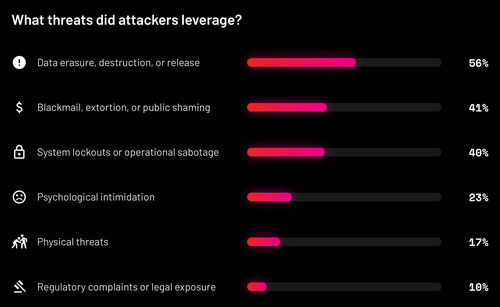
The consequences of these breaches extend far beyond temporary downtime or financial ransom payouts. The survey data reveals a disturbing diversification in the types of leverage cybercriminals use to force compliance. Data erasure, destruction, or public release remains the most prevalent weapon in the extortionist’s arsenal, cited by 56% of respondents. However, traditional techniques are rapidly being supplemented by aggressive personal and operational campaigns. Traditional blackmail, extortion, and public shaming campaigns were reported by 41% of victims, closely mirrored by system lockouts and severe operational sabotage at 40%.
More alarming, however, is the meteoric rise of campaigns targeting the human element outside the corporate firewall. Psychological intimidation was reported by 23% of organizations surveyed, while 17% confirmed that attackers resorted to direct physical threats against executives, employees, or their immediate family members. This crossing of the physical boundary line represents a dramatic escalation in the psychological warfare of cybercrime, signaling that threat actors are willing to leverage personal safety to ensure corporate boards authorize multimillion-dollar cryptocurrency ransom payments.
The Dual Role of Artificial Intelligence in Cyber Warfare
One of the most profound revelations of the Semperis report is the ubiquitous integration of artificial intelligence by both attackers and defenders. AI has fundamentally transformed the speed, scale, and sophistication of modern cyber attacks, acting simultaneously as a potent weapon for malicious actors and a critical target within enterprise networks.
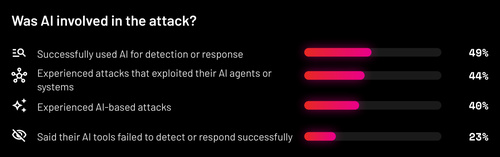
Overall, an overwhelming 84% of respondents reported experiencing attacks that leveraged artificial intelligence in some capacity. The report provides a crucial analytical breakdown of this figure, distinguishing between general AI-based attacks, which were reported by 40% of victims, and direct manipulation or exploitation of the victims’ own AI agents and systems, reported by 44%. This distinction highlights a sophisticated shift in adversary methodology: attackers are not merely using automated LLMs or machine learning algorithms to write malicious code or craft hyper-personalized phishing campaigns; they are actively weaponizing the enterprise’s internal artificial intelligence infrastructure against itself.
By compromising corporate AI agents, threat actors can bypass traditional behavioral monitoring tools, manipulate automated decision-making workflows, and execute lateral movement with unprecedented stealth. This phenomenon creates a profound visibility gap for security operations centers (SOCs).
Weighing in on the challenge of identifying artificial intelligence within modern threat vectors, Chris Inglis, former U.S. National Cyber Director and currently a strategic adviser to Semperis, emphasized the stealthy nature of these operations. "Many attacks are not perceived as being aided and abetted by AI because they’re just too slick, too sophisticated," Inglis noted within the report’s commentary. The sheer velocity of automated decision-making and execution leaves human security analysts struggling to differentiate between legitimate automated maintenance routines and AI-driven hostile takeovers until the damage is already done.
Defensive AI: A Mixed Blessing for Enterprise Security
While attackers leverage artificial intelligence to breach networks and manipulate systems, organizations have increasingly turned to AI-driven security tools to detect, isolate, and neutralize threats before they result in catastrophic business disruption. However, the Semperis report indicates that the defensive deployment of AI has yielded decidedly mixed results in the real world.
According to the survey, nearly half of the respondents—49%—reported that they successfully utilized artificial intelligence for threat detection and incident response during their encounters. These defenders found that machine learning algorithms and behavioral analytics platforms were instrumental in flagging anomalous network activity and accelerating containment procedures.
Conversely, 23% of victimized organizations stated that their defensive AI tools failed to detect or respond successfully to the incoming threats. This performance gap underscores the ongoing arms race between security vendors and adaptive cybercriminal syndicates. When attackers utilize AI to dynamically alter their attack paths, obfuscate payloads, and mimic legitimate administrative traffic, static or insufficiently trained defensive AI models frequently fail, leaving blind spots that adversaries readily exploit. Security experts emphasize that these figures reflect the real-world experiences of breached organizations rather than a controlled, apples-to-apples comparison of competing cybersecurity products, underscoring that AI is not a silver bullet for enterprise defense.

The Evolution of the Threat Landscape: Historical Context
To contextualize the findings of the 2026 Semperis report, one must look back at the trajectory of ransomware over the past decade. Ransomware began largely as a nuisance threat in the early 2010s, utilizing rudimentary file-encryption algorithms and demanding nominal payments in Bitcoin or wire transfers. By the late 2010s and early 2020s, the threat matured into organized criminal syndicates operating under Ransomware-as-a-Service (RaaS) models. These groups professionalized cybercrime, introducing customer support desks, sophisticated negotiation teams, and elaborate multi-extortion frameworks.
Initially, multi-extortion focused on "double extortion"—encrypting systems while simultaneously exfiltrating sensitive intellectual property or customer data to threaten public leaks if the ransom went unpaid. By 2023 and 2024, triple and quadruple extortion tactics emerged, incorporating Distributed Denial of Service (DDoS) attacks against the victim’s public-facing websites and direct harassment of the victim’s clients, partners, and media outlets.
The 2026 data from Semperis marks the next logical, albeit chilling, evolution of this progression: the complete erosion of the boundary between the corporate network and the personal lives of workers. By targeting family members, cybercriminals exploit human empathy, fear, and familial protection instincts in a manner traditionally associated with organized crime syndicates and physical cartels rather than digital extortionists.

Implications for Corporate Governance, Risk, and Compliance
The convergence of AI exploitation and personal intimidation carries profound implications for corporate governance, board-level risk management, and human resources policies. As cyber threats transcend the digital realm and manifest as direct psychological and physical pressures on employees, the traditional mandate of the Chief Information Security Officer (CISO) must expand to encompass physical safety and crisis communication.
Boards of directors can no longer view cybersecurity merely as an IT operational challenge or an insurance liability issue. The involvement of AI agents and the targeting of executives’ families necessitate a holistic, enterprise-wide risk management strategy that integrates digital identity resilience, employee privacy protection, and executive protection services. Organizations must invest heavily in securing identity infrastructure—such as Active Directory and Entra ID—which remains the primary gateway through which attackers achieve initial access and manipulate internal AI agents.
Furthermore, crisis management protocols must be completely rewritten. When ransomware gangs reach out directly to an employee’s personal smartphone or threaten their family members via social media channels, standard incident response playbooks—which typically focus on network isolation, forensic imaging, and ransom negotiation—are rendered insufficient. Organizations must establish clear guidance for employees on how to handle out-of-band communications from threat actors, providing psychological support, legal resources, and, where necessary, physical security measures for targeted personnel.
Future Outlook and Strategic Recommendations
As cybercrime syndicates continue to weaponize artificial intelligence and refine their psychological warfare tactics, the cybersecurity industry faces a formidable challenge. The findings from Semperis serve as an urgent wake-up call to enterprises worldwide: perimeter defenses, traditional endpoint detection, and standard backup strategies are no longer adequate to deter highly adaptive, multi-extortion threat groups.
To counter these sophisticated campaigns, security leaders must adopt a posture of resilience rooted in identity-centric security, zero-trust architectures, and robust crisis management. Organizations must rigorously audit their internal AI deployments, ensuring that automated agents and machine learning systems are subjected to the same rigorous access controls and behavioral monitoring as human users. Moreover, cybersecurity budgets must account for the human element of risk, ensuring that employee safety and executive protection are treated as core components of a comprehensive enterprise defense strategy.
Ultimately, the 2026 Ransomware Risk Report illustrates that the battlefield of modern cybersecurity extends far beyond the server rack and the cloud database. As threat actors increasingly leverage AI and personal intimidation to achieve their objectives, the ultimate defense will depend not only on advanced technology, but on organizational preparedness, vigilance, and an unyielding commitment to protecting the people who drive the enterprise forward.









