The debate surrounding artificial intelligence in modern classrooms has long centered on a binary dilemma: should students be permitted to use generative AI tools, or should they be strictly prohibited? For years, educators, administrators, and policymakers have wrestled with this deceptively simple question. However, as generative technologies become seamlessly embedded in the everyday digital ecosystem—integrated directly into search engines, word processors, translation software, and collaborative platforms—the boundary between utilizing AI and working independently has grown increasingly ambiguous.
Treating artificial intelligence as an all-or-nothing proposition fails to capture the nuanced realities of contemporary pedagogy. More critically, it deprives students of the structured guidance they need to navigate a rapidly evolving technological landscape responsibly. Recognizing the limitations of a binary approach, Zion-Benton Township High School District 126 in Illinois has pioneered a transformative instructional framework. Rather than asking whether AI is allowed, the district has developed a shared instructional language designed to define precisely how much AI involvement is appropriate for any given learning objective.
The Evolution of AI Integration: A Multi-Year Journey

The path toward a nuanced districtwide policy at Zion-Benton Township High School District 126 was not forged overnight. It represents a deliberate, multi-year progression that mirrors the rapid advancement of generative AI technologies in the public sphere.
The district’s engagement with artificial intelligence began informally in 2023, shortly after the widespread public release of advanced generative models. During this initial phase, educators and administrators focused primarily on understanding the capabilities and immediate risks of the technology, grappling with concerns surrounding academic integrity, plagiarism, and the potential erosion of foundational critical thinking skills.
By 2025, the conversation shifted from passive observation to proactive experimentation. The district established structured pilots, allowing select teachers and classrooms to test specific AI applications in controlled environments. These pilots provided critical qualitative data regarding how students interacted with generative tools, which tasks benefited most from AI assistance, and where students stumbled or became overly reliant on automated output.
Entering 2026, Zion-Benton broadened its institutional scope once again, shifting its primary emphasis toward comprehensive AI literacy and deep instructional integration. It was during this phase that the district’s AI Advisory Committee confronted a fundamental pedagogical roadblock: teachers were ill-equipped by generic policies that merely stated whether AI was permitted or banned. Educators required a sophisticated, standardized mechanism to communicate expectations clearly, ensuring consistency across diverse subjects ranging from freshman composition to advanced placement sciences.
The Pitfalls of Blanket Policies: Analyzing Three Distinct Scenarios
To understand the necessity of moving beyond broad categorizations, one must examine how artificial intelligence functions across different educational tasks. A blanket "AI allowed" or "AI prohibited" policy fails because the role of technology changes dramatically depending on the specific pedagogical goal.
Consider three distinct classroom scenarios designed to foster different types of cognitive engagement. In the first scenario, an English literature teacher assigns an essay with the explicit objective of evaluating whether a student can independently construct a persuasive argument and support it with textual evidence. Here, the cognitive heavy lifting—synthesizing thoughts, formulating a thesis, and organizing logic—must occur entirely within the student’s mind. Introducing generative AI at this stage would circumvent the core learning objective.
In the second scenario, students have already completed the arduous work of developing their own original arguments. Once their foundational reasoning is established, the instructor invites them to interact with an AI tool to generate potential counterarguments. The students are then tasked with analyzing these opposing viewpoints, identifying logical fallacies, and strengthening their own defenses. In this context, AI serves as an intellectual sparring partner, enhancing critical analysis rather than replacing it.

In the third scenario, the curriculum focuses explicitly on media and technology literacy. Students are asked to use generative AI extensively to draft reports, but they must rigorously evaluate the outputs, fact-check the generated claims, actively revise the text, meticulously document their exact prompt history, and defend the methodological and ethical decisions they made throughout the writing process.
Applying a single label—such as "AI allowed"—to all three of these experiences obscures profound differences in how technology is utilized. Conversely, an absolute ban across all three scenarios eliminates vital opportunities for students to develop the sophisticated literacy and critical evaluation skills they will inevitably require in higher education and the modern workforce.
The Zion-Benton AI Use Scale: A Structured Framework
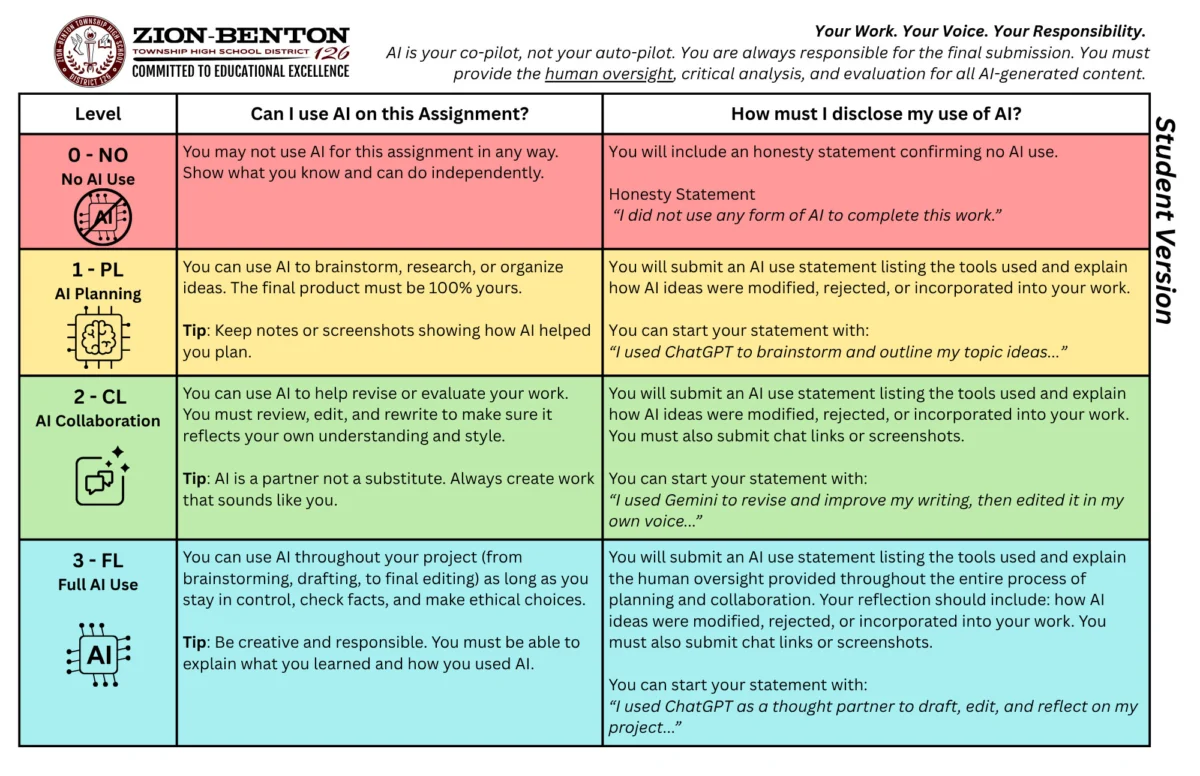
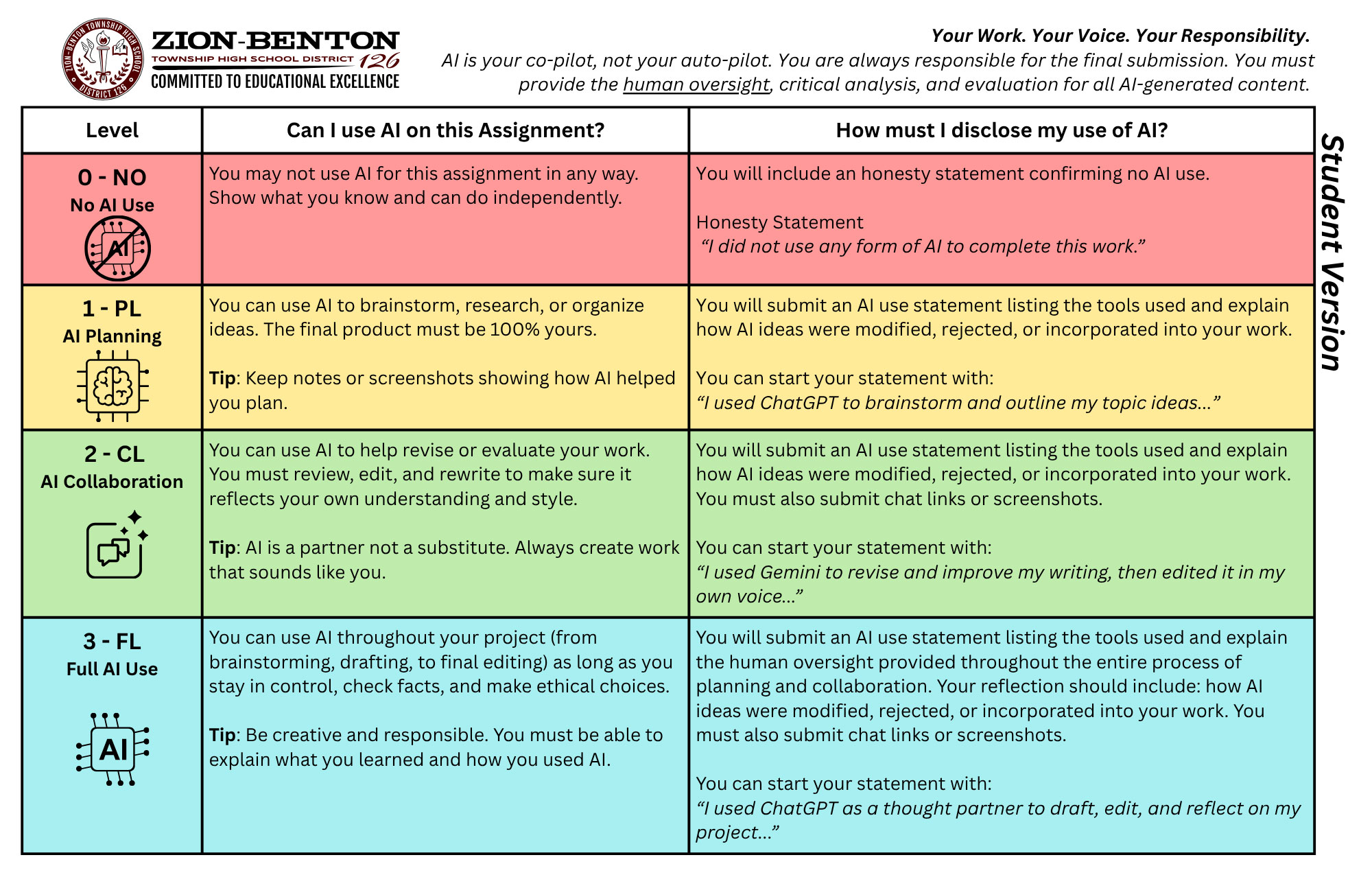
To resolve these operational tensions, the Zion-Benton AI Advisory Committee engineered a comprehensive, districtwide resource known as the AI Use Scale. Designed to be prominently displayed in classrooms and systematically referenced across all academic departments, the scale establishes a common vocabulary for both teachers and students.

The framework categorizes artificial intelligence integration into four distinct levels:
Level 0: No AI. At this foundational tier, artificial intelligence tools are strictly prohibited. The assignment is designed to measure unassisted human capability, ensuring that students build fundamental skills, memory, and baseline cognitive stamina without technological scaffolding.
Level 1: AI Planning. At this stage, AI is utilized strictly as a preparatory or brainstorming aid. Students may use generative tools to outline ideas, organize schedules, or generate practice questions, but the actual execution, drafting, and final product remain entirely human-generated.
Level 2: AI Collaboration. Here, AI acts as an active co-pilot during the learning process. Students might draft their own work first and subsequently use AI to check grammar, suggest stylistic improvements, or provide counterarguments for critical evaluation, provided the student maintains ultimate editorial control and transparency.

Level 3: Full AI Use. Reserved for specialized instructional units focusing on technological fluency, this level encourages extensive AI utilization. Students employ generative tools to produce primary outputs, which they must then critically audit, fact-check, iteratively refine, and thoroughly document, culminating in a defense of their collaborative process.
Rather than simplifying the policing of classrooms, the stated purpose of the scale is to make academic expectations transparent and teachable. By utilizing standardized terminology, Zion-Benton ensures that students encounter predictable, coherent guidelines regardless of which classroom they enter.
Broader Educational Implications and Industry Response
The initiative undertaken at Zion-Benton Township High School District 126 reflects a broader nationwide reckoning within K-12 and higher education institutions. For the past three years, school districts have oscillated between extreme reactions—ranging from immediate, sweeping bans of AI software on school networks to unbridled adoption without pedagogical guardrails.

Educational researchers and policy experts have increasingly advocated for structured frameworks similar to the AI Use Scale. Proponents argue that as generative models become ubiquitous commercial products, shielding students from them is not only futile but professionally negligent. The future workforce will not reward individuals who avoid AI, but rather those who possess the metacognitive awareness to know when, how, and to what extent artificial intelligence should be leveraged.
Furthermore, standardized scales address persistent equity and clarity gaps. Vague assignment instructions often penalize students who misunderstand unwritten rules regarding technology use, disproportionately impacting learners who lack external guidance. By establishing explicit performance tiers, districts promote academic integrity while simultaneously democratizing access to technological literacy.
As school systems nationwide continue to draft and revise their instructional guidelines for the digital age, models like the Zion-Benton AI Use Scale offer a viable blueprint. By reframing the conversation from a simplistic binary of permission versus prohibition to a sophisticated spectrum of integration, educators are successfully reclaiming the narrative—ensuring that technology remains a tool to elevate human intellect rather than replace it.