
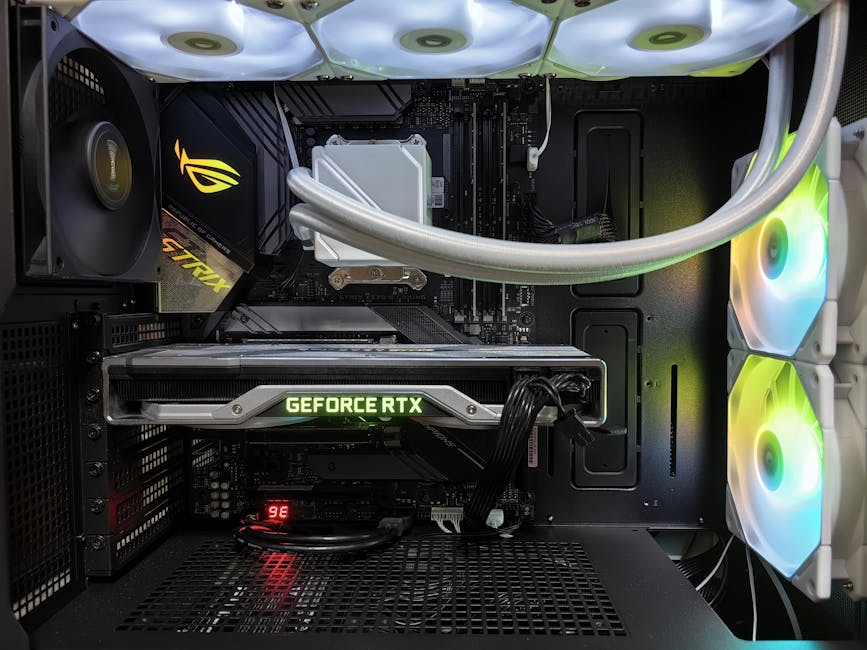
Unveiling the Asus ROG Strix RTX: A Deep Dive into Gaming Performance and Innovation
The Asus ROG Strix RTX series represents the pinnacle of gaming graphics card technology, a testament to Asus’s commitment to pushing the boundaries of performance, cooling, and aesthetics for the most discerning PC enthusiasts and professional gamers. These cards are not merely components; they are the beating heart of a high-end gaming rig, designed to deliver uncompromising frame rates, stunning visual fidelity, and an immersive experience that transcends the ordinary. This article will delve deep into the multifaceted world of the ROG Strix RTX, exploring its core technologies, architectural advancements, cooling solutions, software integration, and the tangible benefits it brings to the gaming and creative professional landscape.
At the core of every ROG Strix RTX card lies a powerful Nvidia GeForce RTX GPU. Depending on the specific model within the Strix series, this could range from the potent RTX 3060 Ti all the way up to the flagship RTX 4090. These GPUs are built on Nvidia’s cutting-edge architectures, whether it be Ampere (RTX 30 series) or Ada Lovelace (RTX 40 series). Ampere introduced significant advancements in ray tracing and AI performance with its RT Cores and Tensor Cores. Ada Lovelace, the more recent architecture, further refines these capabilities, offering dramatically improved ray tracing performance, DLSS 3 (Deep Learning Super Sampling) with frame generation for unprecedented frame rate boosts, and enhanced power efficiency. The ROG Strix models distinguish themselves by leveraging these powerful Nvidia cores and meticulously optimizing them through Asus’s proprietary designs and overclocking capabilities. This means that a Strix RTX card will not only offer the raw power of its underlying Nvidia GPU but also an enhanced, factory-tuned experience that often surpasses reference designs in terms of clock speeds and sustained performance. The emphasis is on delivering a superior gaming experience out of the box, requiring minimal user intervention to achieve peak performance.
Cooling is paramount for any high-performance GPU, and the ROG Strix RTX series is renowned for its exceptionally robust and innovative cooling solutions. Asus has consistently pioneered advanced thermal management technologies, and the Strix RTX cards are prime examples. The "Axial-tech" fan design is a cornerstone of this cooling prowess. These fans feature a longer blade design and a barrier ring that increases downforce and directs airflow more efficiently across the heatsink. Furthermore, the Strix RTX cards often employ multiple Axial-tech fans, strategically positioned to create optimal airflow patterns within the GPU shroud. The heatsink itself is a masterpiece of engineering, typically featuring a large surface area with numerous fins to dissipate heat effectively. The heat is transferred from the GPU die and memory modules to the heatsink via a large, nickel-plated copper base plate, often featuring direct GPU contact for maximum thermal conductivity. Many Strix RTX models also incorporate a heatsink extension that covers the VRM (Voltage Regulator Module) and chokes, ensuring that these critical power delivery components are also kept cool, which is vital for stable overclocking and long-term reliability. The inclusion of a metal backplate not only adds structural rigidity and a premium aesthetic but also contributes to passive cooling by drawing heat away from the PCB. Advanced thermal pads are used to ensure efficient heat transfer between components and the heatsink. This comprehensive approach to cooling ensures that the ROG Strix RTX cards can maintain their boost clocks under heavy load for extended periods, preventing thermal throttling and maximizing gaming performance.
Beyond raw hardware, Asus’s software ecosystem plays a crucial role in unlocking the full potential of the ROG Strix RTX. The Aura Sync RGB lighting system is a prominent feature, allowing users to synchronize the customizable RGB lighting on the GPU with other Aura Sync-compatible components in their system. This creates a visually cohesive and personalized gaming rig. However, Aura Sync is more than just aesthetics; it’s about creating an immersive gaming environment. The lighting can often be configured to react to in-game events, adding another layer of immersion. Armoury Crate is Asus’s unified software control center, and it’s indispensable for managing the ROG Strix RTX. Within Armoury Crate, users can monitor GPU temperatures, clock speeds, power consumption, and fan speeds in real-time. Crucially, it provides access to performance profiles, including "Performance Mode" for maximum gaming power, "Silent Mode" for quieter operation, and often a "Manual Mode" for granular control over fan curves and clock speeds, enabling advanced overclocking. The software also facilitates firmware updates, ensuring that the GPU is always running with the latest optimizations and bug fixes. For users interested in pushing their hardware further, Armoury Crate offers tools for undervolting and overclocking, allowing for custom performance tuning to suit individual needs and silicon lottery variations.
The build quality and design of the ROG Strix RTX series are consistently a cut above the rest. Asus prioritizes durability and a premium user experience. The shrouds are typically constructed from robust materials, often featuring a combination of reinforced plastic and brushed metal accents for a sophisticated and gamer-centric aesthetic. The sheer size of these cards, especially the higher-end models, necessitates careful consideration of case compatibility. The backplates, as mentioned, contribute to the overall solidity and feel of the card. The I/O panel is well-equipped, usually featuring multiple DisplayPort and HDMI outputs to support multi-monitor setups and high-resolution displays with high refresh rates. The attention to detail extends to the PCB design, which is often custom-engineered by Asus with a higher component count and superior power delivery components compared to reference boards. This not only enhances overclocking potential but also contributes to the overall stability and longevity of the card. The aesthetic appeal of the ROG Strix cards is undeniable, with their aggressive styling, prominent ROG branding, and the aforementioned Aura Sync RGB lighting, making them a centerpiece of any high-end gaming build.
The benefits of choosing a ROG Strix RTX card extend beyond theoretical performance metrics. In practical gaming scenarios, these cards deliver a demonstrably superior experience. High frame rates translate to smoother gameplay, reduced input lag, and a competitive edge in fast-paced titles. The advanced ray tracing capabilities provided by the Nvidia RTX cores, coupled with Asus’s optimized cooling, allow gamers to experience games with unprecedented visual realism, with realistic lighting, shadows, and reflections. DLSS technology, especially DLSS 3 with Frame Generation on RTX 40 series cards, is a game-changer, enabling higher resolutions and frame rates without a significant visual fidelity compromise. For creative professionals, the raw processing power and dedicated VRAM of the ROG Strix RTX cards are invaluable. Tasks such as 3D rendering, video editing, and graphic design are significantly accelerated. The CUDA cores within the Nvidia GPUs are highly efficient for parallel processing, drastically reducing render times and improving workflow efficiency. The large VRAM capacities of higher-end Strix RTX cards are essential for handling complex scenes and high-resolution assets in professional applications, preventing bottlenecks and ensuring a smooth creative process.
When considering a ROG Strix RTX card, understanding the specific model and its corresponding Nvidia GPU is crucial for aligning expectations with performance. For instance, an ROG Strix RTX 4070 Ti offers a potent blend of raw performance, excellent ray tracing capabilities, and DLSS 3 support, making it an ideal choice for 1440p high-refresh-rate gaming and entry-level 4K gaming. Stepping up to an ROG Strix RTX 4080 unlocks even greater performance headroom, comfortably handling 4K gaming with high settings and ray tracing enabled, while also excelling in demanding professional workloads. The apex of the series, the ROG Strix RTX 4090, represents the ultimate in consumer-grade graphics performance, capable of pushing the boundaries of what’s possible in gaming and professional content creation, offering an unparalleled experience for those who demand the absolute best. Each tier within the ROG Strix RTX lineup is meticulously designed to cater to specific performance tiers and user needs, ensuring that there is a Strix RTX card to meet the demands of nearly every enthusiast.
In conclusion, the Asus ROG Strix RTX series stands as a benchmark for high-performance graphics cards. It represents a synergy of cutting-edge Nvidia GPU technology, Asus’s innovative thermal management, robust build quality, and a user-friendly software ecosystem. Whether you are a hardcore gamer seeking the smoothest frame rates and the most immersive visual experiences, or a creative professional demanding accelerated workflows and unparalleled rendering power, the ROG Strix RTX series offers a compelling and often superior solution. Its commitment to pushing performance boundaries, coupled with a premium aesthetic and a focus on user experience, solidifies its position as a top-tier choice for anyone building or upgrading a high-end PC. The investment in a ROG Strix RTX card is an investment in uncompromising performance and a gateway to the future of visual computing.





Leave a Reply