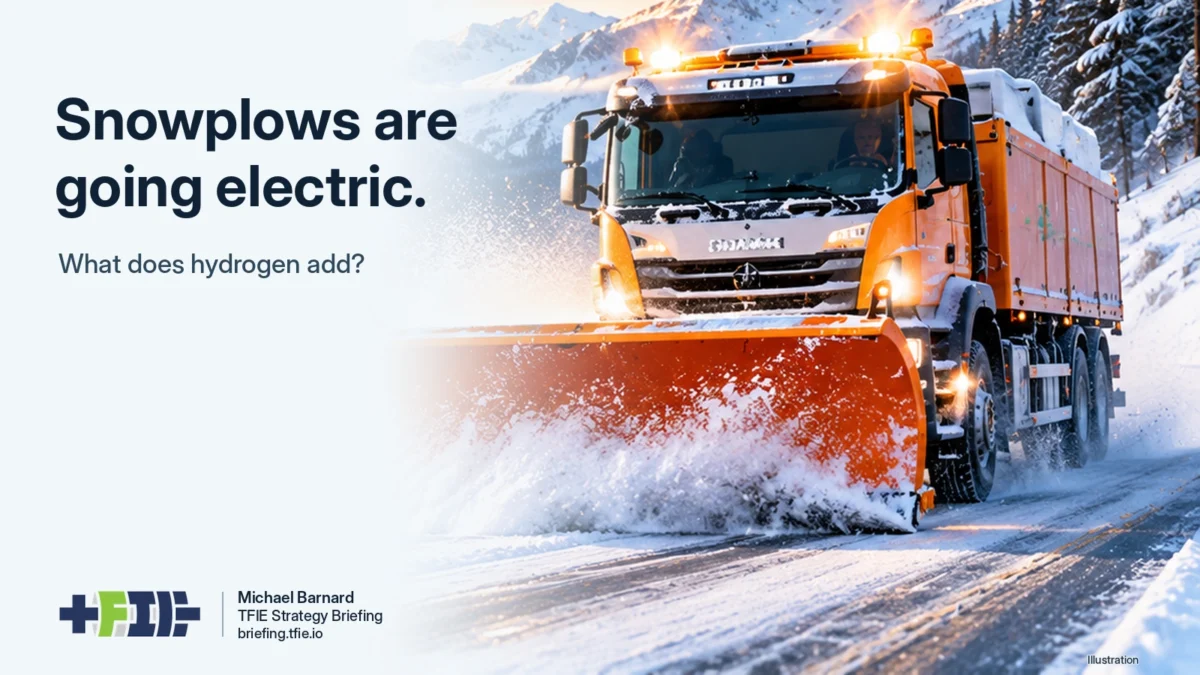
The global transition to zero-emission heavy-duty transport is reaching the front lines of municipal infrastructure. As winter maintenance becomes increasingly complex due to climate-driven volatility, road authorities in the Nordic region and East Asia are testing the viability of battery-electric vehicles (BEVs) for the rigorous, high-torque demands of snow-clearing and road-grading. While Norway has successfully proven the capability of pure battery-electric power in mountain environments, Sweden has introduced a hybrid-hydrogen approach, sparking a rigorous engineering debate over whether complex fuel-cell systems offer a necessary solution or an unnecessary complication in an already maturing electric market.
The Norwegian Benchmark: Battery-Electric Success
The Norwegian Public Roads Administration (NPRA) set a significant precedent in 2025 by deploying a Scania 45 R battery-electric truck to manage snow removal on the Hardangervidda mountain plateau. Known for its extreme weather conditions and high-altitude challenges, the Hardangervidda serves as one of Norway’s most demanding testing grounds. Over the course of a full winter season, the electric vehicle covered approximately 7,000 kilometers, performing duties that included heavy plowing, road grading, and salt-and-sand spreading.
The data gathered from this trial challenged the prevailing skepticism regarding battery endurance in sub-zero temperatures. The Scania unit averaged a power consumption of approximately 2.02 kWh/km. Under mixed-duty conditions, the vehicle demonstrated an operational window of six and a half hours on a single charge. While the trial did highlight specific logistical bottlenecks—most notably the current lack of high-power charging infrastructure in remote mountain passes and minor limitations regarding payload capacity—the NPRA concluded that these were systemic infrastructure hurdles rather than fundamental flaws in the electric powertrain itself.
The Swedish Pivot: Hydrogen as a Range Extender
In contrast to Norway’s "pure battery" approach, a Swedish collaborative project involving Scania, the logistics firm MaserFrakt, and construction company Peab has taken a different technological path. This project utilizes a heavy-duty electric truck augmented by a hydrogen fuel-cell system. The vehicle is equipped with a 356 kWh battery pack supplemented by 56 kilograms of onboard hydrogen storage.
The design philosophy behind the Swedish prototype is to mitigate "range anxiety" and extend operating shifts beyond the six-to-seven-hour threshold demonstrated in the Norwegian trials. However, this design introduces significant mechanical and logistical complexity. By integrating a fuel cell, the truck now operates with two distinct energy storage systems, requiring the vehicle to maintain both an electric charging interface and a specialized hydrogen refueling system. From an engineering perspective, this creates a "whole-system" cost that far exceeds that of a standard BEV. The vehicle requires not only the capital expense of the fuel cell but also the establishment of a localized hydrogen supply chain, including production, transportation, and high-pressure storage facilities.

Global Scaling and the Chinese Market
While Northern Europe grapples with the technical nuances of heavy-duty electrification, China is moving toward large-scale procurement and deployment. Unlike the experimental, pilot-program nature of the Nordic projects, Chinese municipalities have transitioned to the procurement phase. In September 2026, the Mentougou district of Beijing awarded contracts for 24 multifunction, heavy-duty snow-removal trucks.
This transition is bolstered by China’s massive industrial output. By leveraging a domestic supply chain that produces hundreds of thousands of electric commercial vehicles annually, Chinese manufacturers are achieving economies of scale that European specialized manufacturers struggle to match. These electric snow-clearing units share components—such as heavy-duty chassis, battery cells, and high-torque motors—with the broader electric freight trucking industry. This modularity reduces the unit cost of specialized maintenance equipment, making electrification a pragmatic, cost-effective choice for municipal budgets.
Evaluating Alternatives: HVO and Conventional Generators
The push for hydrogen-fuel-cell integration is being scrutinized against more mature, lower-cost alternatives. One such alternative is the use of Hydrotreated Vegetable Oil (HVO), a renewable diesel substitute that can be used in existing internal combustion engines or, more efficiently, to power backup generators for electric fleets.
Copenhagen Airport has adopted a tiered approach that serves as a potential blueprint for other transit hubs. Rather than over-engineering vehicles with dual energy systems, they have prioritized the electrification of their primary fleet while maintaining a small reserve of legacy equipment fueled by renewable diesel. Because snow removal is a seasonal, "peak-demand" task, the use of HVO for extreme, infrequent events allows for significant carbon reduction without the need to build a hydrogen-specific infrastructure for equipment that may sit idle for much of the year.
Furthermore, if an electric snowplow requires a boost in operating time, a conventional, high-efficiency generator running on HVO could serve as a mobile range-extender. This configuration utilizes proven, off-the-shelf power generation technology. It avoids the immense cost and maintenance burden of hydrogen fuel cells while still achieving the objective of emissions reduction during the critical periods when battery life falls short.
The Economic and Operational Calculus
The primary challenge for hydrogen proponents is justifying the "whole-system" cost. A hydrogen-electric vehicle must demonstrate that the additional operating hours gained through fuel-cell supplementation outweigh the following burdens:

- Capital Expenditure (CAPEX): The combined cost of batteries, fuel cells, and hydrogen storage tanks.
- Infrastructure Costs: The construction of hydrogen refueling stations compared to the expansion of the existing electrical grid.
- Maintenance Overhead: The necessity of servicing two complex, distinct propulsion systems.
- Energy Efficiency: The well-to-wheel efficiency of hydrogen is significantly lower than that of direct battery charging due to the energy-intensive processes of electrolysis, compression, and fuel-cell conversion.
For municipal authorities, the goal is to fulfill a public safety mandate—keeping roads clear—at the lowest defensible cost. Norway’s trial suggests that the "battery-only" model is not just a theoretical possibility but a functional reality. As charging technology continues to improve—specifically with the development of mobile, megawatt-scale charging solutions—the need for a secondary hydrogen system may vanish entirely.
Broader Implications for Infrastructure
The divergence between the Norwegian and Swedish strategies reflects a broader tension in the global energy transition. One school of thought prioritizes the "simplicity of the system," advocating for pure battery-electric solutions supported by improved grid and mobile charging. The other seeks to preserve the operational characteristics of legacy fuel-based systems by replacing diesel with hydrogen.
However, the rapid acceleration of battery energy density and the proliferation of electric powertrains in the heavy-duty sector favor the former. When a vehicle can achieve a six-hour shift in sub-zero, high-altitude conditions, the performance gap between electric and diesel is effectively closed for the vast majority of municipal use cases.
As the industry moves toward 2030, the success of these programs will be measured by their reliability during extreme weather events. If the Swedish hydrogen truck is to succeed, it must prove that it can offer a tangible, economic advantage over the simpler, more efficient battery-electric models currently being deployed in Norway and the large-scale, cost-optimized fleets emerging in China. For now, the evidence suggests that for the heavy-duty maintenance sector, the path of least resistance—and perhaps the most effective path—is the one powered by electrons, not molecules. Road authorities would be well-advised to focus on the scalability of charging infrastructure, as this remains the final barrier to a full-scale transition to electric winter maintenance.