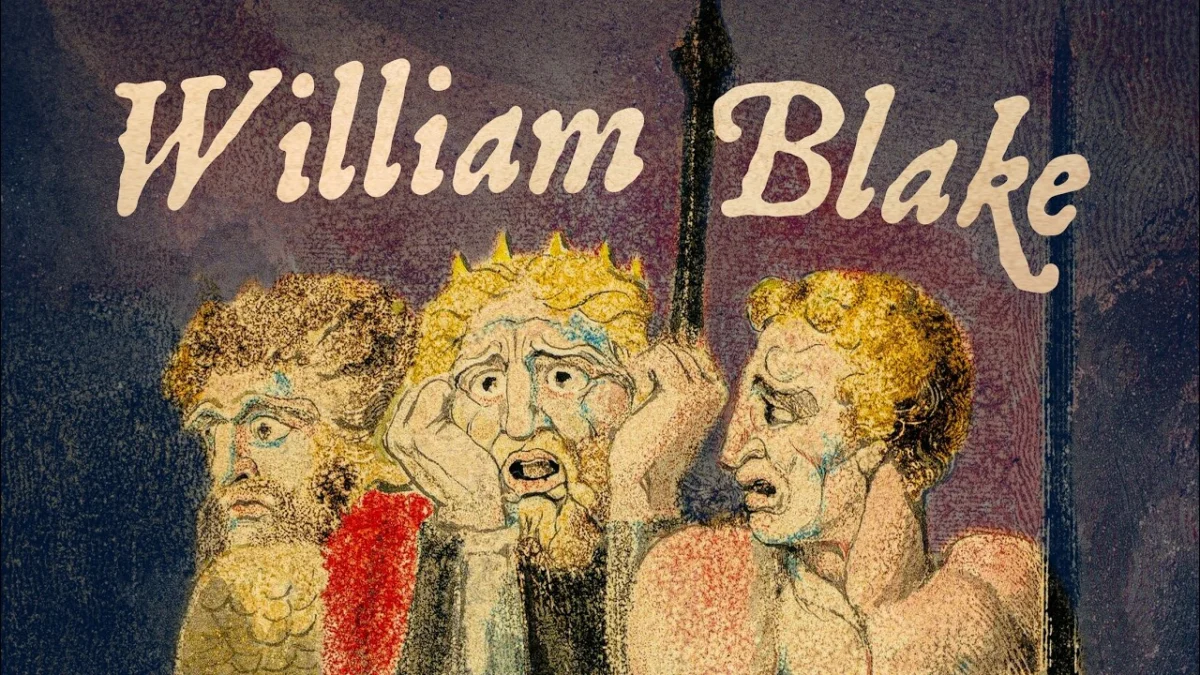
The Synthesis of Word and Image
The primary obstacle to understanding William Blake’s contribution to Western culture lies in the modern tendency to view his various disciplines as separate endeavors. To the contemporary observer, Blake might appear as a poet who happened to paint, or an engraver who wrote verse on the side. However, as noted in recent analyses of his "prophetic books" and his seminal Songs of Innocence and of Experience, Blake viewed these pursuits as inseparable. His "illuminated printing" technique, which he claimed was revealed to him in a vision by his deceased brother Robert, allowed him to control every aspect of a book’s production. Unlike his contemporaries, who often saw their poems set in standard type by commercial printers and their illustrations engraved by separate craftsmen, Blake etched both his text and his designs onto copper plates using an acid-resistant medium.
This process, known as relief etching, was a technological and artistic rebellion. It allowed the text to become part of the visual composition, with vines, figures, and celestial bodies weaving through the stanzas. This "cross-breeding" of media, as described by scholar Morris Eaves in The Cambridge Companion to William Blake, forced the viewer to engage with the work on multiple sensory levels simultaneously. By refusing to inhabit a single "neighborhood of meaning," Blake created a body of work that was essentially unmarketable within the rigid structures of the late eighteenth-century art world, yet uniquely preserved his singular vision without the dilution of external editors or publishers.
Historical Context and the Conflict with the Royal Academy
To understand why Blake’s art was considered radical, one must examine the institutional landscape of the London art scene during his lifetime. The Royal Academy of Arts, founded in 1768 when Blake was a young boy, served as the arbiter of aesthetic value. Under the leadership of Sir Joshua Reynolds, whom Blake famously derided as "Sir Sloshua," the Academy promoted a strict hierarchy of genres. "History Painting"—large-scale depictions of classical or biblical scenes—occupied the highest tier, while engraving and printmaking were relegated to the status of lowly "mechanical" crafts.
Blake, who served a seven-year apprenticeship under the engraver James Basire, was officially classified by the Academy as a mere engraver, a designation that carried significant social and professional limitations. The Academy’s insistence on "General Nature" and the "Grand Style" stood in direct opposition to Blake’s devotion to the "Minute Particular." Where Reynolds advocated for soft, blurred edges and generalized forms, Blake insisted on the "firm and determinate line," believing that clarity of outline was the hallmark of true spiritual vision. This ideological rift ensured that Blake remained an outsider for much of his career, working in relative poverty while producing works that the Academy’s leadership found incomprehensible or "mad."
Chronology of a Visionary Career
The trajectory of Blake’s life (1757–1827) reflects a consistent dedication to his idiosyncratic philosophy, even in the face of total lack of commercial success.
- 1772–1779: Apprenticeship with James Basire. During this time, Blake was sent to Westminster Abbey to sketch the gothic monuments, an experience that deeply influenced his preference for linear, medieval aesthetics over the prevailing Baroque and Neoclassical styles.
- 1789: Publication of Songs of Innocence. This was the first major demonstration of his illuminated printing technique, presenting a world of pastoral harmony and divine presence.
- 1790–1793: Production of The Marriage of Heaven and Hell. This work signaled Blake’s radical break with conventional morality and Enlightenment rationalism, famously asserting that "Energy is Eternal Delight."
- 1794: Publication of Songs of Experience. Paired with the earlier Innocence, this volume explored the "two contrary states of the human soul," critiquing the industrial revolution and the restrictive nature of institutional religion.
- 1804–1820: The creation of his massive prophetic epics, Milton and Jerusalem. These works developed a private mythology involving characters like Los (the spirit of creativity), Urizen (the embodiment of cold reason), and Enitharmon (spiritual beauty).
- 1821–1827: Final years. Despite failing health and poverty, Blake produced some of his most sophisticated work, including the illustrations for the Book of Job and an unfinished series of watercolors for Dante’s Divine Comedy.
Supporting Data: The Scale of the Blake Archive
While Blake was largely ignored during his life—his only solo exhibition in 1809 was a critical and financial disaster—the sheer volume of his output provides a data-rich landscape for modern scholars. The William Blake Archive, a digital project supported by the Library of Congress, currently tracks thousands of individual plates, drawings, and paintings.
Research into his Songs of Innocence and of Experience reveals that no two copies are exactly alike. Because Blake hand-colored each printed plate with watercolors, the mood and emphasis of the poems change from one edition to another. For instance, in some copies of "The Tyger," the beast appears terrifying and fiery; in others, it looks almost whimsical or domestic. This variability highlights Blake’s rejection of the "mechanical" reproducibility of the industrial age in favor of a bespoke, living art form. Furthermore, his 102 illustrations for Dante’s Divine Comedy represent one of the most ambitious artistic undertakings of the nineteenth century, showcasing a technical mastery of color and composition that surpassed the standards of the very Academy that had rejected him.
Analysis of Implications: Specialization vs. Wholeness
The enduring relevance of William Blake lies in his critique of specialization. As Evan Puschak notes, the bedrock of modern human understanding is the principle of specialization—the idea that to be an expert, one must narrow their focus to a single niche. Blake viewed this fragmentation as a spiritual tragedy. He believed that the Enlightenment’s focus on categorization had "cut reality apart," separating the soul from the body, the creator from the creation, and the word from the image.
Blake’s art was a sustained effort to "make it whole again." His interpretation of the Biblical Book of Job, for example, deviates from traditional readings. Blake did not see Job as a man tested by a capricious God, but as a man who mistakenly believed that salvation required "slavish obedience to words written in a book." For Blake, true salvation lay in the exercise of the "Poetic Genius," the divine imagination that exists within every individual. By operating as a "maker of words, maker of images, and cross-breeder of both," Blake lived a life that was an embodiment of this unified vision.
Global Impact and Legacy
The rehabilitation of William Blake’s reputation began in the mid-nineteenth century, spearheaded by the Pre-Raphaelite Brotherhood, particularly Dante Gabriel Rossetti, who recognized Blake as a precursor to their own blend of literary and visual art. In the twentieth century, Blake became a foundational figure for the Beat Generation. Poets like Allen Ginsberg claimed to have had auditory hallucinations of Blake’s voice, and his "Proverbs of Hell" became anthems for the counterculture of the 1960s.
Today, Blake’s influence is visible in the concept of the "total work of art" (Gesamtkunstwerk) and in the modern graphic novel, where the interplay of text and image is used to convey complex narratives. His resistance to the "Dark Satanic Mills" of the Industrial Revolution also positions him as an early critic of the environmental and psychological costs of unbridled technological progress.
In conclusion, William Blake remains "unclassifiable" not because his work is confused, but because it is too expansive for the narrow categories of traditional art history. He remains a singular figure who demonstrated that the highest form of rebellion is the creation of a private, unified world. As society continues to grapple with the effects of extreme specialization and the fragmentation of information, Blake’s insistence on the holistic nature of human creativity offers a radical and necessary alternative. His work stands as a testament to the idea that art is not merely a profession or a set of skills, but a way of perceiving and reconstructing the world in its entirety.