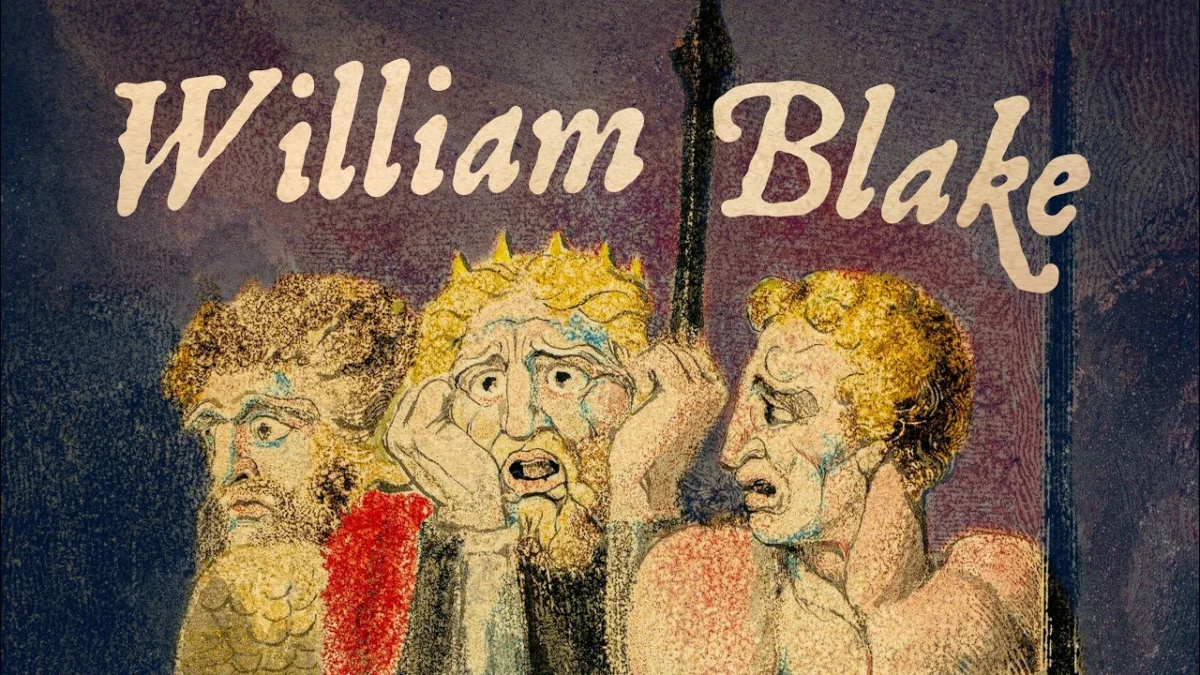
William Blake remains one of the most enigmatic figures in the history of Western art and literature, a man whose work defies the standard taxonomies of the creative disciplines. While often categorized as a poet, a painter, or a printmaker, these labels fail to capture the holistic nature of his output. To view Blake as a multi-talented individual who moved between distinct fields is to misunderstand his fundamental philosophy. For Blake, the act of writing a poem, etching a copper plate, and hand-coloring a print were not separate endeavors but three facets of a single, unified creative process. This synthesis resulted in what scholars frequently call his "illuminated books," works that exist in a category of their own—a radical departure from the conventions of the 18th and 19th centuries.
In a recent analysis, cultural critic Evan Puschak, known as the Nerdwriter, identified Blake as the "patron saint of unclassifiable artists." Puschak’s assessment highlights the fact that Blake did not merely contribute to existing genres; he invented a new medium to house his idiosyncratic visions. By designing, writing, etching, coloring, and printing his books himself, Blake bypassed the traditional gatekeepers of the publishing and art worlds. This autonomy allowed him to create a body of work that challenged the prevailing aesthetic and formal standards of the Royal Academy of Arts, an institution that struggled to reconcile Blake’s "visionary" style with the rigid neoclassicism of the era.
The Technical Innovation of Relief Etching
At the heart of Blake’s unclassifiable nature was a technical breakthrough he called "relief etching." In the late 1780s, the standard method for reproducing images was intaglio engraving, where the artist incised lines into a metal plate, and the ink was held in the grooves. Blake, however, claimed to have received a vision from his deceased brother, Robert, revealing a method where the text and design were drawn on the plate in an acid-resistant medium. When the plate was submerged in acid, the background was eaten away, leaving the letters and images in relief, much like a modern rubber stamp.
This innovation was radical for several reasons. First, it allowed Blake to integrate text and image on a single plate, creating a seamless visual-verbal narrative. Second, it gave him total control over the production process. He was no longer dependent on a publisher or a typesetter. Each copy of his books, such as Songs of Innocence and of Experience, was hand-colored by Blake or his wife, Catherine, ensuring that no two copies were exactly alike. This process turned the book into a unique object of art, bridging the gap between mass-produced literature and one-of-a-kind painting.
Historical Context and the Royal Academy Conflict
To understand why Blake’s art was seen as so radical, one must look at the institutional landscape of the late 18th century. The Royal Academy of Arts, founded in 1768, was the arbiter of artistic merit in Britain. Under the leadership of Sir Joshua Reynolds, the Academy promoted the "Grand Style," which emphasized generalized forms, classical themes, and a strict hierarchy of genres. History painting was at the top, while engraving—Blake’s professional trade—was relegated to a lowly status.
Blake’s rejection of the Academy’s standards was both professional and philosophical. He famously referred to Reynolds as "Sir Sloshua," mocking the painterly, blurred effects favored by the establishment. Blake championed "the firm and determinate line," believing that clarity of outline was the mark of true vision. While the Academy sought to represent "general nature," Blake insisted on the "minute particulars." This defiance isolated him from the commercial art market of his time. He lived much of his life in relative poverty, supported by a small circle of loyal patrons who recognized a genius that the broader public found baffling or even insane.
Chronology of Major Works and Life Events
The trajectory of Blake’s career demonstrates a consistent move toward more complex and "unclassifiable" structures.
- 1757: Born in Soho, London, to a family of Dissenters. His early childhood was marked by visions of angels and spirits, which he maintained throughout his life.
- 1772–1779: Apprenticed to the engraver James Basire. He spent much of this time sketching the gothic monuments in Westminster Abbey, an experience that deeply influenced his linear style.
- 1789: Published Songs of Innocence, the first major work using his relief etching technique. It presented a world of pastoral beauty and divine protection.
- 1794: Published Songs of Experience as a companion to Innocence. Together, they explored the "Two Contrary States of the Human Soul," addressing social injustice and the loss of childhood wonder.
- 1790–1793: Produced The Marriage of Heaven and Hell, a satirical and philosophical work that challenged the dualisms of religious morality.
- 1804–1820: Worked on his "Prophetic Books," including Milton and Jerusalem: The Emanation of the Giant Albion. These are his most difficult works, featuring a private mythology of giant figures like Urizen (reason) and Los (imagination).
- 1821–1827: In his final years, Blake produced some of his most acclaimed visual work, including the 21 copperplate engravings for the Book of Job and 102 watercolor illustrations for Dante’s Divine Comedy.
- 1827: Died in London. He was buried in an unmarked grave in Bunhill Fields, a cemetery for non-conformists.
Supporting Data and Scholarly Perspectives
The scale of Blake’s creative output is staggering when considering the manual labor involved in his printing process. Scholars at the William Blake Archive have cataloged thousands of individual plates and drawings. For instance, his final unfinished project, the illustrations for the Divine Comedy, consists of 102 large-scale watercolors, ranging from preliminary sketches to highly finished paintings.
Morris Eaves, a prominent Blake scholar and author of The Cambridge Companion to William Blake, argues that Blake’s decision to work as a "cross-breeder" of words and images was a deliberate act of resistance against the Enlightenment principle of specialization. In the 18th century, the division of labor was becoming the bedrock of the modern economy and intellectual life. By insisting on doing everything himself, Blake was asserting the wholeness of the human spirit against a system that sought to fragment it.
This "incommensurability," as Eaves describes it, is what makes Blake’s work so resilient. Because it does not fit neatly into the history of English poetry or the history of British painting, it must be engaged with on its own terms. This has led to a diverse range of interpretations, from Blake as a political revolutionary to Blake as a Christian mystic.
Analysis of Implications: The Quest for Wholeness
Blake’s "radical" art was essentially a protest against the "single vision" of the materialist world. He lived through the dawn of the Industrial Revolution, witnessing the rise of the "dark Satanic mills" that he famously decried. For Blake, the mechanical philosophy of figures like Isaac Newton and John Locke had imprisoned the human imagination within the five senses, leading to a fragmented view of reality.
His art was an attempt to heal this fragmentation. In his reading of the Biblical Book of Job, Blake interpreted the story not as a test of patience, but as the story of a man who mistakenly believes that salvation comes from "slavish obedience" to external laws and written words. True salvation, in Blake’s view, was the awakening of the "Poetic Genius" within every individual.
This philosophy explains why Blake’s work remains so relevant in the 21st century. In an era of hyper-specialization and digital fragmentation, Blake’s call for a unified, visionary approach to life resonates with those seeking a more holistic understanding of the world. His "unclassifiable" status is not a failure of definition, but a testament to the limitlessness of his imagination.
Legacy and Modern Influence
While Blake was largely ignored during his lifetime, his influence exploded in the late 19th and 20th centuries. The Pre-Raphaelite Brotherhood, led by Dante Gabriel Rossetti, rediscovered his work and championed his meticulous detail and spiritual intensity. Later, the Surrealists claimed him as a precursor for his exploration of the subconscious and his rejection of rationalism.
In the mid-20th century, Blake became a foundational figure for the Beat Generation. Poets like Allen Ginsberg claimed to have had auditory hallucinations of Blake’s voice, and the "counter-culture" of the 1960s adopted Blake as a prophet of sexual and political liberation. Today, his work continues to be disseminated through high-quality reproductions, such as the Taschen collection of his Divine Comedy illustrations, allowing a global audience to experience the "sublime" nature of his illuminated books in high resolution.
Ultimately, William Blake’s legacy is that of an artist who refused to be divided. By blending the roles of the poet and the painter, the craftsman and the philosopher, he created a "unified act of creation" that continues to challenge and inspire. His work serves as a reminder that the categories we use to organize reality—art, science, religion, politics—are often the very things that prevent us from seeing it as a whole. Through his radical, unclassifiable art, Blake sought to "cleanse the doors of perception," inviting his audience to see the world not as it appears to the eye, but as it appears through the infinite lens of the imagination.