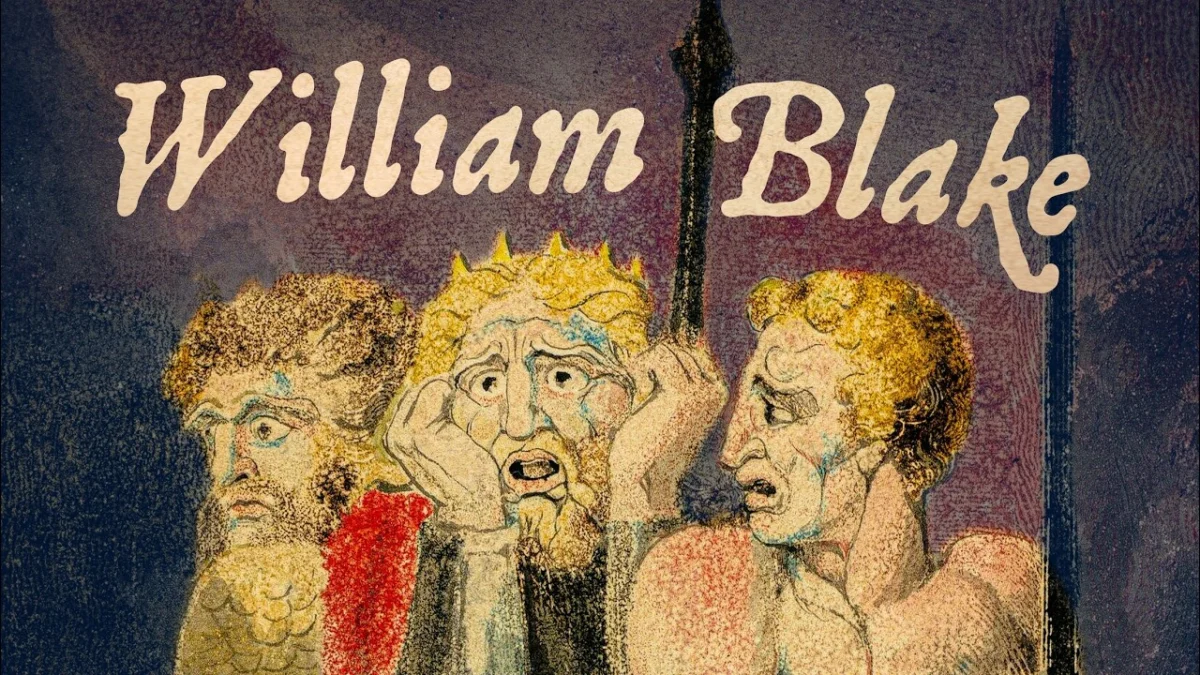
William Blake remains one of the most enigmatic figures in the history of Western art and literature, a man whose work defies the conventional boundaries of categorization. To describe him simply as a poet, a painter, or a printmaker is to overlook the fundamental nature of his genius. While he certainly practiced all three disciplines, his legacy is built upon the fact that these were not separate pursuits but three facets of a singular, unified act of creation. Blake’s work, most notably his "illuminated books" such as Songs of Innocence and of Experience and his complex "prophetic books," represents a synthesis of word and image that remains virtually unparalleled. This holistic approach has led modern critics, including Evan Puschak of the Nerdwriter series, to label him the "patron saint of unclassifiable artists," a figure who prioritized the integrity of his vision over the rigid specialization demanded by the institutions of his time.
The Synthesis of Word and Image
The primary vehicle for Blake’s unique vision was a technique he called "relief etching," or what he sometimes referred to as "the infernal method." Unlike traditional intaglio engraving, where the design is incised into a metal plate, Blake’s method involved drawing his designs and writing his text onto copper plates using an acid-resistant liquid. When the plate was submerged in acid, the background was eaten away, leaving the letters and illustrations in relief. This allowed Blake to print the text and images simultaneously, which he would then hand-color with watercolors.
This process was not merely a technical innovation; it was a philosophical statement. By controlling every stage of production—from the initial composition of the poetry to the physical etching, printing, and coloring—Blake bypassed the commercial publishing industry of the late 18th and early 19th centuries. This total autonomy ensured that the visual and textual elements of his work were inextricably linked. In works like The Marriage of Heaven and Hell, the imagery does not merely illustrate the text; it interacts with it, sometimes contradicting the literal meaning of the words or providing a visionary expansion of the themes. This "cross-breeding" of media created what scholar Morris Eaves describes as "incommensurable neighborhoods of meaning," forcing the viewer to engage with the work as a total sensory and intellectual experience.
Institutional Conflict and the Royal Academy
Blake’s refusal to conform to established artistic categories placed him at odds with the prevailing cultural authorities of his day, most notably the Royal Academy of Arts. Founded in 1768, when Blake was a young adolescent, the Academy sought to professionalize British art by establishing strict hierarchies. Under the leadership of its first president, Sir Joshua Reynolds, the Academy promoted the "Grand Manner," which favored historical and mythological subjects executed with a specific set of formal standards.
In this institutional framework, engravers were relegated to a lowly status, viewed more as craftsmen who reproduced the works of others rather than as original artists. Blake, who served a seven-year apprenticeship under the engraver James Basire before briefly studying at the Royal Academy, found these restrictions stifling. He famously loathed Reynolds’ emphasis on "General Nature," counter-arguing that "To Generalize is to be an Idiot; To Particularize is the Alone Distinction of Merit." Blake’s commitment to "minute particulars"—the specific, vibrant details of his visions—represented a radical departure from the neoclassical aesthetics of the period. His decision to work as an independent maker of words and images was a direct rejection of the Academy’s principle of specialization, which he believed fragmented the human spirit.
A Chronology of Visionary Labor
The development of Blake’s unclassifiable art can be traced through several distinct phases of his career, each marked by a deepening of his mythological system and his technical mastery.
- The Formative Years (1788–1794): During this period, Blake perfected his relief etching technique. In 1789, he produced Songs of Innocence, followed in 1794 by Songs of Experience. These collections, often published together, explore the "two contrary states of the human soul." During this time, he also began his series of "Continental Prophecies," including America a Prophecy (1793) and Europe a Prophecy (1794), which used the political upheavals of the era as a backdrop for a cosmic struggle between the forces of order and rebellion.
- The Lambeth Period and the Great Color Prints (1795): Working in Lambeth, Blake produced a series of twelve "Large Color Prints." These works, such as Newton and Nebuchadnezzar, were not part of illuminated books but were standalone images created through a unique monotype process. They represent some of his most striking critiques of Enlightenment rationalism and the limitations of materialist philosophy.
- The Epic Prophecies (1804–1820): Blake’s later years were dominated by his most ambitious works, Milton: A Poem and Jerusalem: The Emanation of the Giant Albion. These are massive, complex narratives that detail his private mythology, involving characters like Urizen (the personification of cold reason and law) and Los (the personification of the creative imagination). These books are the pinnacle of his "prophetic" style, blending autobiography, history, and theology into a dense, visual tapestry.
- The Final Masterpieces (1821–1827): In his final years, Blake turned to illustrating the works of others, though he did so through the lens of his own idiosyncratic beliefs. His Illustrations of the Book of Job (1826) and his unfinished series of 102 watercolors for Dante’s Divine Comedy are considered some of the greatest achievements in the history of book illustration.
Philosophical Underpinnings and the Rejection of Specialization
Blake’s art was fundamentally a revolt against the "single vision" of the Enlightenment. He lived during an era characterized by the rise of industrialization and the scientific revolution, spearheaded by figures like Isaac Newton and John Locke. To Blake, the emphasis on empirical observation and mathematical logic was a form of mental imprisonment—what he called "mind-forg’d manacles."
He believed that the modern world’s obsession with specialization and the division of labor was symptomatic of a deeper spiritual fragmentation. By separating art from poetry, and reason from imagination, humanity had lost touch with the "Poetic Genius," which Blake believed was the true source of all human perception. His "unclassifiable" art was an attempt to mend this rift. Through his synthesis of media, he sought to engage the "fourfold vision" of the human spirit, which includes the physical, the emotional, the intellectual, and the divine.
His reading of the Biblical Book of Job serves as a poignant example of this philosophy. While traditional interpretations see Job as a story of patient suffering and submission to divine will, Blake interpreted it as the story of a man who mistakenly believes that salvation lies in the "slavish obedience to words written in a book." For Blake, true salvation was found in the active exercise of the imagination, a process he equated with the presence of the Divine in humanity.
Modern Implications and the Digital Archive
Nearly two centuries after his death in 1827, Blake’s work continues to resonate with contemporary audiences, perhaps more so now than during his lifetime. In a world that remains heavily partitioned by professional specialization and academic silos, Blake’s holistic approach offers a compelling alternative. His influence can be seen in the development of the modern graphic novel, the visionary aesthetics of the 1960s counter-culture, and the multi-media experiments of digital artists.
The accessibility of Blake’s work has been significantly enhanced by the digital age. The William Blake Archive, a hypermedia project supported by the Library of Congress and various academic institutions, has digitized thousands of his prints, paintings, and manuscripts in high resolution. This archive allows scholars and the public to see the variations between different copies of his illuminated books—each of which is unique due to his hand-coloring process—further highlighting the "unclassifiable" and artisanal nature of his output.
Evan Puschak’s analysis underscores the relevance of Blake to the modern "creator economy." In an era where individuals are often encouraged to be their own writers, designers, and publishers, Blake serves as a historical prototype. He demonstrated that the most profound artistic statements often come from those who refuse to stay within the lines drawn by institutions.
Impact and Legacy
The legacy of William Blake is a testament to the power of the individual vision against the tide of cultural conformity. While he died in relative obscurity and was often dismissed by his contemporaries as "mad," his reputation has grown steadily since the mid-19th century. The Pre-Raphaelites rediscovered his work, admiring his rejection of academic art, and later poets like W.B. Yeats and Allen Ginsberg found in him a spiritual forebear.
Today, Blake is recognized not just as a great English poet or a significant Romantic artist, but as a singular phenomenon in world culture. His work serves as a reminder that the categories we use to organize human knowledge—art, literature, religion, science—are often arbitrary. By breaking these categories apart and weaving them back together, Blake sought to make reality whole again. His art remains radical because it demands that we see the world not through the eye, but through the imagination, transforming the "ratio" of the material world into the infinite expanses of the visionary mind. In the end, Blake’s unclassifiable nature is his greatest strength; it ensures that his work cannot be easily consumed or forgotten, remaining instead a perennial challenge to the limits of human perception.