To English speakers, the German word Gleichschaltung is cumbersome and rarely heard, yet it remains central to understanding the systemic transformation of Germany during the 1930s. In 1933, the nation was fundamentally altered almost overnight through what the United States Holocaust Memorial Museum defines as “a concerted policy of coordination.” Through this systematic enforcement, culture, the economy, education, and law fell under strict totalitarian control. Independent artists, institutions, and publications either faced immediate purges or were fundamentally altered to reflect the aesthetic and political doctrines of the National Socialist German Workers’ Party.
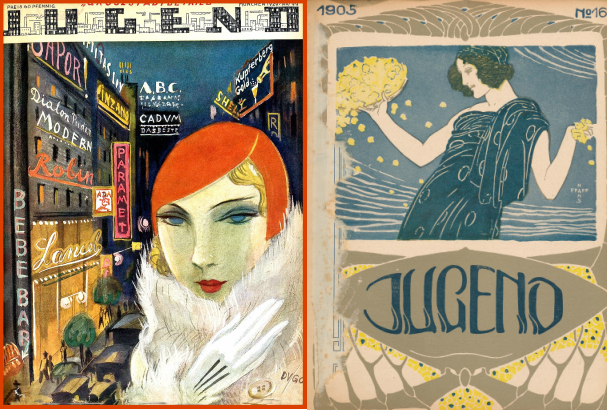
Few historical artifacts illustrate this cultural hijacking as clearly as the Munich-based arts and literature journal Jugend (Youth). Founded in 1896, Jugend spent decades serving as the vanguard of European modernism and the birthplace of the German Art Nouveau movement, known as Jugendstil. However, following the Nazi seizure of power, the periodical was gradually stripped of its avant-garde identity and transformed into a vehicle for state propaganda until its final publication in 1940. Today, the complete 44-year run of the magazine has been digitized and made publicly accessible by the University of Heidelberg, offering contemporary researchers, historians, and art enthusiasts an unprecedented window into the rise and forced ideological collapse of a cultural titan.
The Birth of Jugend and the Genesis of Jugendstil
The late nineteenth century was a period of intense creative upheaval across Europe, characterized by a rejection of academic historicism and a desire to forge a visual language fit for a rapidly industrializing society. In Britain, France, Austria, and the United States, artists embraced post-Impressionism, Orientalist motifs, folk art, and the burgeoning fields of graphic and industrial design.
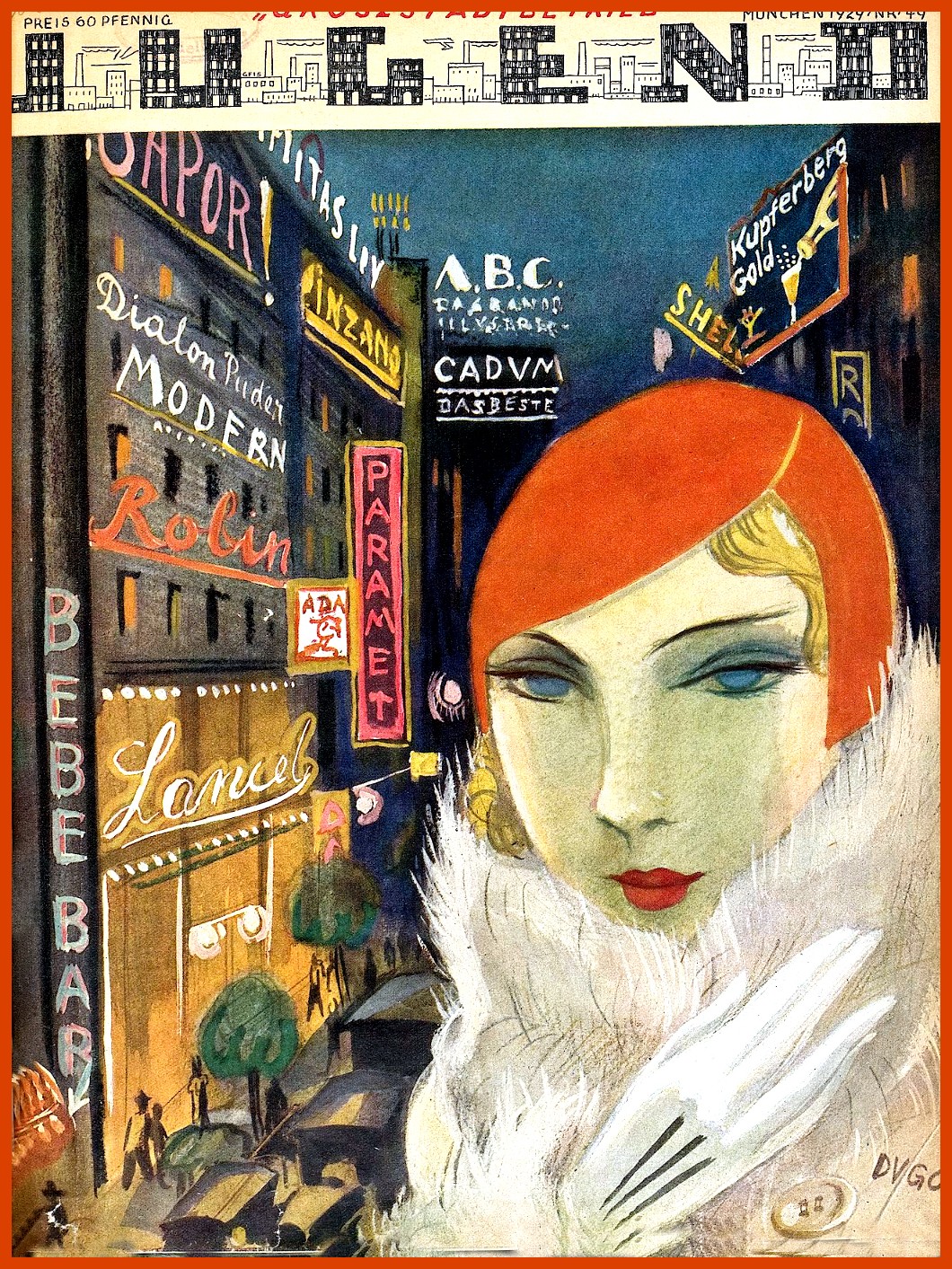
Against this backdrop, writer and publisher Georg Hirth launched Jugend in Munich in January 1896. Hirth intended the weekly magazine to be a vibrant platform for a new cultural renaissance, deliberately bypassing established artistic traditions and academic conventions. The publication quickly became a magnet for independent thinkers, satirists, poets, and visual artists who sought to break away from nineteenth-century realism.
The impact of the magazine on German visual culture was so profound that the German variant of Art Nouveau became known universally as Jugendstil. Art historians generally divide the movement into two distinct phases: a pre-1900 era dominated by sinuous, organic floral motifs heavily influenced by Japanese art and British Art Nouveau, and a post-1900 phase marked by a gradual shift toward geometric abstraction, functionalism, and cleaner architectural lines.
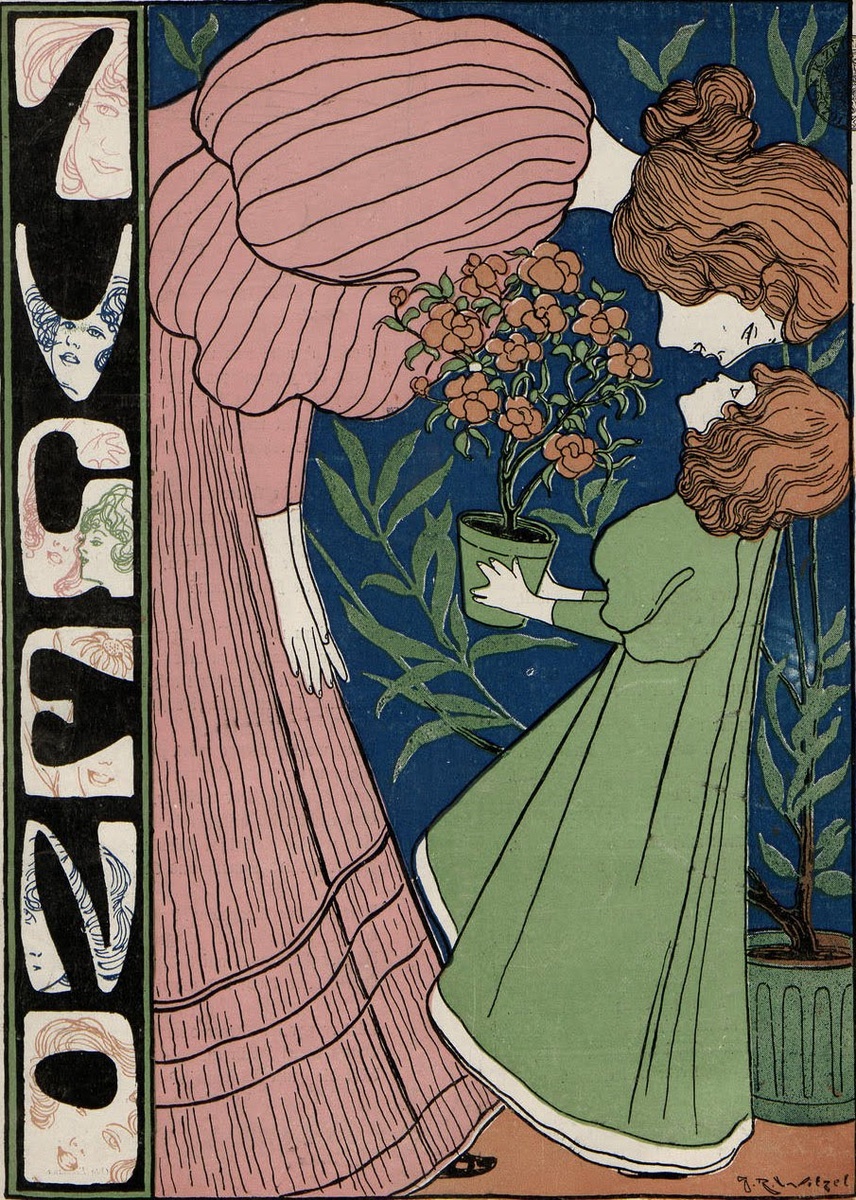
Throughout its early decades, Jugend was celebrated internationally for its bold typography, striking satirical illustrations, and brilliant escapism. A critic writing in a 1904 issue of The Yale Literary Magazine noted the unique status of the publication, observing that its editorial tone and visual daring had no equivalent in England or the United States. Observers frequently remarked that Jugend’s primary political and social platform was one of universal opposition—challenging bourgeois complacency, rigid morality, and traditional state authority with biting wit and radical visual flair.
Chronology of a Cultural Shift: From Avant-Garde to State Control
The trajectory of Jugend can be broken down into distinct historical eras that mirror the political turbulence of modern German history:
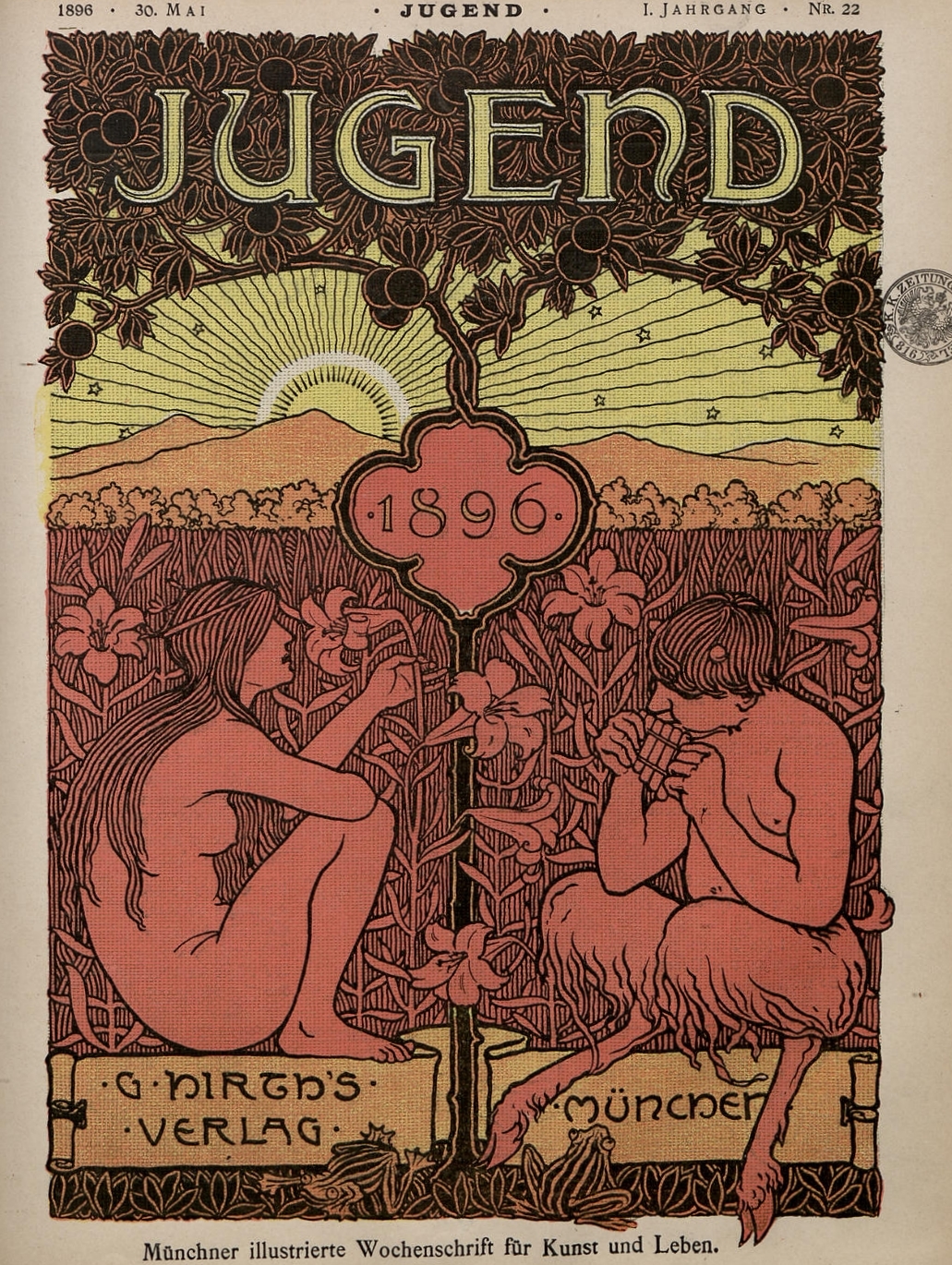
- 1896–1900 (The Florative Dawn): Georg Hirth establishes the magazine in Munich. The publication pioneers Jugendstil, featuring organic, flowing lines, vibrant color palettes, and contributions from emerging European designers and illustrators.
- 1900–1918 (Expansion and Satire): The Munich artistic community disperses to cultural hubs like Berlin, Weimar, and Darmstadt. Jugend evolves into a sophisticated sociopolitical and satirical journal, critiquing Wilhelmine society while maintaining its artistic independence.
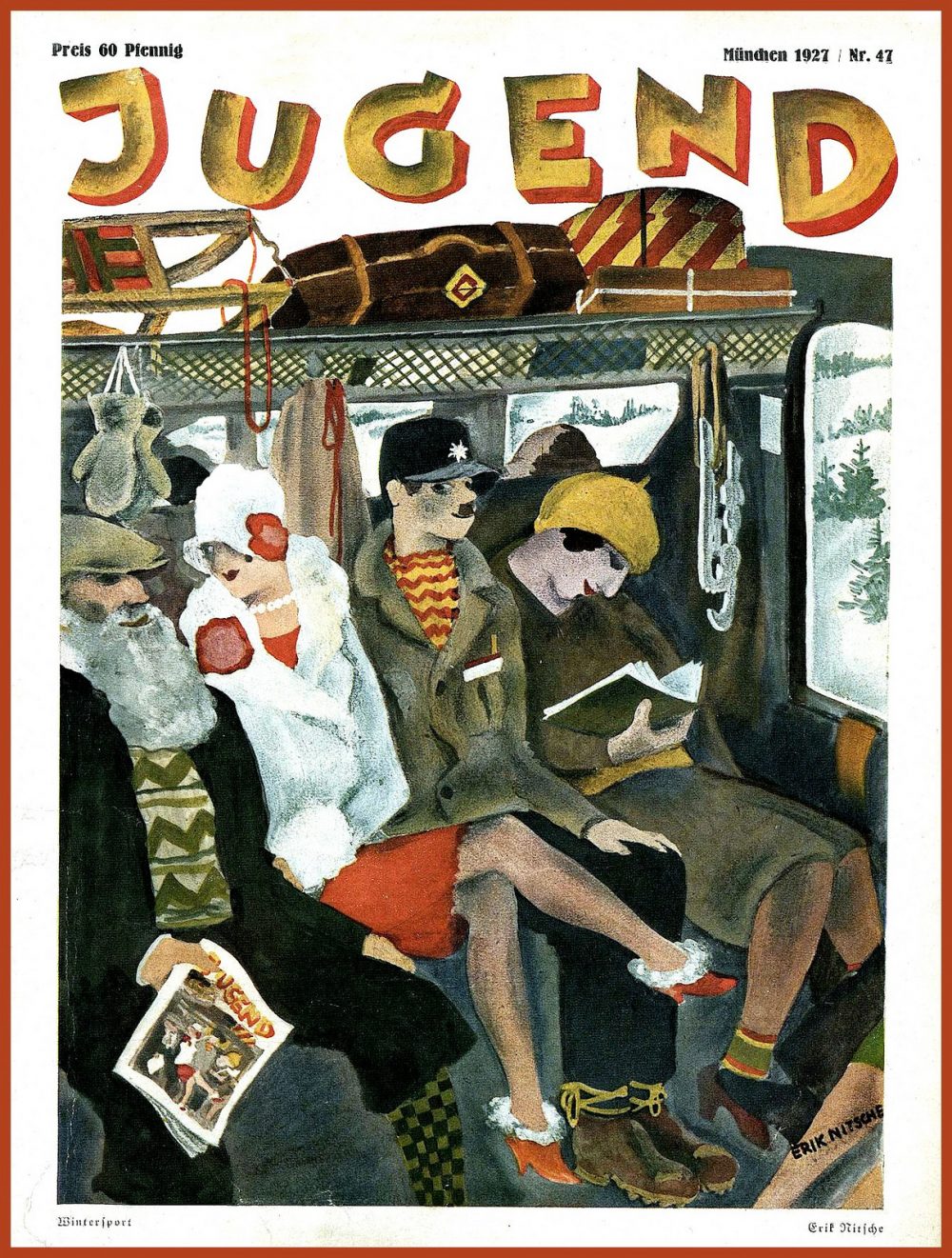
- 1918–1933 (Weimar Republic Turmoil): Amid economic devastation and political polarization following the First World War, the magazine navigates the avant-garde experiments of the Weimar era, featuring Dadaist-adjacent humor, expressionist graphics, and fierce debates over the future of German culture.
- 1933–1940 (Gleichschaltung and Nazification): Following Adolf Hitler’s appointment as Chancellor, the Nazi regime initiates the coordination of German media. Jugend is subjected to strict editorial oversight, purging its Jewish and avant-garde contributors, replacing its dynamic illustrations with neoclassical imagery, and eventually folding in 1940 as wartime resource shortages and shifting propaganda needs render it obsolete.
Supporting Data and Archival Accessibility
The preservation of Jugend’s historical record has been secured through modern digital archiving initiatives. The University of Heidelberg’s digital library (DigiUniHeidelberg) has scanned hundreds of issues, encompassing tens of thousands of pages spanning from 1896 to 1940. Researchers and the general public can search, browse, and download complete PDF volumes of the magazine free of charge. Additional high-resolution imagery and cover art are accessible via specialized digital curation groups on platforms such as Flickr.
This comprehensive archive provides quantitative and qualitative data on how editorial boards adapted under authoritarian pressure. Metrics from the digital collection reveal a stark contrast between pre-1933 issues—which regularly featured dozens of independent illustrators utilizing asymmetrical layouts, whimsical caricatures, and provocative social commentary—and post-1933 issues, which experienced a drastic reduction in artistic diversity, settling instead into rigid, symmetrical layouts dominated by heroic realism, militaristic iconography, and heavy neoclassical typography.
Institutional Context: The Mechanism of Gleichschaltung
To fully comprehend the transformation of Jugend, historians analyze the broader institutional mechanisms deployed by the Nazi regime immediately after taking power in January 1933. The Reich Ministry of Public Enlightenment and Propaganda, led by Joseph Goebbels, was established in March 1933. Shortly thereafter, the Reichskulturkammer (Reich Chamber of Culture) was created to oversee all literature, press, broadcasting, theater, music, and fine arts.
Under this legislative framework, continued professional practice was contingent upon membership in state-run professional organizations, which systematically excluded Jews, political dissidents, and artists whose work was labeled entartet (degenerate). For a publication like Jugend, survival required absolute capitulation. The magazine’s traditional championing of individual expression, cosmopolitanism, and playful subversion directly conflicted with the Blut und Boden (Blood and Soil) ideology promoted by Nazi cultural theorists.
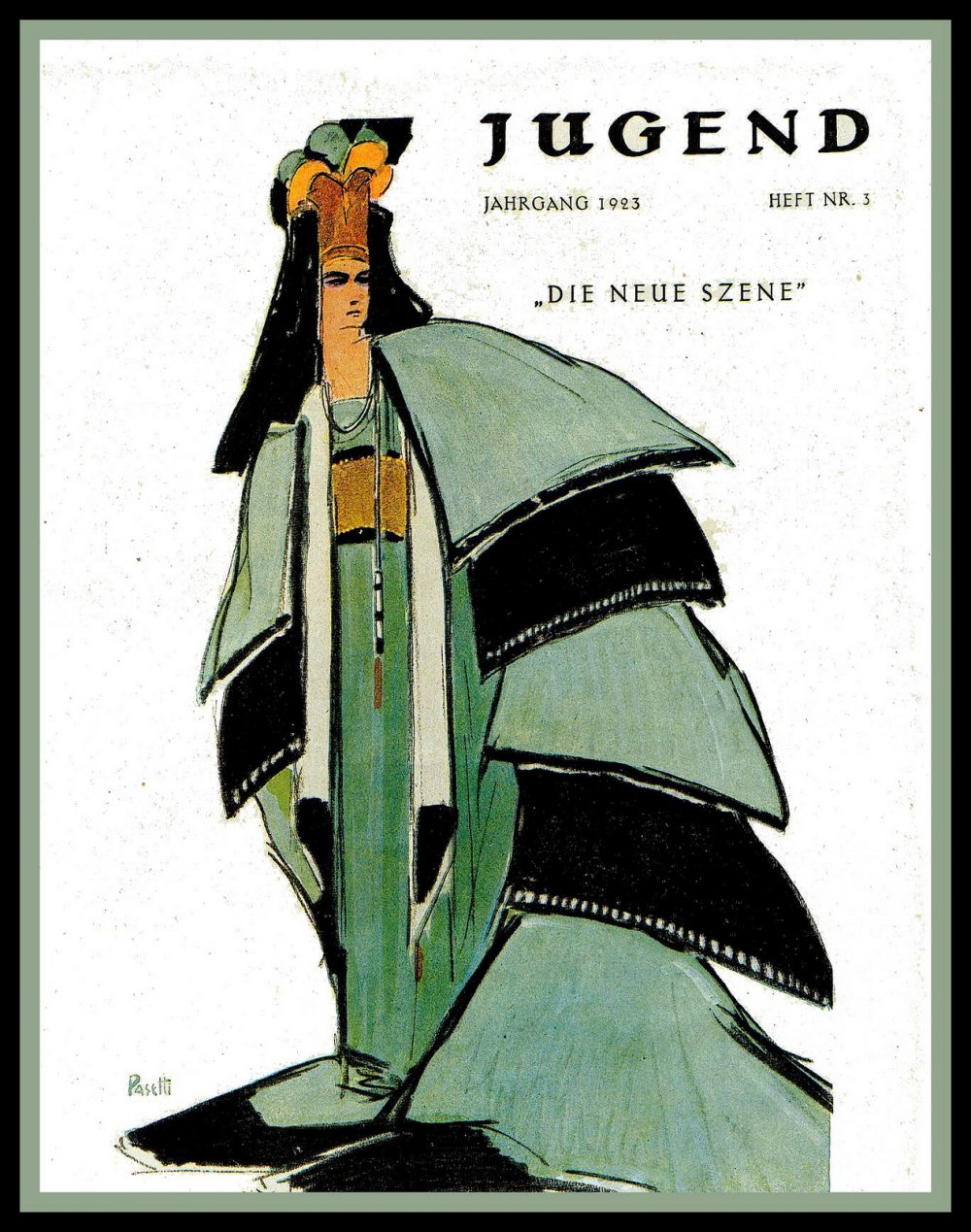
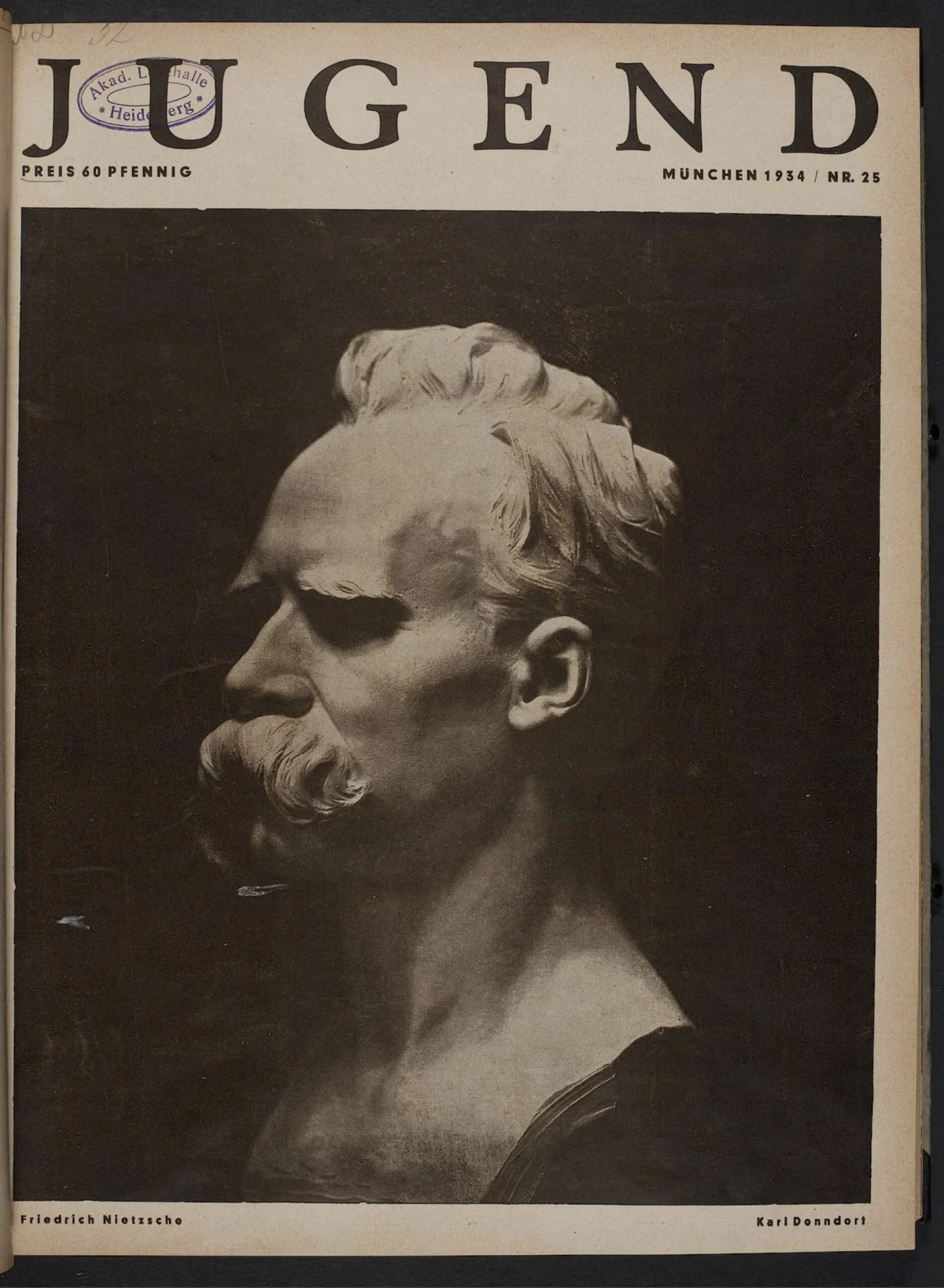
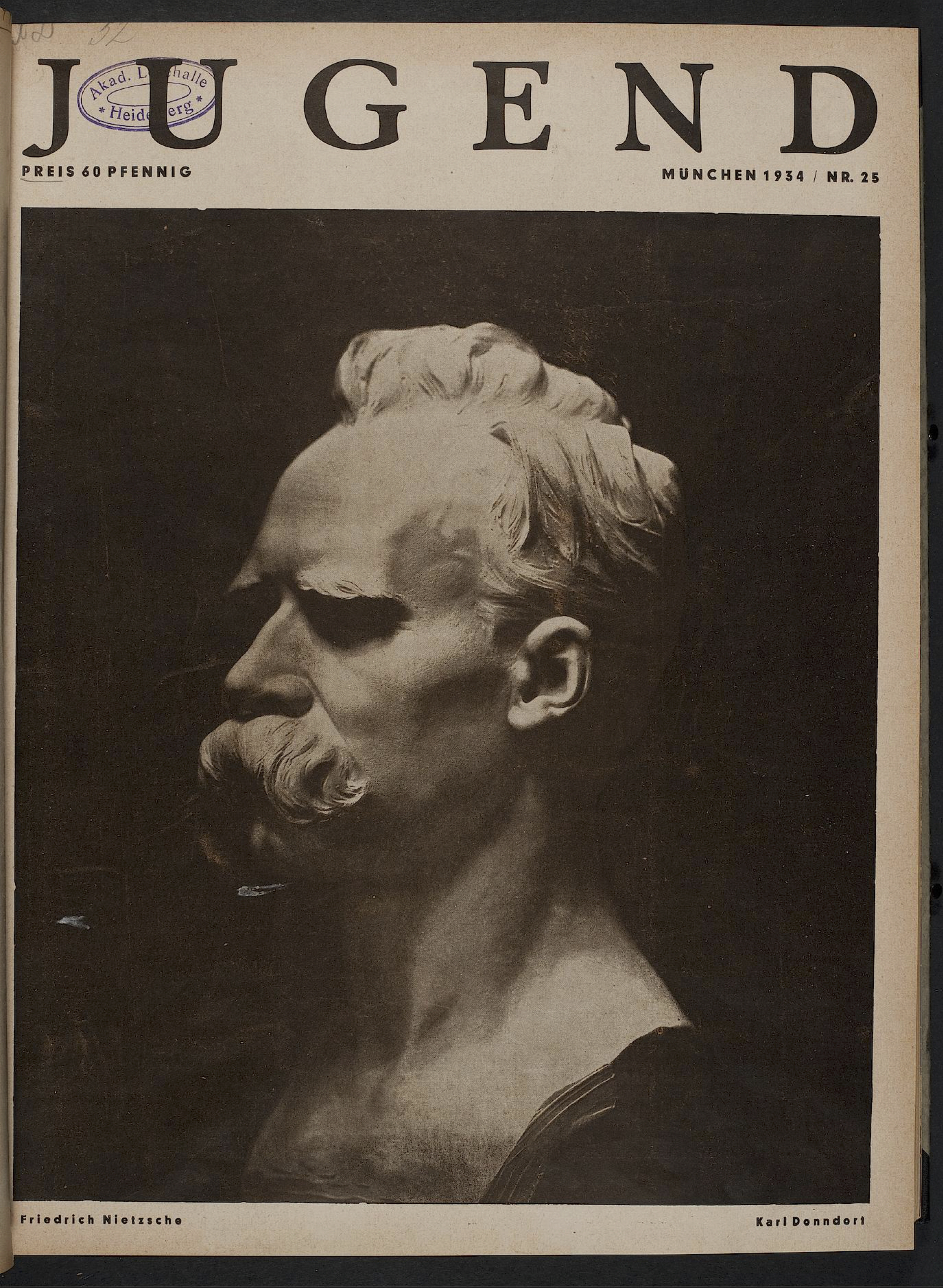
Consequently, the editorial leadership was replaced or coerced. By 1934, covers that once featured whimsical Art Nouveau nymphs or biting political satire were replaced by somber, monumental imagery, such as neoclassical busts of Friedrich Nietzsche. The magazine effectively abandoned the very principles that had made it a global beacon of modern design, trading its cultural vitality for state-sanctioned conformity.
Broader Impact and Implications
The digital availability of Jugend offers far more than a nostalgic look at turn-of-the-century graphic design; it serves as a vital case study in the vulnerability of cultural institutions under authoritarian pressure. The forced evolution of the magazine demonstrates how quickly a vibrant, pluralistic press can be hollowed out and repurposed to serve state propaganda when democratic safeguards collapse.
Modern cultural historians and media analysts frequently point to the Gleichschaltung of German media as a cautionary historical parallel. The archive serves as a permanent reminder of the tension between artistic freedom and state control, illustrating how totalitarian regimes systematically target independent thought by first co-opting, and ultimately erasing, the cultural vanguards of their time. Through the exhaustive preservation efforts of academic institutions like the University of Heidelberg, the full scope of this historical tragedy—both the brilliant creative heights of Jugendstil and the sobering reality of its suppression—remains open for public scrutiny and scholarly analysis.