
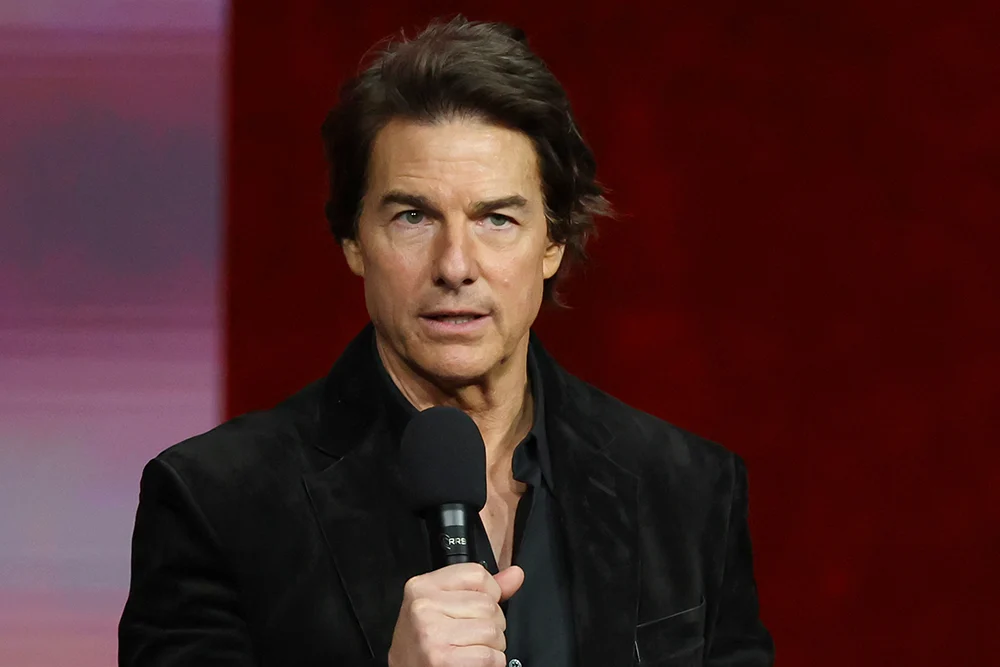
The enduring debate regarding the role of artificial intelligence in the creative arts reached a high-profile platform this Monday in London, as global superstar Tom Cruise offered an impassioned defense of human-centric filmmaking. Speaking during an intimate “Life in Pictures” retrospective hosted by the British Academy of Film and Television Arts (BAFTA), the veteran actor and producer addressed the industry’s most existential question: whether the rapid advancement of generative AI threatens to diminish the value of human performance and craftsmanship in motion pictures.
Cruise’s appearance, which served as both a retrospective of his four-decade career and a forward-looking discussion on the nature of cinema, provided a rare window into the philosophy of one of Hollywood’s most dedicated proponents of the theatrical experience. As the industry grapples with the integration of synthetic media, deepfakes, and algorithmic storytelling, Cruise’s stance—that audiences will ultimately prioritize the visceral, “real” experience of human performance—serves as a cornerstone for the traditionalist approach to studio filmmaking.
A Legacy of Technical Mastery and Human Risk
To understand the weight of Cruise’s perspective, one must view it through the lens of his career trajectory. From his breakout roles in the 1980s with Top Gun to his critical successes in Jerry Maguire and Magnolia, and eventually his role as the primary architect of the Mission: Impossible franchise, Cruise has consistently pushed for practical effects. His commitment to performing high-stakes stunts—often risking physical injury to capture genuine motion on camera—stands in direct opposition to the increasing reliance on digital augmentation and AI-driven post-production.
The Mission: Impossible franchise has frequently served as a testing ground for cutting-edge technology. However, Cruise and his collaborators have historically used technology to enhance, rather than replace, the physical presence of the actor. The upcoming 2025 installment, Mission: Impossible – The Final Reckoning, is notable for directly confronting the AI dilemma by positioning an artificial entity as the central antagonist. By doing so, the production aims to explore the sociological implications of a world where algorithms can manipulate reality, a theme that mirrors the current anxiety permeating the Hollywood labor force.
The Theatrical Experience as a Distinct Art Form
During the conversation moderated by Edith Bowman, Cruise articulated a clear distinction between the convenience of streaming and the cultural ritual of the cinema. While he acknowledged that streaming platforms have a place in the modern distribution ecosystem, he maintained that the theatrical experience is a unique "art form" that cannot be replicated in a domestic setting.
"There is nothing like human," Cruise stated, emphasizing that the communal nature of a darkened theater creates an energy that is fundamentally human. This sentiment aligns with recent box office data, which suggests that audiences are increasingly seeking out "event" cinema that offers a tangible, high-production value experience. The summer of 2026 provided a robust proof-of-concept for this theory, as the global box office shattered historical records, accumulating $4.76 billion between May 1 and Labor Day. Industry analysts point to a "flight to quality" among consumers, where audiences are favoring films that demonstrate significant human labor, intricate set design, and authentic performances over those perceived as being churned out through automated processes.
The Economic and Cultural Impact of AI
The implications of AI in the film industry extend far beyond the visual aesthetic; they reach into the heart of labor contracts, intellectual property rights, and the future of creative authorship. The dual strikes by the Writers Guild of America (WGA) and SAG-AFTRA in 2023 were largely driven by fears regarding the unregulated use of generative AI to replace human writers and performers.
Cruise’s call to "keep creating" functions as a rallying cry for the creative community. His argument suggests that while the technological infrastructure for AI-driven film production is inevitable, the "demand side" of the equation—the audience—will maintain a psychological preference for human struggle and achievement. This is an economic argument as much as it is an aesthetic one: if the market value of "human-made" content remains higher than that of "machine-made" content, the industry will naturally incentivize the preservation of human talent.
Transformation in the Spotlight: The Case of Digger
Beyond the theoretical, Cruise offered a glimpse into his commitment to transformative acting with his upcoming film, Digger. Directed by Alejandro G. Iñárritu, the project represents a departure from the high-octane action roles for which Cruise is globally known. In the film, Cruise portrays a wealthy oil tycoon, a role that required an extensive physical transformation.
The process involved the use of sophisticated prosthetics and a fat suit, a metamorphosis that initially required six hours of application per day. By choosing a role that relies on deep, character-driven transformation rather than digital trickery, Cruise is reinforcing his belief in the power of physical acting. His description of Digger as "the most original film and one of the most moving films I’ve ever seen" suggests a shift in his late-career focus toward projects that prioritize narrative depth and human complexity. The film, slated for an October 2, 2026 release through Warner Bros., is already generating significant buzz as a potential awards contender, further validating his pivot toward traditional, performance-heavy prestige cinema.
Chronology of a Shifting Landscape
- 1981–1999: The rise of Tom Cruise as a global icon, defined by physical performance and the establishment of the modern blockbuster era.
- 2000–2020: The expansion of the Mission: Impossible franchise, characterized by an increasing reliance on practical, in-camera stunts as a counter-movement to the rise of CGI.
- 2023: WGA and SAG-AFTRA strikes underscore the industry-wide anxiety regarding the role of AI in creative authorship and likeness rights.
- Summer 2026: A record-breaking box office performance signals a strong audience appetite for human-centric "event" cinema.
- October 2026: Scheduled release of Digger, marking a new chapter for Cruise as he explores character-driven narratives while championing the preservation of traditional cinematic techniques.
Fact-Based Analysis: The Human Element in the Digital Age
The tension between human creativity and automation is not new to the film industry. The transition from silent film to "talkies," the introduction of Technicolor, and the rise of CGI all prompted similar existential questions about the death of the "real." However, the AI revolution is unique in its capacity to mimic the creative decision-making process itself.
From a production standpoint, AI tools are already being utilized to streamline visual effects (VFX) workflows, enhance audio restoration, and assist in script coverage. Yet, as Cruise suggests, these tools remain subservient to the human intent. The consensus among top-tier filmmakers, including Christopher Nolan and Martin Scorsese, often mirrors Cruise’s optimism: technology is a tool, but it lacks the "human spark" that allows a story to resonate on an emotional level.
The financial risk of relying entirely on AI-generated content is also a deterrent for major studios. Film franchises rely on the brand equity of stars—human stars with a history of audience connection. Replacing these icons with synthetic counterparts risks alienating the very fan bases that sustain the blockbuster model. Consequently, the likely near-term future of Hollywood is a hybrid model: one where AI is relegated to the back-office and technical labor, while the "face" of the industry remains resolutely human.
Conclusion
Tom Cruise’s intervention at the BAFTA event serves as a reminder that the film industry is not merely a manufacturing sector for entertainment products, but a cultural arena for human expression. By positioning himself as a bridge between the classic era of practical stunts and the modern era of digital anxiety, Cruise is advocating for a path that embraces technological advancement without sacrificing the humanity that makes cinema an essential human experience. As Digger prepares for its theatrical debut and the Mission: Impossible franchise nears its climax, the industry will be watching closely to see if his faith in the audience’s desire for "real things" continues to hold true in an increasingly synthetic world.








Leave a Reply