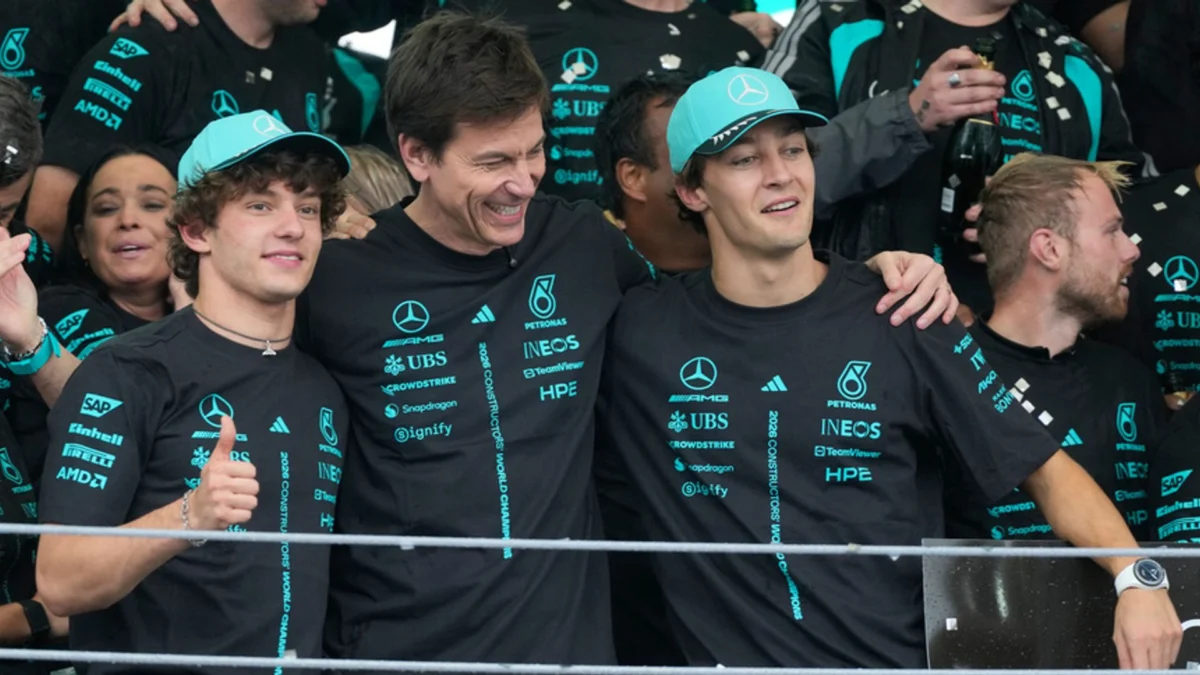
The landscape of Formula 1 has undergone a seismic shift, culminating in a historic triumph for Mercedes-AMG Petronas as they secured the 2026 Constructors’ Championship at the Sao Paulo Grand Prix. This victory marks the ninth title in the team’s illustrious history, effectively closing a complex five-year chapter of reconstruction, technical evolution, and internal resilience. For Team Principal Toto Wolff, the crowning achievement is not merely a trophy to add to the cabinet at Brackley, but a testament to the organizational fortitude required to navigate the volatile nature of elite motorsport.
The 2026 season has been defined by the successful transition to a new regulatory era. Following the introduction of radically different aerodynamic and power unit specifications, Mercedes emerged as the team best equipped to navigate the technical challenges of the new ground-effect machines. Combined with the earlier crowning of Kimi Antonelli as the Drivers’ Champion, the team has successfully achieved a clean sweep of the sport’s most prestigious honors, re-establishing a dynasty that had been challenged since the conclusion of their record-breaking eight-year streak in 2021.
A Chronology of Redemption: The Path Back to the Summit
The trajectory of Mercedes over the last half-decade serves as a compelling study in corporate resilience. The 2022 season represented the dawn of the "ground effect" era, a period that proved to be a crucible for the Silver Arrows. Inheriting a concept that struggled with severe porpoising and aerodynamic instability, the team found itself in unfamiliar territory.
From 2022 through 2025, Mercedes transitioned from a dominant force to a challenger fighting for scraps. The 2022 season saw the team fall to third in the standings, followed by a turbulent 2023 that highlighted deep-seated flaws in their car philosophy. By 2024 and 2025, the team began the process of re-learning the fundamental mechanics of the sport, moving away from the "zero-pod" design and embracing more conventional aerodynamic solutions.
Throughout these four years, the statistics tell a story of a team that refused to collapse. Despite the technical deficit, the team maintained a level of competitive consistency, securing podiums and race victories through the efforts of George Russell and the departing Lewis Hamilton. However, for an organization accustomed to championship glory, these seasons were marked by the psychological weight of "getting it wrong," as Wolff candidly described. The 2026 season, therefore, represents the culmination of that iterative process—a systematic dismantling of the issues that plagued their previous four campaigns.
Statistical Context and Historical Standing
With their 2026 success, Mercedes now stands level with the Williams Racing team, both boasting nine Constructors’ titles. This places them in an elite tier of motorsport history, trailing only the historic juggernauts of McLaren, with ten titles, and Ferrari, which holds the all-time record with sixteen.
The achievement is particularly significant when considering the parity introduced by the 2026 regulations. The field was effectively reset, yet Mercedes managed to engineer a car that possessed the best average performance across a variety of circuits. Data from the season indicates that while other teams occasionally challenged for singular victories, the consistency of the Mercedes W17 chassis—optimized for reliability and aerodynamic efficiency—was the deciding factor in the championship battle.
The Human Element: Beyond the Cockpit
While the drivers are the most visible protagonists of the sport, Toto Wolff has been quick to divert credit toward the "2,500 superstars" working within the Mercedes factories in Brackley and Brixworth. The internal philosophy at Mercedes has shifted toward a more holistic view of team performance, emphasizing that the drivers’ success is the output of thousands of hours of research, design, and manufacturing.
Kimi Antonelli, the breakthrough star of the 2026 season, has been instrumental in this success. His championship victory, the first for a young talent in his debut season with the team in recent history, has validated the team’s long-term investment in driver development. Antonelli’s performance, particularly in managing the pressure of a title fight, has been described by senior engineers as "poised beyond his years."
George Russell, a veteran of the team’s recovery phase, echoed this sentiment following the race in Sao Paulo. "When I joined in 2022, the goal was to fight for championships again," Russell noted. "The journey has been far from linear, but the collective belief within the factory never wavered. We are not just a group of individuals; we are a machine that has learned how to fix itself."
Implications for the Future of Formula 1
The success of Mercedes in 2026 serves as a significant narrative for the broader sport. It challenges the notion that a team, once dominant, is destined for a long-term decline after a regulatory shift. By successfully navigating the "back and forth" of their development cycle, Mercedes has provided a blueprint for other teams currently struggling to find their footing in the new regulatory landscape.
Furthermore, the team’s ability to retain talent and maintain morale during the "wilderness years" of 2022–2025 is being studied as a case model for organizational behavior. In a sport where staff turnover is high and pressure is constant, Mercedes managed to keep its core technical team intact, ensuring that the institutional knowledge gained during the lean years was applied effectively to the 2026 car.
As the team prepares for the final rounds of the season and looks toward the 2027 calendar, the focus shifts to sustaining this momentum. The competitive landscape is expected to tighten further as rivals such as Ferrari and Red Bull iterate on their own 2026 concepts. However, for now, the mood within the paddock is one of profound respect for a team that has managed to execute a return to the top in a time frame that few believed possible.
Reflection on the Sao Paulo Grand Prix
The final clinching of the title in Brazil was not the "stylistic" victory the team might have preferred—both Russell and Antonelli faced challenges in the mixed conditions, finishing fourth and fifth respectively—but the result was sufficient to secure the mathematical advantage. The race served as a microcosm of the season: challenging, unpredictable, and requiring a high degree of adaptability.
"We would have liked to have done it in a bit more style," Russell admitted during the post-race interviews, acknowledging the difficulty of the Sao Paulo circuit. Yet, the broader context of the 2026 season remains one of dominance and recovery. The championship is not defined by the single race in Brazil, but by the relentless pursuit of performance that started in the winter of 2022.
Looking Ahead: The Las Vegas Challenge
With the Constructors’ and Drivers’ titles secured, Mercedes enters the final stages of the 2026 season with the freedom to experiment. The upcoming Las Vegas Grand Prix represents a new challenge, both in terms of circuit configuration and the unique atmosphere of the event.
For the team, the pressure is off, yet the professional requirement to continue pushing remains. The data gathered in the final races will be critical for the development of the 2027 contender. As the sport moves toward a more sustainable and technologically advanced future, Mercedes has reaffirmed its position as a central pillar of the Formula 1 ecosystem. The story of their 2026 campaign is, above all, a story of an organization that refused to accept the status quo and, through sheer persistence, reclaimed its place at the pinnacle of the sport.