
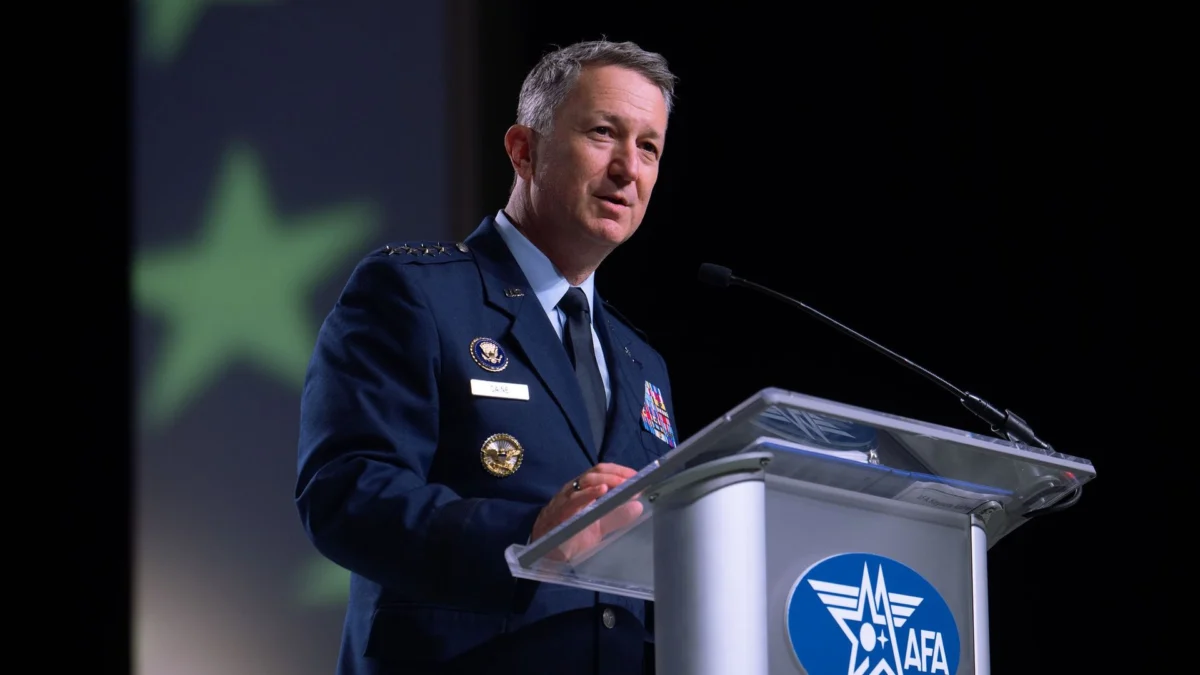
The United States military is undergoing a fundamental shift in its strategic posture, officially expanding its operational theater from the traditional domains of land, sea, air, and low-Earth orbit to include the vast, high-stakes expanse of cislunar space. This region, encompassing the gravitational influence of Earth and extending to the surface of the moon, is no longer viewed merely as a scientific frontier but as a critical domain for national security. Gen. Dan Caine, the chairman of the Joint Chiefs of Staff, articulated this new reality on September 16, 2026, during his keynote address at the Air & Space Forces Association’s Air, Space & Cyber Conference in National Harbor, Maryland. His remarks signaled that the military must prepare for potential conflict in a theater that stretches hundreds of thousands of miles from the Earth’s surface.
A New Battlefield: Defining Cislunar Strategic Importance
Cislunar space serves as the gravitational highway between Earth and its natural satellite. As the international community accelerates lunar exploration, the region has become a focal point for geopolitical friction. For decades, military doctrine focused on the "near-Earth" environment—the critical belt of space where GPS, communications, and intelligence satellites reside. However, the rapid advancement of autonomous landing systems, lunar resource extraction technologies, and permanent base-building initiatives has rendered the moon and its surrounding space a vital economic and strategic asset.
The strategic pivot is underscored by the race to the lunar south pole, a region believed to contain significant deposits of water ice. Water is the "oil" of the solar system, capable of being processed into hydrogen and oxygen for rocket propellant, effectively transforming the moon into a gas station for deep-space missions. Control over these resources, and the infrastructure required to access them, will likely define the norms of behavior in space for the remainder of the 21st century.
Chronology of Escalation: From Science to Security
The transition from a peaceful scientific environment to a contested space domain has been rapid. A brief timeline illustrates the shift:
- January 2019: China’s Chang’e 4 mission achieves the first-ever soft landing on the far side of the moon, demonstrating a level of technical sophistication that caught many Western observers by surprise.
- 2020–2023: The U.S. and its partners formalize the Artemis Accords, establishing a framework for lunar cooperation, while China and Russia announce plans for the International Lunar Research Station (ILRS).
- June 2024: China’s Chang’e 6 mission successfully returns samples from the lunar far side to Earth, marking a significant milestone in autonomous operations and proving the ability to maintain complex logistics in deep space.
- April 2026: NASA’s Artemis II mission captures iconic imagery of the Earth setting over the lunar horizon, a symbolic reminder of the fragility and reach of humanity as it returns to the lunar vicinity.
- September 2026: Senior U.S. military leadership publicly acknowledges the need for combat readiness in cislunar space, confirming that the "battlefield" now extends to the moon.
The Shift in Military Doctrine: Moving Beyond Assumptions
During his address, Gen. Caine emphasized that the U.S. military can no longer rely on the luxury of "uncontested access" to these regions. The era of assuming that space is a sanctuary, or that American dominance is an immutable fact, has ended. Caine’s rhetoric suggests a move toward a more resilient, distributed force capable of operating in degraded environments.

"Future conflicts will demand that we operate without the assumptions of uncontested access, secure rear areas or uninterrupted or uncontested sustainment," Caine told the audience. This acknowledgment reflects a broader change in military thinking: the understanding that the loss of a single, high-value asset could cripple an entire theater of operations. Consequently, the Space Force is pivoting toward a architecture of "proliferated" systems—smaller, more numerous, and more maneuverable satellites that are harder for an adversary to target and destroy.
Official Admissions: The Reality of On-Orbit Weapons
Perhaps the most significant development from the September 2026 conference was the candid admission regarding the presence of weapons in orbit. Gen. Douglas Schiess, head of the U.S. Space Force, provided a rare confirmation that American "Guardians" are already operating on-orbit capabilities designed to defend against space-enabled threats.
While the specifics remain classified, military analysts suggest these systems are primarily non-kinetic. Unlike the Cold War-era "Star Wars" concepts that focused on explosive interceptors, the current arsenal is focused on electronic warfare. Jamming capabilities, high-energy lasers, and microwave emitters are designed to "blind" or "degrade" adversary sensors rather than create long-lived, uncontrollable debris fields that would threaten all spacefaring nations, including the United States.
This transparency is a calculated move. By acknowledging the existence of these systems, the U.S. is signaling a deterrent posture. The message is clear: any attempt to disrupt critical U.S. infrastructure in orbit will be met with defensive—and potentially offensive—countermeasures.
The Global Landscape of Counterspace Capabilities
The U.S. is not alone in developing these technologies. The "space domain" is already a cluttered and highly competitive environment. Russia and China have both demonstrated the ability to conduct "co-orbital" maneuvers, where an inspector satellite approaches another nation’s spacecraft to gather intelligence or potentially interfere with its operations.
Furthermore, both nations have conducted successful anti-satellite (ASAT) missile tests. While these kinetic tests have been widely condemned by the international community due to the resulting space debris, they serve as a stark reminder of the vulnerability of current satellite constellations. The threat of a "space Pearl Harbor"—a sudden, coordinated attack on the satellite networks that power everything from global finance to tactical military communications—is the primary driver behind the Pentagon’s current restructuring.

Broader Implications for Global Stability
The militarization of cislunar space raises profound questions about international law and the potential for conflict escalation. The Outer Space Treaty of 1967 prohibits the placement of weapons of mass destruction in orbit, but it is notoriously vague regarding conventional military operations, surveillance, and the placement of non-nuclear defensive systems.
As the U.S., China, and other actors accelerate their lunar ambitions, the lack of a clear "rules of the road" in deep space creates a significant risk of miscalculation. If a military satellite and a commercial mining probe operate in the same vicinity, a simple navigational error could be interpreted as an act of aggression.
Furthermore, the economic implications are immense. The ability to control lunar supply chains, monitor mineral extraction, and secure the communications lines between the Moon and Earth will provide a decisive advantage to whichever power can project force most effectively.
Conclusion: A New Era of Deterrence
The remarks by Gen. Caine and Gen. Schiess represent a watershed moment in military history. The "high ground" of the 21st century is no longer a mountaintop or a mountain range, but the orbital space surrounding our planet and the lunar surface itself.
As the United States integrates its military forces into this new, vast domain, the focus remains on deterrence. By openly discussing the necessity of fighting in cislunar space and acknowledging the existence of on-orbit defense systems, the U.S. is attempting to define the parameters of the new space race. The goal is to ensure that the peace and stability that have defined global commerce and security for the last half-century are not shattered by conflict in the final frontier. Whether this posture will lead to a new era of stability or a spiraling arms race remains to be seen, but one thing is certain: the battlefield has expanded, and the stakes have never been higher.










Leave a Reply