
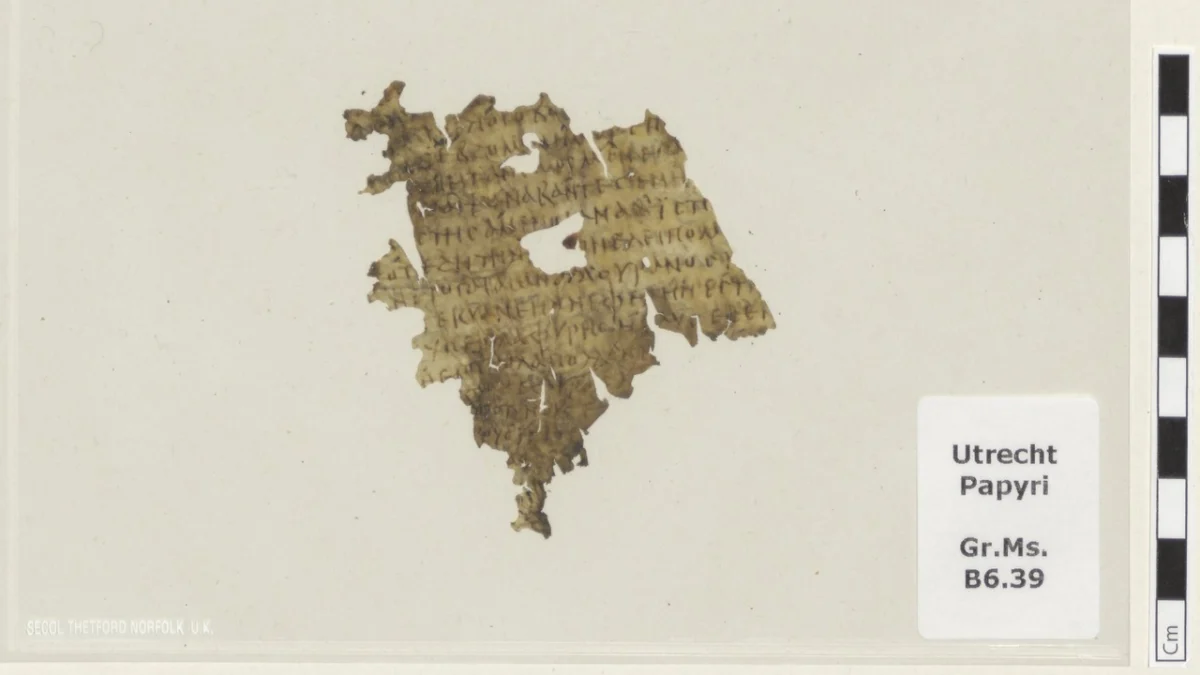
A routine examination of historical archival materials in the Netherlands has yielded a remarkable classical literature discovery. Dr. Mark de Kreij, a specialist in Greek literature and researcher at Radboud University, has identified a torn piece of parchment containing verses from Homer’s legendary epic, the "Odyssey." The artifact, which textual analysis indicates was produced in Egypt around A.D. 300, was found hidden among a collection of early Christian manuscripts housed within the Utrecht University library.
The discovery illuminates ancient reading habits, the transmission of classical literature in the late Roman Empire, and the surprising ways historical archives continue to yield lost or overlooked treasures.
Main Facts and the Discovery
The artifact in question is a small, weathered fragment of parchment featuring legible Greek text. While examining texts acquired by Utrecht University in the mid-20th century, de Kreij recognized distinct phrasing that immediately signaled a connection to classical antiquity rather than the early Christian theological works he was primarily investigating.
Upon closer inspection, the researcher confirmed that the handwritten lines belonged to the "Odyssey," the ancient Greek epic traditionally attributed to Homer, which recounts the arduous ten-year journey of the hero Odysseus returning home to Ithaca after the Trojan War.
Paleographic analysis—the study of historical handwriting—suggests the fragment dates back to approximately the fourth century A.D., around the year 300. Crucially, the physical dimensions and layout of the parchment indicate it was not part of a grand, ceremonial scroll, but rather originated from what modern scholars would classify as a pocket edition. This compact format suggests the text was likely produced for personal use, travel, or private study by an individual living in Roman-era Egypt, where the manuscript was originally generated before eventually making its way to Europe centuries later.
Chronology and Archival Provenance
To understand how a piece of fourth-century Egyptian literature ended up in a Dutch university library, historians and archivists must trace a winding path of acquisition, scholarship, and institutional collection practices spanning nearly seventeen centuries.
- Circa A.D. 300: An anonymous scribe in Roman Egypt handwrites a compact copy of Homer’s "Odyssey," utilizing durable parchment suitable for a portable manuscript format.
- Antiquity to Modern Era: The manuscript fragments endure centuries of degradation, eventually breaking down into smaller pieces and becoming mixed with other regional texts, including early Christian writings circulating in North Africa and the Near East.
- Mid-20th Century: Utrecht University acquires a collection of historical Egyptian and Greek texts to bolster its theological and classical research archives. For decades, the specific fragment remains uncatalogued in detail, resting quietly among boxes of miscellanea and early Christian manuscripts.
- September 14 (Recent Announcement): Following detailed examination by Dr. Mark de Kreij, Utrecht University publicly announces the identification of the fourth-century Homeric fragment, drawing international attention from classicists, historians, and manuscript experts.
Supporting Data and Historical Context
The survival of any classical literary text from antiquity is a statistical improbability. The vast majority of ancient literature was recorded on perishable materials such as papyrus or animal-skin parchment, which were highly vulnerable to humidity, fire, rot, and insects. Most works of classical antiquity that survive today do so because they were painstakingly recopied by medieval scribes in monastic scriptoriums, often generations or centuries after the originals were composed.
However, the dry, arid climate of Egypt provided a unique exception, preserving thousands of fragments—known broadly as papyrology finds—dating from the Hellenistic, Roman, and Byzantine periods. The Utrecht fragment adds to this vital corpus of physical evidence showing how widely read Homeric poetry was outside of institutional or elite academic centers.
During the fourth century A.D., the Roman Empire was undergoing profound religious and cultural transformations. Christianity was rapidly ascending as the dominant state religion under emperors like Constantine the Great, yet classical pagan literature, philosophy, and epic poetry remained core pillars of education for the literate elite. The existence of a portable, pocket-sized "Odyssey" from this transitional era demonstrates that individual readers continued to carry, study, and cherish classical Greek epics even as the broader sociopolitical landscape of the Mediterranean world shifted dramatically.
Official Responses and Academic Significance
Representatives from Utrecht University and Radboud University have emphasized the broader significance of the find, noting that it underscores the hidden depth contained within existing university collections. Archives across Europe and North America frequently hold uncatalogued or misattributed fragments acquired during the intense periods of archaeological exploration and manuscript acquisition in the nineteenth and twentieth centuries.
"Finding a piece of classical literature within a collection primarily designated for early Christian texts highlights the interconnected intellectual life of late antiquity," noted academic administrators in a joint statement regarding the discovery. Scholars of Greek literature often rely on a carefully maintained stemma—a family tree of manuscripts—to reconstruct the original wording of ancient texts. While major libraries hold extensive codices from the medieval period, early fragments originating directly from late antiquity are crucial because they lie closer to the point of composition, offering fewer degrees of separation from the ancient sources.
Although the Utrecht fragment does not radically rewrite the established text of the "Odyssey," textual scholars value every new piece of physical evidence for the insights it provides into ancient orthography, regional textual variants, and the circulation of literature throughout the Roman provinces.
Broader Impact and Implications for Papyrology
The identification of the fourth-century "Odyssey" fragment serves as a compelling reminder of the untapped potential resting within university archives and museum basements worldwide. In an era where digital humanities, multispectral imaging, and advanced paleographic tools are transforming how researchers interrogate historical artifacts, physical discoveries continue to surprise the academic community.
As researchers like Dr. de Kreij continue to comb through mixed archival collections, the boundary between known history and undiscovered provenance remains porous. The humble pocket edition of Homer’s epic, discarded or lost in the sands of Egypt seventeen hundred years ago, has re-emerged to offer modern scholars a tangible link to the reading public of the ancient world.









Leave a Reply