
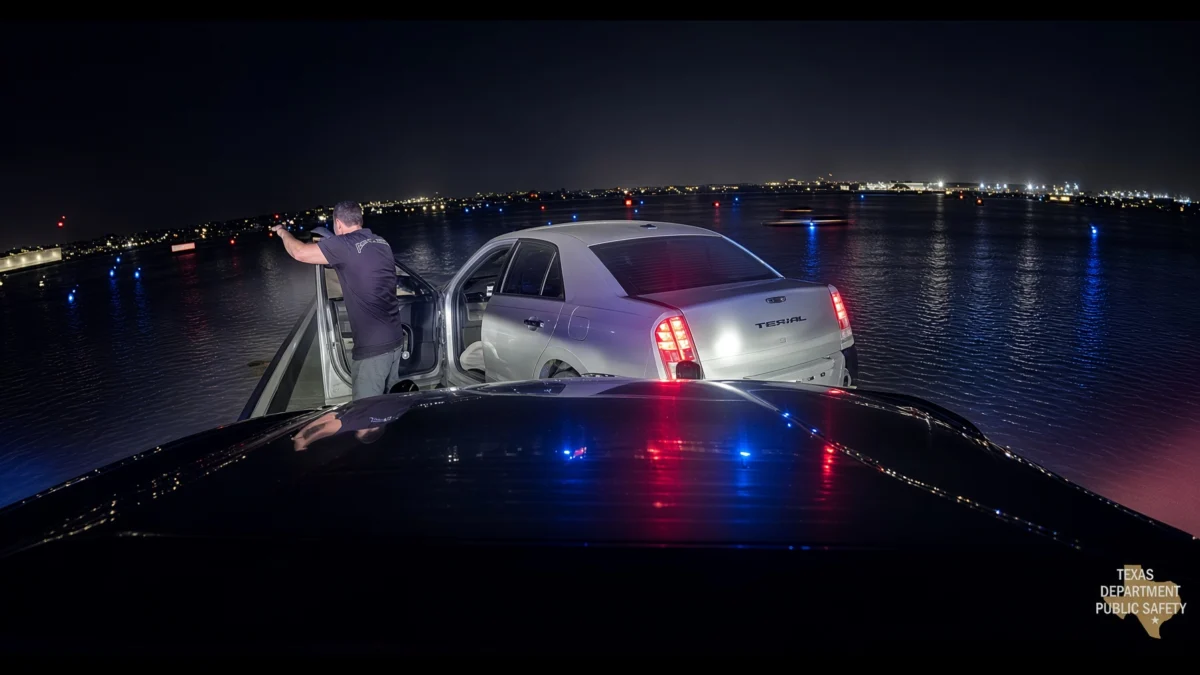
The Texas Department of Public Safety (DPS) has released high-stakes dashcam and body camera footage detailing a harrowing incident that occurred on August 22, when a suspect fleeing state troopers navigated a damaged vehicle through multiple airport security barriers before coming to a stop on the airfield of the San Antonio International Airport. The video, released as part of the department’s "CAUGHT in Central Texas" series, provides a harrowing look at the tactical maneuvers employed during the pursuit and raises questions regarding perimeter security protocols at major metropolitan aviation hubs.
The incident began in the early hours of August 22, at approximately 1:30 a.m., when a Texas Department of Public Safety trooper attempted a routine traffic stop on a 2012 Chrysler sedan near the intersection of Loop 410 and Babcock Road. What began as a standard enforcement action quickly escalated into a high-speed pursuit that spanned several miles across the San Antonio metropolitan area. The footage captures the vehicle in a state of visible mechanical decay; the rear bumper cover is seen dragging along the asphalt, creating sparks and debris as the driver weaves through residential and commercial corridors.
At one point during the high-speed chase, the driver is observed maneuvering the vehicle onto the wrong side of a traffic median, narrowly avoiding oncoming infrastructure before correcting his path. The suspect eventually led troopers toward the San Antonio International Airport, specifically approaching the facility from the direction of Jones Maltsberger Road. The visual evidence shows the driver accelerating through staggered orange construction-style barriers before forcefully ramming his vehicle through a locked perimeter gate.
The suspect continued his trajectory down a narrow, fenced service passage, with the pursuing trooper maintaining close proximity. Upon breaching the inner airfield, the driver traveled a short distance across the open pavement before the damage to his vehicle—compounded by the impact with the gate—rendered it inoperable. According to the footage, the driver complied with law enforcement commands approximately 16 seconds after entering the airport grounds, exiting the vehicle with his hands raised.
Chronology of the Incident
The timeline of the pursuit demonstrates the rapid progression from a minor traffic violation to a significant security breach.
- 01:30 a.m.: A DPS trooper initiates a traffic stop on a 2012 Chrysler near Loop 410 and Babcock Road.
- 01:35 a.m. – 01:45 a.m.: The suspect engages in an extended flight through city streets, displaying erratic driving behavior and sustaining visible damage to the rear of the vehicle.
- 01:48 a.m.: The suspect arrives at the San Antonio International Airport perimeter off Jones Maltsberger Road.
- 01:49 a.m.: The suspect maneuvers through airport security barriers and breaches the access gate, entering the airfield operational area.
- 01:50 a.m.: The vehicle comes to a forced stop on the airfield; the driver is taken into custody by DPS troopers with the assistance of body-worn camera units.
Forensic Findings and Legal Charges
Following the apprehension of the suspect, law enforcement officers conducted a search of the 2012 Chrysler. Inside the vehicle, troopers discovered a firearm, which led to immediate additional charges. While the initial DPS release highlighted counts of evading arrest with a vehicle and the unlawful carrying of a weapon, court records indicate a more comprehensive list of six charges filed against the individual.
The suspect remains in custody at the Bexar County jail, held on a combined bond of $59,500. Legal experts note that the inclusion of charges related to the breach of a secured aviation facility, combined with the presence of a firearm, significantly complicates the suspect’s defense. The severity of the charges reflects the potential danger posed to both airport staff and the general public during the intrusion.
Airport Security and Operational Integrity
A critical aspect of this investigation is the impact—or lack thereof—on the San Antonio International Airport’s day-to-day operations. Despite the dramatic nature of the breach, officials from the San Antonio Airport System confirmed that no flights were grounded, diverted, or delayed as a direct result of the intrusion. The incident occurred in a remote sector of the airfield, far from active runways and taxiways currently in use for commercial aviation at that hour.
However, the ease with which the suspect bypassed the perimeter gate has sparked internal reviews regarding the efficacy of physical barriers at secondary access points. Airport security experts suggest that while "staggered barriers" are designed to deter speed, they are not always sufficient to stop a vehicle intent on forced entry. The incident has prompted discussions between the Texas DPS and airport security administrators to evaluate whether additional bollards or reinforced locking mechanisms are required at entry points that are not primary public thoroughfares.
The Role of Technology in Modern Policing
The release of this footage serves as a dual-purpose endeavor for the Texas Department of Public Safety. On one hand, it functions as a transparency initiative, allowing the public to understand the realities of law enforcement encounters in the region. On the other, it highlights the increasing reliance on integrated dashcam and body camera systems. The transition from the high-angle, wide-view dashcam footage to the close-quarters, high-definition body camera perspective during the arrest provided investigators with a clear, incontrovertible record of the suspect’s submission and the officers’ conduct.
This level of documentation is increasingly vital in contemporary litigation. By capturing the entirety of the pursuit, from the initial traffic stop to the final handcuffing, the state has built a robust evidentiary foundation that limits the scope for dispute regarding the suspect’s actions and the force used during the arrest.
Broader Implications for Public Safety
The San Antonio incident is a microcosm of a larger trend involving vehicle pursuits that end on restricted government or critical infrastructure property. Nationwide, law enforcement agencies are grappling with the "no-win" scenario of high-speed chases: the risk of ending the pursuit early and allowing a dangerous driver to remain at large versus the risk of pursuing a suspect into high-consequence areas like airports, military bases, or dense urban centers.
Data from the National Highway Traffic Safety Administration (NHTSA) suggests that while pursuits are often necessary to protect the public from immediate threats, they contribute significantly to property damage and bystander risk. In this specific case, the fact that the suspect was armed added a layer of urgency that likely justified the trooper’s decision to follow the vehicle onto the airfield. Had the trooper disengaged, the suspect would have potentially remained in control of a firearm while at large in a major metropolitan area.
Official Response and Moving Forward
While the Texas Department of Public Safety has not issued a formal policy change following the incident, the release of the "CAUGHT in Central Texas" segment underscores a commitment to holding suspects accountable for endangering public infrastructure. The San Antonio International Airport administration has stated that they are fully cooperating with the investigation and are conducting their own internal review of the perimeter breach to ensure that future unauthorized access is mitigated.
As the legal proceedings against the suspect continue, the case will likely serve as a reference point for future security training exercises. The ability of the suspect to traverse the distance from the public street to the inner airfield in under a minute serves as a stark reminder of the vulnerability of large-scale facilities.
In conclusion, the events of August 22 highlight both the effectiveness of modern police surveillance and the persistent challenges of securing critical infrastructure. Through the lens of the released footage, the public is afforded a rare glimpse into the tactical considerations of a high-speed pursuit and the subsequent legal ramifications for those who attempt to bypass the rule of law. The suspect remains in custody, and the investigation remains ongoing, with further developments expected as the case moves through the Bexar County court system. For now, the city remains focused on the integration of these lessons to bolster the security of one of its most vital assets.









Leave a Reply