
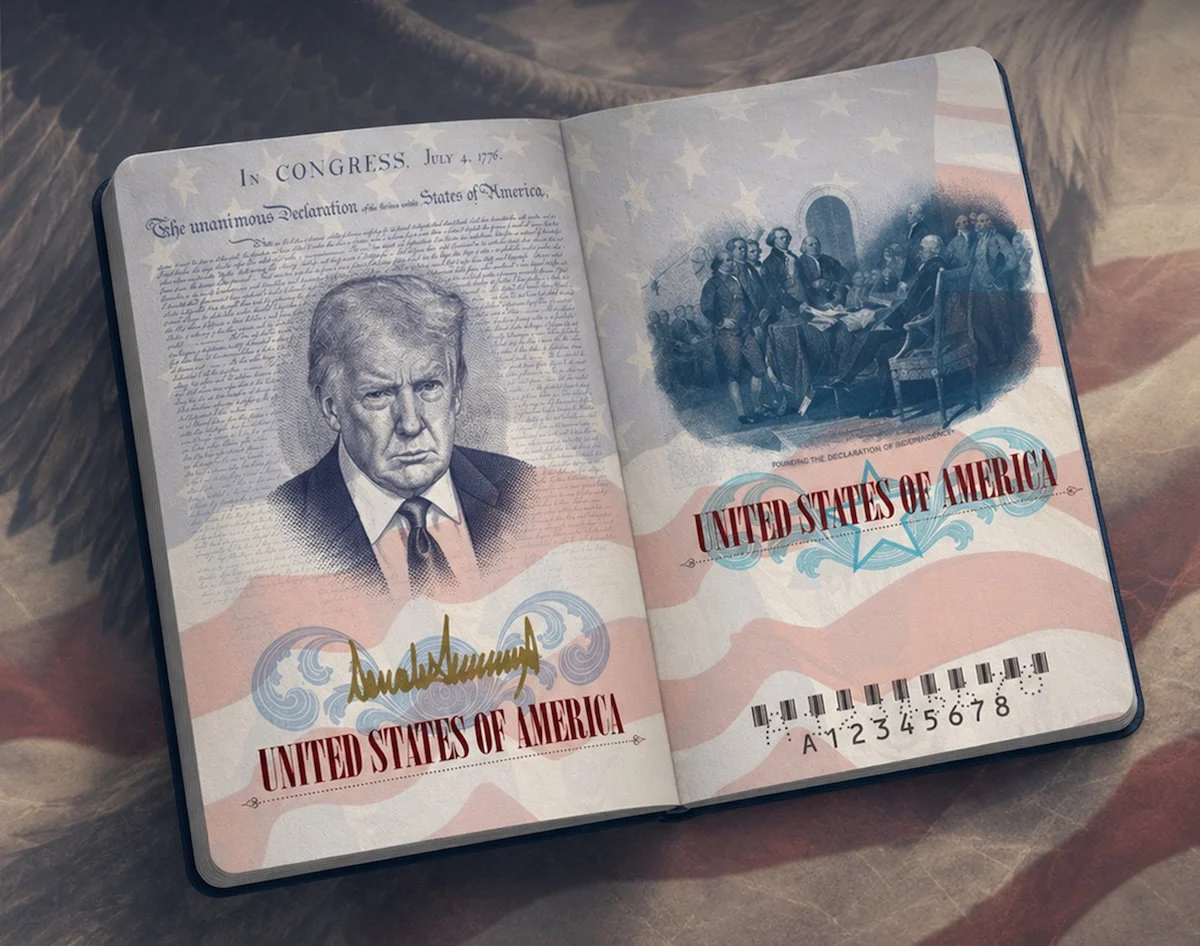
The United States Department of State has officially announced the introduction of a limited-edition passport design intended to commemorate the upcoming 250th anniversary of American independence. This commemorative travel document, which represents a significant departure from traditional American passport aesthetics, features the likeness and signature of President Donald J. Trump. The rollout marks the first time in the history of the United States that a sitting or former president has been featured as a primary visual element within the nation’s official travel credentials. The initiative, timed to align with the lead-up to the 2026 Semiquincentennial, has sparked immediate discussion regarding diplomatic protocol, national symbolism, and the administrative procedures governing the issuance of federal identification.
The new design incorporates several distinct visual and structural changes to both the interior and exterior of the passport booklet. On the inside front cover, the standard imagery has been replaced with a portrait of President Trump. This image is framed by the transcribed text of the Declaration of Independence and an artistic rendering of the American flag. Notably, the President’s signature is featured prominently in gold ink. Subsequent pages continue the historical theme, including a detailed depiction of the Founding Fathers during the signing of the Declaration of Independence in 1776.
The exterior of the passport has also been modified to distinguish it from the standard "Next Generation Passport" (NGP) currently in circulation. The words "United States of America" have been enlarged and repositioned at the top of the front cover. The back cover introduces a new commemorative motif: a "250" emblem centered within a circle of 13 stars, a direct reference to the 1777 version of the American flag. Despite these aesthetic changes, the State Department confirmed that the document maintains all standard biometric security features, including the poly-carbonate data page and embedded electronic chips required for international travel under International Civil Aviation Organization (ICAO) standards.
Administrative Rollout and Availability
The distribution of the commemorative passport is currently restricted by both geography and volume. According to the State Department’s guidelines, the limited-edition design is exclusively available to applicants who appear in person at the Washington Passport Agency in Washington, D.C. This facility primarily handles urgent travel requests and specialized federal appointments. The Department has indicated that this design will serve as the default issuance at this specific location until the limited stock is exhausted.
Crucially, the agency has noted that applicants processing their renewals or new applications at the Washington Passport Agency will not have the option to choose between the commemorative design and the standard blue-cover passport. If an individual applies at this location while the limited edition is in stock, they will receive the Trump-centric design regardless of personal preference. Travelers seeking to avoid the commemorative design are advised to utilize the online renewal system or visit one of the other 25 regional passport agencies or thousands of passport acceptance facilities (such as post offices and libraries) across the country, where the standard design remains the only version being issued.
Historical Context: The U.S. Semiquincentennial
The release of this passport is part of a broader federal effort to mark the 250th anniversary of the signing of the Declaration of Independence, an event colloquially known as the Semiquincentennial. Historically, the United States has used major anniversaries to update national symbols and currency. During the 1976 Bicentennial, the U.S. Mint released special designs for the quarter, half-dollar, and dollar coins, while various federal agencies launched commemorative programs to foster national pride.
However, the inclusion of a political figure on a passport is unprecedented in the American context. Since the mid-20th century, U.S. passport designs have typically focused on neutral national symbols, such as the Great Seal of the United States, American landscapes, and iconic monuments like the Statue of Liberty or Mount Rushmore. The 2007 "American Symbols" passport series featured quotes from various historical figures, including Martin Luther King Jr. and George Washington, but did not include their portraits. The shift toward featuring a current head of state brings the U.S. document closer in style to those of certain constitutional monarchies or nations where the head of state is a central figure in national identity, though even in those cases, the practice is rare for travel documents intended for general citizens.
Official Responses and Political Precedents
The announcement has generated a range of reactions from political analysts and the public. Critics have argued that the passport, as a document representing the state rather than a specific administration, should remain free of partisan or individual-specific imagery. Concerns have been raised about how the document might be perceived at foreign border crossings, particularly in nations with complex diplomatic relations with the current administration.
In response to criticism on social media platforms, the official White House account on X (formerly Twitter) defended the design by drawing parallels to previous commemorative items issued by prior administrations. Specifically, the White House pointed to a commemorative MetroCard issued in Washington, D.C., for the inauguration of President Barack Obama in January 2009. The administration argued that commemorating a president’s role in the nation’s history is a long-standing tradition. Furthermore, the White House shared a post referencing "two kings" in the context of a meeting between President Trump and King Charles III, suggesting that the commemorative design reflects the President’s significant stature on the world stage during this milestone year for the country.
Supporters of the new design view it as a bold assertion of American leadership and a fitting tribute to the president leading the country into its 250th year. They argue that the signature and imagery serve as a "collector’s item" that marks a specific era in American history, much like commemorative coins or stamps.
Technical Specifications and Global Recognition
From a technical standpoint, the State Department assures that the limited-edition passport is a fully functional Type-P (Personal) passport. It utilizes the "Next Generation Passport" technology, which was phased in starting in 2021. This technology includes:
- Polycarbonate Data Page: A sturdy, multi-layered plastic page that contains the user’s personal information and photo, which is laser-engraved to prevent tampering.
- Tactile Features: Raised printing that can be felt by touch, adding a layer of security against forgery.
- Enhanced Images: The "ghost image" and other secondary photos are integrated with advanced inks that react to different light spectrums.
- Updated Artwork: While the Trump-centric version features unique themes, the underlying security inks and watermarks are consistent with the highest global standards.
The State Department has notified the International Air Transport Association (IATA) and foreign customs authorities of the design change to ensure that travelers carrying the limited-edition document do not face delays or questions regarding the authenticity of their credentials. Because the biometric data remains the primary source of verification, the visual changes on the cover and interior pages do not technically alter the document’s validity under international law.
Implications and Analysis
The introduction of the Trump-centric passport raises important questions about the intersection of national identity and political branding. In the United States, the president serves as both the head of government and the head of state. While the head of state role often involves ceremonial and symbolic duties, the placement of a living leader’s image on a primary identification document is a practice more commonly associated with systems where the leader is synonymous with the state itself.
For the State Department, the logistics of a "limited edition" passport present unique challenges. Passports are typically valid for ten years for adults. This means that long after the 250th anniversary celebrations conclude and the current administration ends, these documents will remain in active use globally. This creates a lasting visual legacy of the current era.
Furthermore, the decision to limit issuance to the Washington Passport Agency creates a localized phenomenon. It effectively makes the commemorative passport a "D.C. exclusive," potentially leading to an increase in appointment requests at that specific location from supporters, while simultaneously prompting those who prefer the standard design to seek alternative renewal methods.
As the United States approaches July 4, 2026, the federal government is expected to unveil further commemorative measures. Whether this passport design remains a localized limited edition or is expanded to other agencies will likely depend on public demand and administrative capacity. For now, it stands as one of the most unique and debated commemorative efforts in the history of the U.S. Passport Service, reflecting the current administration’s approach to national symbolism and the celebration of the American story.







Leave a Reply