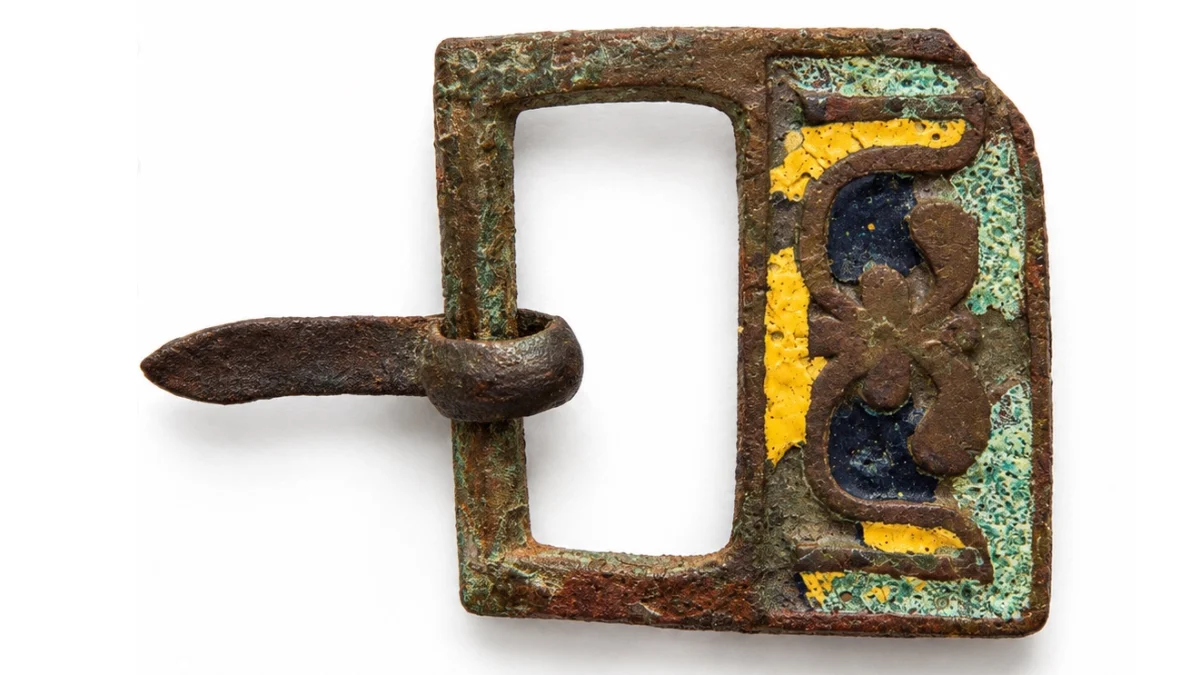
Archaeologists in Ukraine have announced the recovery of an exquisitely crafted, brightly enameled belt buckle dating back nearly two millennia. Unearthed in the picturesque Tsetsyn Forest of southeastern Ukraine, the small yet remarkably preserved artifact provides compelling physical evidence of the complex cultural, economic, and military exchanges that occurred on the fringes of the Roman Empire during late antiquity. The discovery offers modern researchers a rare window into the lives of the nomadic equestrian warriors who roamed the Pontic-Caspian steppe and surrounding borderlands during a period of profound geopolitical transformation.
According to institutional reports and academic statements released by the Bukovinian State Medical University, the artifact was initially discovered by local residents walking within the forested expanse of the Tsetsyn region. Recognizing that the metallic object bore historical significance rather than being ordinary modern debris, the finders acted responsibly by preserving the item and handing it over to regional experts. The artifact was eventually delivered to Dr. Antonii Moisei, a professor at Bukovinian State Medical University and a specialist in the region’s deep history, who initiated formal documentation and analysis of the piece.
Physical Characteristics and Artistic Craftsmanship
Measuring approximately 0.8 inches (2.1 centimeters) on each side, the roughly square metal buckle is distinguished by its intricate polychrome ornamentation. Unlike standard utility fastenings of the era, this piece features vibrant inlays of teal, blue, and yellow enamel. The survival of these vivid mineral-based colors after roughly 1,800 years underground highlights both the high quality of the original metallurgy and the favorable chemical composition of the forest soil that preserved it.
Enameling—the technique of fusing powdered glass to a metallic substrate through high-temperature firing—was a sophisticated skill practiced by artisans across various cultural spheres in antiquity. The presence of multi-colored enamel on a martial accessory of this size suggests it was a luxury item rather than mass-produced military gear. Such pieces were often utilized by tribal elites to display status, wealth, and alliances with neighboring powers, including the sprawling administrative apparatus of Rome.
Chronological Context and the Roman Frontier
To understand the true historical weight of the Tsetsyn Forest find, historians must examine the chronology of the 2nd and 3rd centuries CE. This era corresponds with the height and eventual stabilization of the Roman Empire, a period often referred to by historians as the Pax Romana, though the frontiers were rarely entirely peaceful. The northern and eastern boundaries of Rome’s sphere of influence—stretching toward modern-day Eastern Europe, Ukraine, and the Black Sea basin—were dynamic zones of contact between centralized imperial legions and decentralized tribal confederations.
During this timeframe, various nomadic and semi-nomadic equestrian groups, including Sarmatians, Goths, and other steppe populations, interacted extensively with Roman outposts. These interactions took many forms, ranging from armed conflict and territorial skirmishes to lucrative trade networks, diplomatic treaties, and mercenary service within the Roman military apparatus. The belt buckle discovered in Ukraine likely dates to the late 2nd or early 3rd century CE, placing it squarely within an epoch of intense migration and cultural syncretism across Eastern Europe.
The Role of Nomadic Equestrian Warriors
The designation of the artifact as a possible accessory for a nomadic equestrian warrior stems from both its stylistic attributes and the geographical distribution of similar finds. Equestrian nomads of the Eurasian steppes placed immense cultural value on personal adornment, particularly items associated with horse riding, weaponry, and belt assemblies. In many ancient nomadic cultures, the belt was far more than a functional garment fastener; it was a symbol of social rank, military achievement, and tribal identity. Elaborately decorated belt fittings, plaques, and buckles were frequently buried with elite warriors or passed down through generations as precious heirlooms.
The Tsetsyn Forest, situated in a region historically characterized by rolling hills, dense woodlands, and proximity to major river valleys, served as a natural transit corridor. For centuries, these geographical pathways facilitated the movement of goods, ideas, and human populations between the Carpathian Mountains and the open steppe. A nomadic rider traversing these borderlands would have worn garments secured by robust leather belts embellished with metal fittings designed to withstand the rigors of long-distance mounted travel.
Discovery Timeline and Academic Processing
The path from the forest floor to academic scrutiny followed a standard protocol for accidental archaeological finds in Eastern Europe:
- Discovery: Local residents exploring the Tsetsyn Forest discover the metal object on or near the surface of the soil.
- Surrender: Recognizing the artifact’s antiquity, the finders secure the item and contact academic authorities.
- Transfer: The buckle is handed over to Professor Antonii Moisei at the Bukovinian State Medical University for preliminary analysis.
- Authentication: Specialists evaluate the dimensions, metallurgical composition, and decorative style, confirming an age of approximately 1,800 years.
- Public Disclosure: The university releases a formal statement detailing the find, highlighting its significance for local and regional history.
This chain of custody underscores the vital role that citizen participation plays in safeguarding cultural heritage. Without the intervention of observant citizens, fragile artifacts of this nature risk being lost to illegal antiquities looting or environmental degradation.
Broader Implications and Historical Analysis
The recovery of Roman-era artifacts on the periphery of the empire yields critical data regarding trade routes and cultural diffusion. While the Tsetsyn Forest is located outside the formal provincial borders of Rome, the presence of Roman or Roman-influenced luxury goods demonstrates that commercial and diplomatic tentacles extended far beyond the imperial limes (borders).
Historians categorize these interactions into several distinct mechanisms:
- Gift Diplomacy: Roman emperors and provincial governors frequently distributed luxury items—such as glassware, jewelry, weapons, and refined metalwork—to barbarian chieftains and nomadic leaders to secure peace, ensure safe trade, and buy political loyalty.
- Mercenary Trade: Nomadic warriors who served as auxiliary cavalry units within the Roman military returned to their homelands bearing foreign goods, currency, and stylistic preferences acquired during their service.
- Long-Distance Commerce: A robust network of merchants moved goods across the European continent, exchanging amber, furs, and agricultural products for Mediterranean manufactured items.
The enameled belt buckle serves as a tangible meeting point for these disparate worlds. It bridges the gap between the sophisticated metallurgical workshops of the civilized Mediterranean or provincial manufacturing centers and the rugged, mobile lifestyle of the steppe warrior.
Future Prospects for Archaeological Research in the Region
The Tsetsyn Forest has long been recognized by regional historians as a landscape rich in historical potential, with previous explorations yielding various traces of past human activity spanning multiple epochs. However, accidental finds like the enameled buckle often prompt calls for more systematic, non-destructive archaeological surveys and controlled excavations in the surrounding area.
While a single belt buckle cannot rewrite the history of Eastern Europe, it acts as a crucial puzzle piece. Archaeologists hope that continued collaboration between academic institutions, regional museums, and local communities will lead to the identification of related sites—perhaps seasonal camps, burial mounds, or settlement traces—that can provide a broader context for the individual who once wore this colorful accessory.
As analysis of the artifact continues, researchers plan to conduct non-invasive metallurgical testing to determine the exact chemical composition of the bronze or brass substrate and the mineral components of the enamel. Such scientific data can frequently pinpoint the specific manufacturing region or workshop responsible for an item’s creation, shedding even brighter light on the complex socioeconomic networks that bound the ancient world together across vast distances.