Against the backdrop of shifting global financial landscapes, mounting economic pressures, and critical reductions in bilateral aid, the World Health Organization (WHO) and the African Union (AU) Commission have officially renewed their longstanding strategic partnership. The formal signing of an updated Memorandum of Understanding (MoU) took place on the sidelines of the 78th World Health Assembly in Geneva, Switzerland. This landmark agreement represents a decisive recalibration of multilateral cooperation, designed to fortify health security, accelerate universal health coverage (UHC), and foster sustainable development across the African continent.
The renewed accord arrives at a critical juncture for public health worldwide. As traditional funding streams dwindle and international development assistance faces unprecedented contractions, African nations are increasingly compelled to pivot away from aid dependency toward localized resilience and self-reliance. By reinforcing the institutional architecture that links global normative guidance with regional policy implementation, the updated MoU positions the African Union—specifically its Department of Health, Humanitarian Affairs, and Social Development—at the vanguard of the continent’s health sovereignty initiatives.
A Defining Moment for Primary Health Care and Regional Leadership
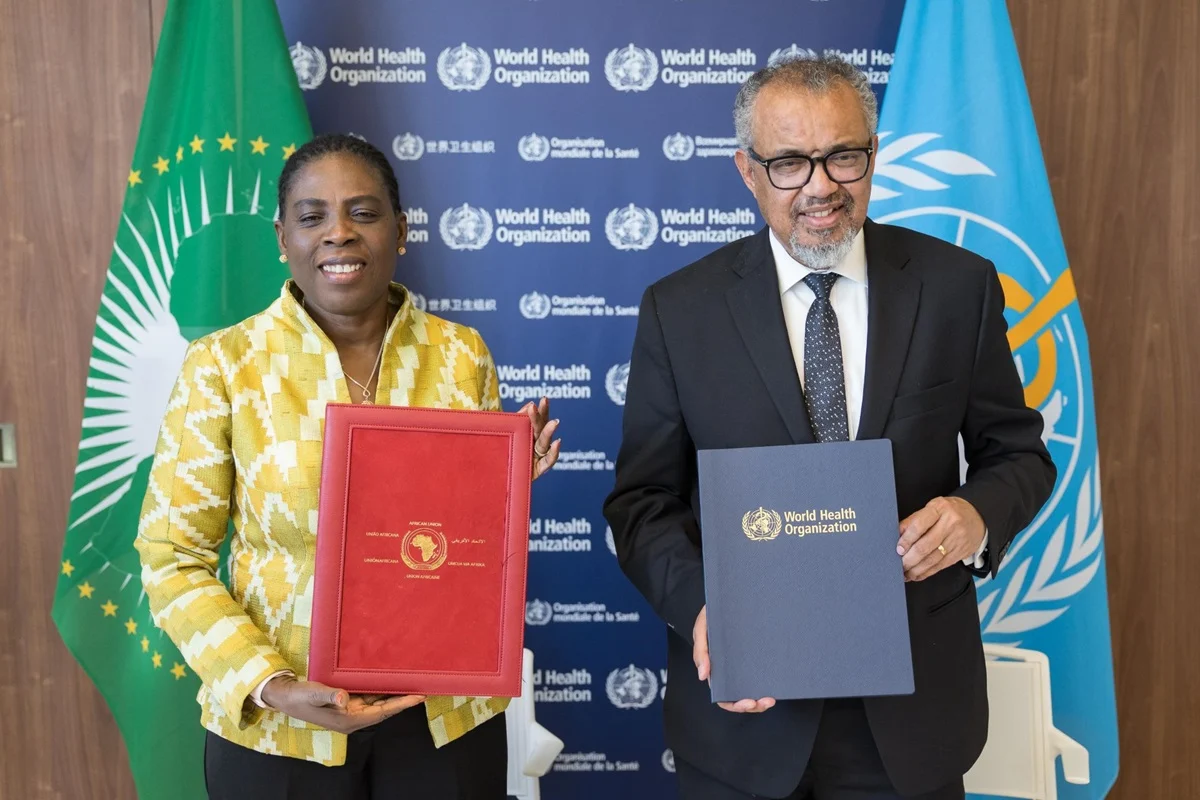
The signing ceremony in Geneva was attended by high-ranking dignitaries from both organizations. Her Excellency Ambassador Amma Adomaa Twum-Amoah, Commissioner for Health, Humanitarian Affairs, and Social Development, executed the agreement on behalf of His Excellency Mahmoud Ali Youssouf, Chairperson of the African Union Commission. They were joined by Dr. Tedros Adhanom Ghebreyesus, Director-General of the World Health Organization.
The ceremony underscored a shared realization: the traditional models of international health assistance are evolving, requiring a more integrated, country-led approach. Commissioner Twum-Amoah articulated this paradigm shift during her address, stressing that the continent must fundamentally alter its financial and strategic planning.
"This Agreement marks a new chapter in AU-WHO cooperation," Commissioner Twum-Amoah stated. "By working together more closely, we can better respond to the health needs of our populations and ensure that no one is left behind. The African Union values WHO’s central and leading role in global health and looks forward to deepening this strategic partnership in support of our shared goals. We need to move from budgeting for survival to planning for health sovereignty."
This sentiment captures the core philosophy driving the updated framework. For decades, health sector financing in many low- and middle-income African countries has relied heavily on volatile external donations, philanthropic grants, and bilateral assistance programs. While these funds have historically saved millions of lives—particularly in the fight against infectious diseases such as HIV/AIDS, tuberculosis, and malaria—they have also created systemic vulnerabilities. When donor priorities shift or economic downturns occur in Western capitals, healthcare delivery on the ground in Africa often faces immediate disruption. The new MoU seeks to address these systemic flaws by embedding self-reliance and domestic resource mobilization into the DNA of regional health planning.
Chronology of Collaboration: Building on the 2019 Framework
To fully understand the significance of the Geneva agreement, it is necessary to examine the evolutionary trajectory of the partnership between the two bodies. While informal cooperation and ad-hoc collaborations have existed for decades, the modern institutional relationship was codified significantly in October 2019, when the WHO and the AU signed a comprehensive Memorandum of Understanding.
That 2019 agreement sought to streamline coordination between WHO regional offices—specifically the WHO Regional Office for Africa (AFRO) and the WHO Regional Office for the Eastern Mediterranean (EMRO)—and the various technical departments of the African Union, including the Africa Centres for Disease Control and Prevention (Africa CDC). Over the subsequent five years, that framework was tested by some of the most profound public health crises in modern history, most notably the COVID-19 pandemic, successive outbreaks of Ebola virus disease, and persistent resurgences of cholera, measles, and emerging zoonotic threats.
The COVID-19 pandemic, in particular, exposed the stark inequities in global health architecture. African nations initially faced severe bottlenecks in accessing diagnostics, personal protective equipment (PPE), and vaccines, largely due to supply chain monopolies and a reliance on external manufacturing hubs. This crisis catalyzed a fierce determination within the African Union to reclaim control over its health security. The subsequent establishment of the Partnerships for African Vaccine Manufacturing (PAVM) and the strengthening of the Africa CDC as an autonomous public health agency marked crucial milestones in this journey toward independence.
Recognizing that the 2019 agreement required updating to reflect these post-pandemic realities, negotiations began in earnest late last year. The newly minted 2025 MoU builds directly upon the foundations laid six years ago, but introduces modernized mechanisms for institutional alignment, digital health integration, regulatory harmonization, and crisis response. Furthermore, it explicitly acknowledges the elevated global stature of the African Union, following its historic induction as a permanent member of the G20 in late 2023. This diplomatic elevation gives the AU a direct platform to influence global macroeconomic and health governance, making its technical partnership with the WHO more strategic and mutually reinforcing than ever before.
The Threat of Bilateral Aid Cuts and the Imperative of Self-Reliance
The urgency surrounding the new agreement cannot be separated from the current macroeconomic climate. In recent months, several traditional donor nations have announced substantial reductions in their foreign aid budgets, driven by domestic fiscal pressures, inflationary challenges, and shifting political landscapes. These contractions pose an existential threat to numerous health programs across the developing world, where external financing often covers a significant percentage of recurrent operational costs for basic healthcare delivery.
Dr. Tedros Adhanom Ghebreyesus did not mince words when addressing this precarious financial reality during the signing ceremony.
"This renewed agreement comes at a critical time, as cuts to bilateral aid imperil the health of millions in Africa," Dr. Tedros warned. "It reflects our determination to translate our partnership into tangible results for the people of Africa, and support countries to leave behind the era of aid dependency and transition to sustainable self-reliance. We are proud to stand with the African Union in driving forward the health priorities of the continent."
The WHO Director-General’s remarks highlight a sobering reality for public health technocrats: relying on external charity is no longer a viable long-term strategy for achieving universal health coverage. The transition toward sustainable self-reliance requires African governments to increase domestic budgetary allocations to health—most notably honoring the Abuja Declaration targets, which call for allocating at least 15% of annual national budgets to the improvement of the health sector.
At the same time, the partnership emphasizes the importance of strengthening regulatory frameworks through the African Medicines Agency (AMA), boosting local pharmaceutical production to reduce reliance on imported medical products, and establishing robust supply chain networks that can withstand future geopolitical and economic shocks.
Strategic Pillars of the Renewed Agreement
While the administrative details of the MoU cover a broad spectrum of cooperative activities, the framework is structured around several critical operational focus areas. Although the operational text outlines five core functional domains, the overarching architecture is designed to ensure seamless technical synergy between WHO normative guidance and AU policy execution.
- Health Security and Emergency Preparedness: Enhancing early warning systems, cross-border surveillance, and joint outbreak response capabilities. Building upon the lessons of COVID-19 and recent viral hemorrhagic fever outbreaks, the partnership aims to empower regional institutions like the Africa CDC to rapidly deploy countermeasures and coordinate technical assistance.
- Universal Health Coverage and Primary Health Care: Supporting member states in reforming their primary health care systems to deliver equitable, comprehensive, and affordable care at the community level. This includes addressing structural workforce shortages, improving health infrastructure, and integrating traditional medicine where appropriate.
- Regulatory Harmonization and Local Production: Accelerating the operationalization of the African Medicines Agency (AMA) to streamline drug approvals, combat substandard and falsified medical products, and create a predictable regulatory environment conducive to scaling up local manufacturing of vaccines, therapeutics, and diagnostics.
- Data, Digital Health, and Research: Strengthening health information systems, leveraging digital health innovations, and aligning research agendas to address Africa-specific disease burdens. This pillar emphasizes evidence-based policymaking and the secure management of health data across borders.
- Sustainable Financing and Health Economics: Assisting governments in developing innovative domestic financing models, improving public financial management in the health sector, and reducing out-of-pocket expenditures that currently impoverish millions of families across the continent.
Implications for Global Health Governance
The formalization of this updated MoU has profound implications not just for Africa, but for the architecture of global health governance as a whole. For decades, international health priorities were largely dictated by donor capitals, philanthropic foundations headquartered in the Global North, and multilateral agencies acting with limited input from regional bodies.
The rising influence of the African Union, coupled with its institutional partnership with the WHO, signals a structural shift toward plurilateralism and true regional ownership. By speaking with a unified voice on the global stage—amplified by its G20 seat—the African Union is successfully redefining the terms of international engagement. Rather than acting merely as recipients of aid and technical assistance, African institutions are increasingly setting the agenda, defining their own epidemiological priorities, and demanding equitable partnerships based on mutual accountability.
For the World Health Organization, this partnership is equally vital. As the directing and coordinating authority on international health within the United Nations system, the WHO relies heavily on regional coalitions to translate global health resolutions into localized action. By cementing its alliance with the AU, the WHO ensures its normative guidance remains deeply anchored in the political and social realities of the fastest-growing continent on earth.
Looking Ahead: Implementation and Accountability
As the dignitaries departed Geneva and the 78th World Health Assembly drew to its conclusion, the true test of the renewed Memorandum of Understanding shifted from diplomatic pageantry to practical implementation. Officials from both the AU Commission and the WHO have stressed that robust monitoring and evaluation mechanisms will be put in place to track progress across the designated cooperation areas.
Regular joint steering committee meetings, transparent reporting frameworks, and continuous dialogue between technical working groups will be essential to ensure that the commitments made on paper translate into measurable improvements in health outcomes for ordinary citizens. Whether it is a mother accessing maternal healthcare in a rural clinic, a child receiving routine immunizations without financial hardship, or a regional laboratory detecting a novel pathogen before it becomes a pandemic, the ultimate measure of this partnership will be felt on the ground.
In an era defined by economic uncertainty and complex geopolitical tensions, the renewed alliance between the World Health Organization and the African Union offers a beacon of pragmatic multilateralism. By anchoring their cooperation in the pursuit of health sovereignty, self-reliance, and universal coverage, both organizations are laying the groundwork for a more resilient, equitable, and secure health future for the African continent and the world.
For further information and media inquiries, please contact:
- Professor Julio Rakotonirina | Director | Department of Health, Humanitarian Affairs and Social Development | African Union Commission | E-mail: [email protected] | Media Contact: Mr. King David Cartey (African Union Commission)
- Ms. Stéphanie Seydoux | Director | DG Envoy for Multilateral Affairs | World Health Organization | E-mail: [email protected] | Media Contact: WHO Media Team (World Health Organization)