
The World Health Organization (WHO) Director-General, Dr. Tedros Adhanom Ghebreyesus, successfully completed the initial phase of a high-stakes, two-day state visit to the Hashemite Kingdom of Jordan. The visit serves to underscore the robust, multifaceted partnership between the global health agency and the Jordanian government, placing a sharp focus on universal health coverage (UHC), comprehensive mental health frameworks, and critical humanitarian health actions in a region profoundly affected by protracted conflict.
Throughout the first day of engagements, Dr. Tedros’s itinerary highlighted Jordan’s exemplary role as a regional humanitarian anchor, providing sanctuary and medical care to millions of displaced individuals. The visit also featured notable participation from Prince Harry, the Duke of Sussex, and Meghan, the Duchess of Sussex, who joined the WHO delegation in their official capacities as co-founders of Archewell Philanthropies to champion mental health integration and emergency health equity.
A Royal Audience and Strategic Health Priorities
The cornerstone of the day’s diplomatic schedule was an official audience with His Majesty King Abdullah II. This high-level dialogue underscored Jordan’s sustained leadership in positioning health security and universal access as fundamental pillars of both national stability and international cooperation.
Discussions between Dr. Tedros and King Abdullah II centered heavily on bolstering national health systems, expanding equitable access to primary care, and securing sustainable international financing for ongoing emergency health operations across the Middle East. Particular attention was devoted to the plight of the Palestinian population, specifically addressing the coordinated medical evacuation of critically ill and injured patients from Gaza into Jordanian medical facilities. Furthermore, the leaders reviewed the expansive healthcare demands generated by Jordan’s hosting of over three million refugees, primarily originating from Syria and Gaza.
Dr. Tedros commended the Jordanian monarch for his unwavering political will and moral clarity. "I wish to express my appreciation to His Majesty King Abdullah II for his commitment to advancing universal health coverage," Dr. Tedros stated. "I also extend my thanks to His Majesty and the people of Jordan for their solidarity and generosity in providing health services to more than three million refugees, primarily from Gaza and Syria, who are living in the country."
The WHO chief explicitly praised the King’s visionary humanitarian initiatives, most notably the "Medical Corridor" framework. This strategic undertaking has proven instrumental in facilitating the transfer and treatment of pediatric cancer patients and children suffering from severe conflict-related trauma out of the blockaded Gaza Strip. "Jordan continues to show the world what it truly means to put health and humanity first," Dr. Tedros added.
Witnessing Humanitarian Realities on the Ground
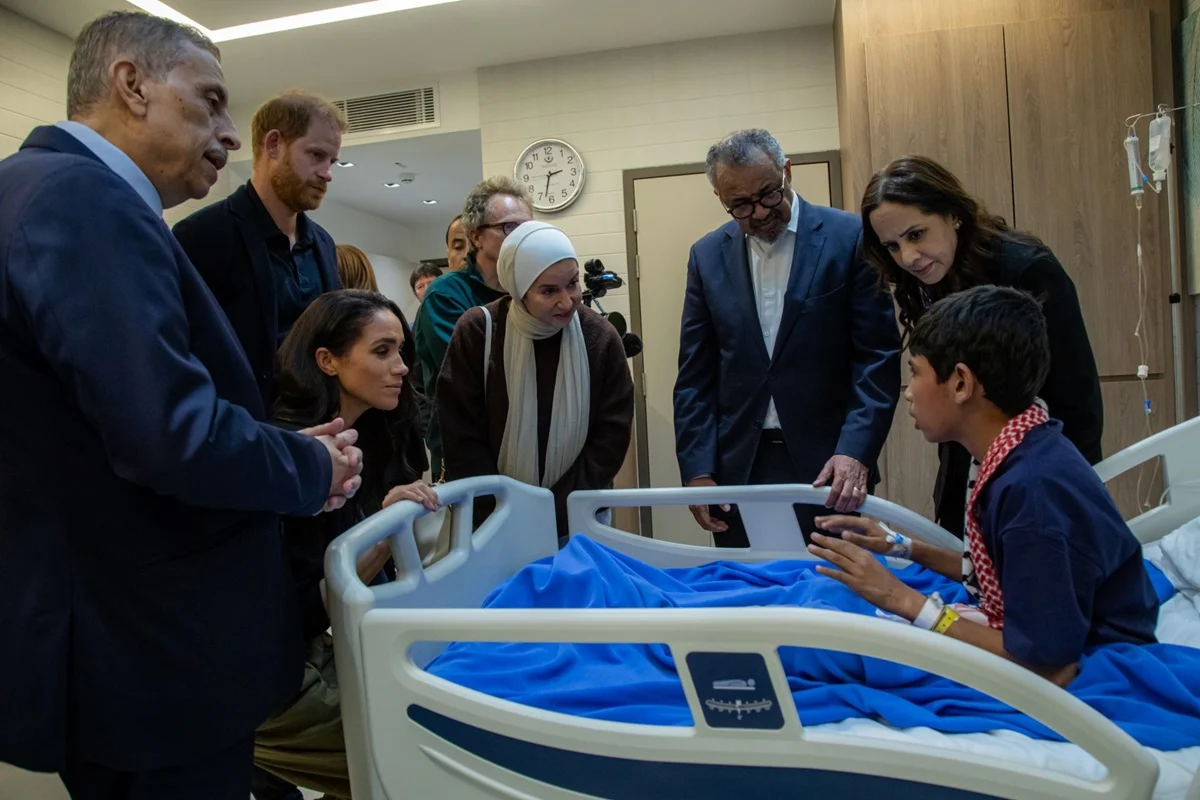
Moving beyond diplomatic chambers, Dr. Tedros transitioned from high-level policy discussions to direct engagement with frontline medical personnel and patients. Accompanied by members of the WHO delegation, the Director-General visited a specialized, WHO-supported hospital facility in Jordan dedicated to treating children evacuated from Gaza.
During the hospital walkthrough, Dr. Tedros interacted directly with young patients, their families, and the multidisciplinary teams of doctors, nurses, and specialists delivering intensive care. These frontline workers manage complex trauma injuries, pediatric oncology cases, and other life-threatening medical conditions under immense operational pressure.
This field visit served to underscore the indispensable nature of the Jordan-facilitated medical evacuation corridor. Public health analysts note that as traditional healthcare infrastructure in conflict zones collapses, secondary and tertiary referral pathways like the one maintained by Jordan become absolute lifelines. Dr. Tedros emphasized that sustained, predictable international financial and logistical support is non-negotiable to keep these corridors open and functional for vulnerable populations.
High-Level Financing Roundtable and Partner Coordination
Recognizing that humanitarian goodwill must be matched by structural financial backing, Dr. Tedros convened a strategic, high-level roundtable meeting. The gathering brought together key international health partners, donor governments, United Nations agencies, and philanthropic organizations.
The primary objective of the roundtable was to align funding priorities regarding the strengthening of Jordan’s domestic health system while simultaneously underwriting ongoing regional humanitarian health operations. Discussions prioritized the scaling up of community-level mental health services and the development of sustainable financing models for nations bearing disproportionate responsibilities in hosting large refugee populations.
Participants at the roundtable engaged in substantive debates concerning aid efficiency, burden-sharing among donor nations, and the integration of emergency humanitarian response frameworks into long-term national development plans. Dr. Tedros welcomed the concrete commitments voiced by international partners, stressing that investing in Jordan’s healthcare infrastructure yields high returns for regional stability and global health security.
Bilateral Negotiations on Primary Health Care and Mental Health Integration
In addition to multilateral forums, the WHO Director-General held intensive bilateral negotiations with Jordan’s Minister of Health. These talks drilled down into the mechanics of institutionalizing universal health coverage through a robust primary healthcare delivery model.
Jordan has garnered international acclaim for its progressive integration of mental health services into routine primary healthcare clinics. This systemic reform ensures that psychological support is not treated as a luxury or a specialized add-on, but rather as an essential, accessible component of daily medical practice.
The integration effort has been closely supported by the WHO through the Director-General’s Special Initiative for Mental Health. Public health experts observe that integrating mental health into primary care significantly reduces social stigma, lowers barriers to treatment, and provides cost-effective interventions for populations experiencing the compounding psychological traumas of displacement and economic hardship.
Archewell Philanthropies and the Global Advocacy for Mental Health
A distinctive dimension of the state visit was the active participation of Prince Harry, Duke of Sussex, and Meghan, Duchess of Sussex. Operating through Archewell Philanthropies, the couple has maintained a long-standing, collaborative relationship with the WHO, supporting diverse global health campaigns ranging from equitable COVID-19 vaccine distribution to specialized emergency medical evacuations and mental health destigmatization initiatives.
Prince Harry engaged extensively in discussions highlighting the imperative of investing in psychological resilience across communities and emergency settings. His advocacy specifically spotlighted the mental health vulnerabilities of demographic cohorts frequently overlooked in crisis responses—namely men, adolescents, and young children.
Dr. Tedros acknowledged the profound impact of this high-profile partnership: "I want to thank our partners, including Prince Harry, Duke of Sussex and Meghan, Duchess of Sussex, whose commitment to mental health and humanitarian action has helped bring visibility, resources and hope to some of the world’s most vulnerable communities. Their collaboration is helping to advance WHO’s mission to ensure health for all."
Articulating his perspective on the ground in Amman, Prince Harry remarked: "It is an honour to join the Director-General of the World Health Organization in Jordan, a country that is leading by example in compassion, resilience and innovation. Through our work with Archewell Philanthropies, my wife and I have seen first-firsthand the impact of WHO’s efforts to support mental health and deliver life-saving care in emergencies."
The Duke of Sussex further emphasized the inextricable link between psychological recovery and enduring geopolitical stability. "We remain deeply committed to advancing awareness, reducing stigma and expanding access to mental health support for all those affected by conflict and crisis. Mental health is fundamental to recovery, dignity and long-term peace, and we are proud to stand with WHO and partners around the world to make it a global priority," he stated.
Agenda for the Concluding Day of the State Visit
As the state visit transitions into its second and final day, Dr. Tedros’s schedule remains rigorous and multifaceted. The itinerary includes a specialized visit to Jordan’s National Center for Rehabilitation of Addicts, an institution receiving technical and strategic support from the WHO. The Center is recognized for pioneering integrated medical, psychological, and social intervention models to address substance use disorders within the region.
Furthermore, the Director-General is slated to meet with prominent community leaders and local women’s advocacy networks, including representatives from the Jordanian Hashemite Fund for Human Development (JOHUD). These grassroots engagements are designed to evaluate community-led health promotion and resilience initiatives.
The itinerary will also feature a high-level briefing and tour at the renowned King Hussein Cancer Center (KHCC). Discussions at KHCC will focus on cutting-edge advancements in regional oncology care, specialized training programs for medical professionals across the Middle East, and the expansion of cross-border institutional partnerships.
The state visit will officially conclude with a series of operational debriefings with humanitarian logistics partners. These final sessions are intended to reinforce Jordan’s irreplaceable strategic positioning as an indispensable regional logistics and medical hub, capable of sustaining emergency healthcare delivery even amidst unprecedented geopolitical turbulence.
Broader Implications and Contextual Analysis
Public health analysts evaluating Dr. Tedros’s mission to Amman emphasize that the visit carries profound systemic implications extending far beyond Jordan’s borders. By spotlighting Jordan’s dual capacity to advance sophisticated structural reforms—such as universal primary healthcare and mental health mainstreaming—while simultaneously managing severe exogenous shocks like refugee influxes and medical evacuations from conflict zones, the WHO is holding up the Kingdom as a global benchmark.
In an era defined by compounding humanitarian emergencies, the international community faces a growing crisis of donor fatigue and stretched aid budgets. The high-level financing roundtable convened during this visit represents a tactical effort by the WHO to mobilize targeted investments, reminding global donors that supporting frontline host nations like Jordan is not merely an act of charity, but a strategic investment in international health security.
Ultimately, the diplomatic alignment between the WHO, the Jordanian Monarchy, and influential philanthropic entities like Archewell establishes a collaborative blueprint for future crisis management. As the region continues to navigate deep structural instabilities, the insights gleaned and partnerships solidified during this state visit will directly inform global strategies for equitable healthcare access, refugee health protection, and the destigmatization of mental healthcare in fragile states.






Leave a Reply