
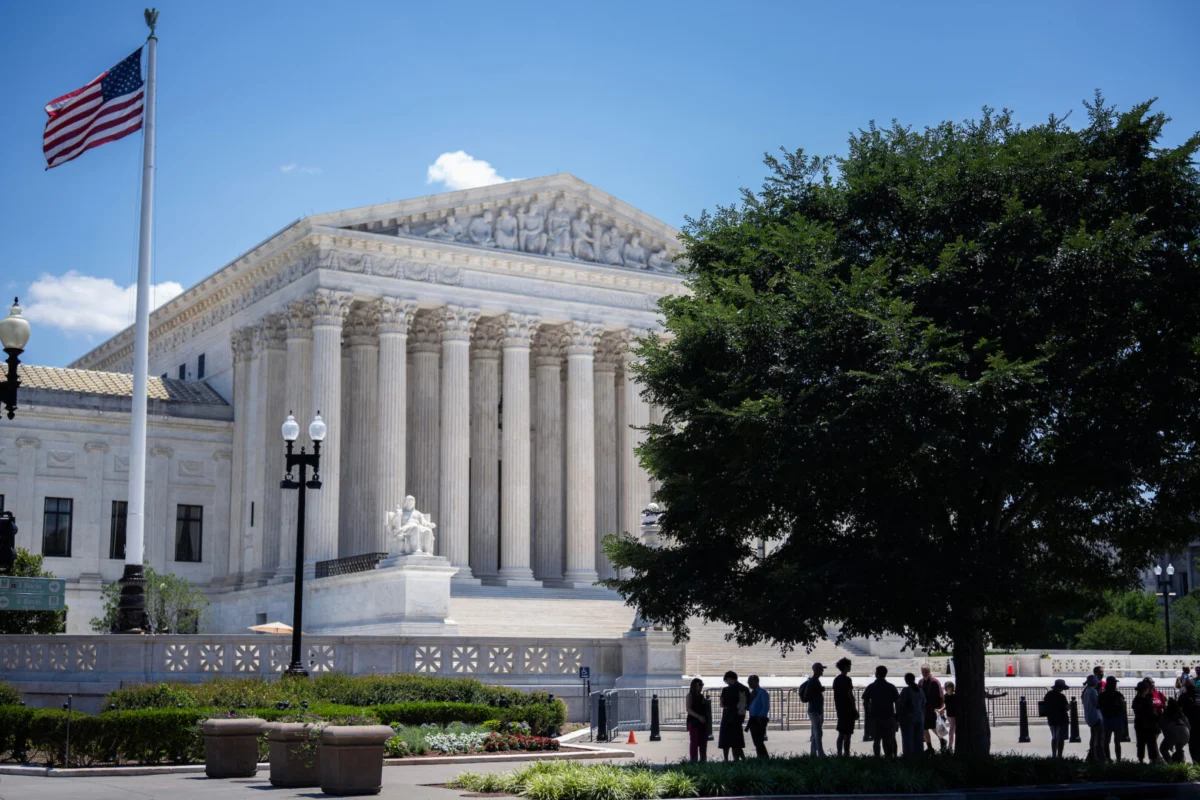
The Supreme Court of the United States issued a definitive order on Friday that effectively shelved Missouri’s attempt to implement a contentious 2025 congressional map, mandating instead that the state proceed with the electoral boundaries established in 2022. This high-stakes judicial intervention comes as the state faces an ongoing election cycle, with the Court emphasizing that any late-stage shift in district lines would inevitably trigger widespread confusion and administrative failure. The unsigned ruling, which contained no noted dissents, explicitly cautioned lower courts against further attempts to force the adoption of the 2025 lines, citing the potential for irreparable electoral instability.
A Chronology of Legal Flux
The legal battle over Missouri’s electoral map has been defined by a rapid succession of conflicting rulings across state and federal jurisdictions. The controversy centers on a map passed by the Republican-controlled state legislature, which sought to redraw districts in a manner that would significantly bolster GOP influence in the state’s congressional delegation.
In September, the Missouri Supreme Court ruled that the 2025 map could not be utilized for the November general election because a citizen-led petition effort, organized by the group People Not Politicians Missouri, was currently challenging the adoption of those lines via a potential ballot measure. Consequently, the state high court ordered that the 2022 boundaries remain in effect. Following this, a federal lawsuit brought by Republican congressional candidate Bob Onder and other plaintiffs challenged this directive, arguing that the state was constitutionally required to use the 2025 lines because the August primaries had already been conducted under those boundaries.
Judge Stephen R. Clark of the U.S. District Court for the Eastern District of Missouri initially sided with the plaintiffs, agreeing that the primary election created a requirement for the 2025 map to be used in the general election. However, the U.S. Supreme Court paused that ruling pending further review. On Monday, a three-judge panel of the U.S. Court of Appeals for the 8th Circuit reversed course, siding with the district court and insisting that the 2025 map must be used. Friday’s Supreme Court order finally overruled that appellate decision, citing the proximity of the general election and the impossibility of conducting a fair and orderly vote under the disputed 2025 lines.
The Stakes of the Redistricting Map
The 2025 map, which served as the primary catalyst for this litigation, was designed to reshape the political landscape of Missouri’s House delegation. Under these lines, the Republican Party was projected to secure a firm majority in seven of the state’s eight congressional districts. Perhaps most notably, the map targeted the 5th District, currently represented by Democrat Emanuel Cleaver II.
Data from Inside Elections with Nathan L. Gonzales indicates that the 2025 redraw would have transformed the 5th District from a reliably Democratic stronghold—which supported Kamala Harris by a 23-point margin in the 2024 election cycle—into a district that would have favored Donald Trump by 18 points. This drastic 41-point swing underscored the partisan nature of the dispute and motivated both the Republican efforts to enforce the new lines and the grassroots opposition from People Not Politicians Missouri.
Arguments from the Litigants
The legal arguments presented to the Supreme Court highlighted the tension between administrative feasibility and the principle of voter continuity. State officials, caught between conflicting judicial orders, warned that any last-minute shift to the 2025 map would effectively prevent the state from meeting federal deadlines for the distribution of mail-in ballots. Officials noted that if the state were forced to revert to the 2025 map at this late stage, it would trigger a cascade of eligibility challenges regarding candidates who had filed to run for office based on the 2022 map.
“Yet the honest truth is that — regardless of what this Court does — Missouri will not be able to run an orderly 2026 General Election,” state officials stated in their filing, while noting that they would prefer to move forward under the 2025 lines if the judiciary allowed it.
Conversely, the plaintiffs, led by Bob Onder, argued that the transition back to the 2022 map infringed upon the rights of voters who participated in the August primaries. They contended that there must be a “continuity of constituency” between the primary and the general election. Their filing argued that more than 1.4 million Missourians were effectively disenfranchised from voting for the candidates who would appear on their November ballots, and that over 250,000 voters had cast ballots for congressional candidates who would now be unable to represent them due to the reverted map.
Judicial Reasoning and the Prevention of Chaos
The Supreme Court’s decision to prioritize administrative stability over the theoretical arguments of the plaintiffs is a recurring theme in the Court’s "Purcell principle"—a legal doctrine that discourages federal courts from interfering with state election laws in the immediate lead-up to an election.
In its ruling, the Court stated, “At this late date, ordering reversion to the 2025 map in the midst of an ongoing election would usher in electoral chaos.” The Court further defined this chaos as a two-fold problem: confusion regarding the logistics of how to conduct the election and deep-seated uncertainty regarding the legal rules that would govern the final certification of the results. By reinstating the 2022 boundaries, the Court aimed to provide a definitive framework that election administrators could follow to minimize the risk of a botched election cycle.
Implications for Future Redistricting Efforts
This case highlights the growing intersection between state-level ballot initiatives and federal redistricting litigation. As political parties continue to use redistricting as a tool for partisan advantage, the ability of grassroots organizations to use state-level petitions to delay or block those maps has become a critical feature of American election law.
The Supreme Court’s directive to lower courts—urging them not to order the use of the 2025 lines again—signals an attempt to close the door on further litigation regarding these specific boundaries for the current cycle. For Missouri, the immediate consequence is a return to the status quo of 2022, ensuring that the November elections proceed under known, established boundaries. However, the case leaves unresolved broader questions about how states should navigate the transition from a primary election held under one set of rules to a general election held under another, particularly when those rules are subject to ongoing constitutional challenges.
As the state prepares for the final push toward the general election, the focus for officials has now shifted from legal battles to the logistics of managing a voter base that has been subjected to significant uncertainty. The decision serves as a stark reminder that while the judiciary is the ultimate arbiter of constitutional questions, it is also constrained by the practical realities of election administration. For Missourians, the uncertainty surrounding the congressional map has concluded, but the political impact of the underlying redistricting debate is likely to resonate well beyond the 2026 election cycle, potentially fueling further legislative action when the next session of the Missouri General Assembly convenes.






Leave a Reply