
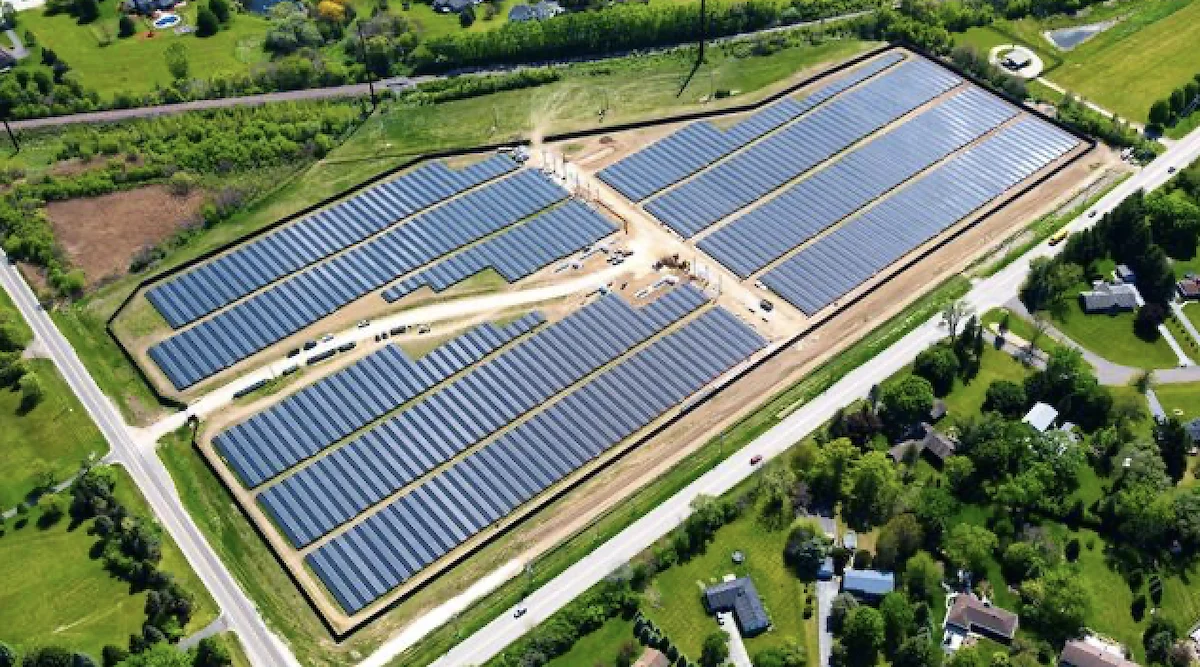
The transition toward renewable energy is increasingly hampered by the physical realities of land scarcity and complex regulatory landscapes. As demand for solar power surges, developers are encountering a "goldilocks" problem: large tracts of suitable, flat, and non-contested land are becoming difficult to secure, while urbanized areas often lack the acreage required for conventional utility-scale arrays. A breakthrough in the city of Elgin, Illinois, however, signals a shift in how developers approach these constrained environments. The commissioning of the 11-megawatt (DC) Bowes Solar array demonstrates that through technological innovation and strategic community integration, even irregularly shaped, encumbered land can be transformed into high-yield power infrastructure.
The Bowes project, spearheaded by the renewable energy firm Cultivate Power, occupies a 22-acre site that was previously deemed unsuitable for conventional development. Wedged between residential subdivisions and intersected by high-voltage power lines and active train tracks, the site presented a logistical puzzle. Furthermore, the presence of protected wetlands in the parcel’s corner restricted the usable footprint, effectively limiting the scope for traditional horizontal racking configurations.
The Technical Evolution of Land Usage
To overcome these limitations, Cultivate Power utilized a high-density, software-enabled racking system designed by Planted Solar. Conventional solar development typically requires five to seven acres of land for every megawatt-peak (MWp) of capacity. Under these standard metrics, an 11-megawatt project would typically demand between 55 and 77 acres. By utilizing the Planted Solar system, which requires only approximately two acres per MWp, Cultivate Power was able to achieve the desired capacity on a footprint roughly one-third the size of a standard installation.
This density is achieved through a combination of proprietary structural design and terrain-following capabilities. Whereas traditional racking systems often require extensive site grading to create a perfectly level plane—a process that is both environmentally disruptive and prohibitively expensive—the Planted Solar system can accommodate slopes of up to 27 percent. This allows developers to work with the existing topography rather than attempting to reshape the landscape. In the case of the Bowes project, this meant dividing the installation into two distinct arrays, maximizing the irregular footprint while maintaining necessary setbacks from residential zones and protected wetlands.
A Timeline of Development and Integration
The development of the Bowes project followed a rigorous multi-year timeline characterized by extensive local engagement and technical pre-planning. While the final commissioning occurred recently, the groundwork for the project began with a site assessment that factored in both the physical constraints of the Elgin parcel and the socioeconomic needs of the surrounding municipal area.
Following the initial feasibility study, Cultivate Power engaged in a series of community-focused consultations. These sessions were pivotal in navigating potential NIMBY (Not In My Backyard) opposition. By presenting a design that prioritized low-profile racking—ensuring the array remains invisible from the street via opaque fencing and perimeter screening—the developers mitigated concerns regarding aesthetic impact. The project reached its construction phase following the successful navigation of Illinois’s complex utility permitting processes, integrating the facility into the Commonwealth Edison (ComEd) grid.
Economic Implications for Local Ratepayers
The Bowes project serves as a model for "community solar," a sector defined by its ability to provide direct financial relief to local residents who might otherwise be unable to install rooftop solar panels. This is particularly vital for renters and households in low-to-moderate income (LMI) brackets.
The data surrounding the project’s economic impact is significant. According to reports, the array is designed to reduce energy charges for subscribers by approximately 20 percent. The distribution model, managed through ComEd, encompasses 580 households, as well as municipal entities including two towns, three small businesses, and a local church. Over the next 40 years, it is estimated that the collective savings for these subscribers will reach $13.9 million.
Beyond direct rate reductions, the facility acts as a consistent revenue generator for the local government. Property tax payments generated by the site are projected to total $2.1 million over the next four decades. These funds are earmarked for local school districts and essential municipal services, effectively turning a "dead" piece of land—previously hindered by environmental and structural barriers—into a long-term fiscal asset for the city of Elgin.

Broader Industry Implications: Rural vs. Urban
While the Elgin project highlights the success of high-density solar in urban settings, the technology holds broader implications for rural energy strategy. Cultivate Power’s equity investor, Generate Capital, has identified significant potential for applying these high-density techniques to agricultural land.
In regions such as Mercer County, Illinois, where the Goldenrod Solar project was recently commissioned, the goal is to provide stable, supplemental income to landowners without compromising the viability of the surrounding farmland. The Goldenrod project, a 5-megawatt installation, serves 850 subscribers, with 55 percent of that base consisting of LMI households.
The convergence of urban space-saving technology and rural land-management goals marks a maturation of the solar industry. Historically, solar developers relied on massive, flat, clear-cut fields. Today, the focus is shifting toward "precision solar"—projects that adapt to the land rather than demanding the land adapt to the project.
Community Engagement as a Development Pillar
The success of the Bowes project underscores the necessity of corporate social responsibility (CSR) in renewable energy infrastructure. Beyond energy savings and tax revenue, Cultivate Power has made targeted contributions to local institutions, including Elgin Community College and Food for Greater Elgin. By fostering partnerships with local stakeholders, developers can transform a project from a purely commercial entity into a recognized community asset.
This approach addresses a critical hurdle in modern energy development: community skepticism. When projects are framed not just as infrastructure, but as contributors to food security, education, and local economic resilience, the threshold for public approval is significantly lowered. The inclusion of organizations like the Friends of the Fox River and the Evolve Foundation in the Bowes project’s outreach strategy reflects a shift in how utility-scale projects are perceived by their neighbors.
Future Outlook and Analytical Conclusions
The implications of the Bowes project extend beyond Illinois. As the United States moves toward more ambitious decarbonization targets, the ability to utilize "marginal" land—sites with steep slopes, irregular boundaries, or environmental constraints—will be the deciding factor in whether the grid can absorb the necessary capacity.
From a policy perspective, the success of the Elgin project provides a blueprint for local governments to streamline the permitting of small-scale, high-density solar. By favoring developers who utilize low-impact, high-density racking, municipal planners can achieve climate goals without sacrificing prime real estate or triggering local opposition.
Furthermore, the data regarding the 27 percent slope tolerance and the 2-acres-per-MWp efficiency suggests that the "law of diminishing returns," which has historically killed smaller, constrained projects, is being systematically dismantled by engineering advances. As these technologies scale, the cost per kilowatt-hour is expected to decrease, further cementing the role of community solar as a pillar of the transition to a decentralized, renewable-heavy energy grid.
The Bowes Solar array is, ultimately, a microcosm of the current state of the energy transition: a project that requires equal parts engineering ingenuity, fiscal planning, and social diplomacy. By proving that constraint is not a barrier to capacity, the Elgin project establishes a new standard for how modern power infrastructure will occupy the shared space of our communities in the decades to come. As the cost of fossil fuels remains volatile and the push for grid independence continues to accelerate, the adoption of high-density, community-centric solar solutions will likely move from an innovative niche to a standard industry practice.









Leave a Reply