
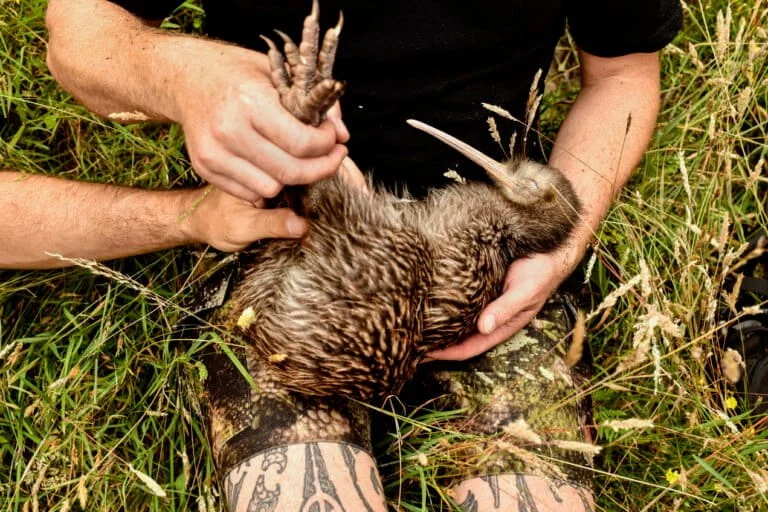
For the first time in a century and a half, the iconic kiwi bird once again roams the hills surrounding Wellington, Aotearoa New Zealand. This monumental ecological milestone is the result of the Capital Kiwi Project, an ambitious conservation initiative that successfully translocated more than 250 birds back to the region. Achieving this feat required not only intensive ecological intervention across thousands of hectares of modified land, but also deep-rooted relationship-building with Indigenous nations, local landowners, and regional communities.
The successful return of Aotearoa’s national symbol highlights a shifting paradigm in modern conservation. Rather than relying solely on isolated, fenced-off sanctuaries or offshore islands, the project demonstrates that native species can successfully thrive in peopled, working landscapes when communities and Indigenous stewards unite under a shared ecological vision.
A Landscape Transformed: Overcoming the Threat of Invasive Predators
To understand the magnitude of the kiwi’s return to Wellington, one must examine the ecological history of Aotearoa New Zealand. For millions of years, the islands evolved in isolation from continental landmasses. Aside from a few species of native bats, the country’s unique biodiversity was dominated by birds. Without mammalian predators with four legs and teeth, these avian species developed distinct evolutionary traits, such as flightlessness and ground-nesting habits.
When human settlers arrived—first Polynesian voyagers centuries ago, followed by European settlers in the 19th century—they introduced various mammalian species, including rats, cats, and mustelids like stoats. Because native birds like the kiwi had evolved without defenses against these scent-hunting predators, the ecological impact was devastating. Populations plummeted from an estimated tens of millions down to roughly 60,000 to 70,000 individuals nationwide.
While adult kiwi are large enough to defend themselves with powerful claws and can fiercely protect their massive eggs, their chicks remain highly vulnerable. In areas without active pest management, an alarming 95% to 100% of kiwi chicks fall victim to stoats before reaching "fighting weight"—the one-kilogram threshold at which they can adequately defend themselves.
To give the translocated kiwi a fighting chance, the Capital Kiwi Project undertook a massive infrastructural challenge. The team deployed more than 5,300 traps across a 24,000-hectare (59,300-acre) project area encompassing sheep and cattle farms, forestry blocks, and regional infrastructure. This intensive predator-removal effort drastically reduced stoat numbers, creating a safe operational window for young birds to mature.
Chronology of the Reintroduction Effort
The path to rewilding Wellington’s hills was built on years of careful planning, community engagement, and institutional coordination.
Nearly a decade ago, the initiative began as an ambitious idea among conservationists who noticed that other native species, such as the kaka parrot, were beginning to return to the capital’s skies thanks to regional pest control networks and the fenced sanctuary Zealandia. Project founders questioned whether the country’s ultimate flagship species—the kiwi—could also be restored to a landscape shared heavily by humans.
Between 2017 and 2020, project leaders spent roughly 18 months engaging in intensive community outreach. They sat down for cups of tea in local marae (traditional Māori meeting houses), village halls, and farm wool sheds to consult with residents, landowners, and regional iwi (nations).
Following years of trap network establishment and rigorous monitoring to ensure stoat populations had dropped below critical thresholds, the initiative received government and tribal approvals. In late 2022, the first cohort of kiwi arrived in Makara, marked by a historic public welcoming ceremony. Additional translocations followed annually, culminating in a major milestone in 2024 that brought the total number of introduced birds and newly hatched wild chicks past the 300 mark.
Te Ao Māori and the Tono Process
Crucial to the success of the Capital Kiwi Project is its grounding in Te Ao Māori (the Māori world). Rawiri Walsh, the project’s Kaimanaaki Kiwi (kiwi guardian) and iwi liaison, emphasizes that the initiative is as much a social and cultural restoration as it is an environmental one.
Under New Zealand law and Te Tiriti o Waitangi (the Treaty of Waitangi), any species translocation requires formal sign-off and agreement from the Indigenous tribes of the affected regions. To acquire the birds, the Capital Kiwi Project had to engage in a tono, a traditional formal request or gifting process between iwi.
Elder Poto Davis of the Waikato region established the framework for this modern tono, insisting that the request involve high-level tribal leadership to honor the deep cultural significance of the birds. Once the gifting iwi agreed to share their surplus kiwi—many of which had been raised through captive-nesting programs—the birds were transported to Wellington.
Upon arrival, the birds and project workers were welcomed through a pōwhiri, a traditional Māori welcoming ceremony. Through this ritual, the responsibility for the care and wellbeing of the kiwi was formally transferred from the gifting iwi to the local community, landowners, and mana whenua (indigenous people of the land).
Māori cultural narratives view the kiwi as Te Manu Huna a Tāne (the hidden bird of Tāne, the god of the forest). For the people of Aotearoa, releasing a flightless bird back into the ground represents an intimate act of restoration. It signifies putting something back into the whenua (land), reinforcing the cultural belief that humans and the environment are inextricably linked.
Remarkable Results and Ecological Implications
The results of the Wellington reintroduction have significantly surpassed initial expectations. Under the Department of Conservation permit, project leaders targeted a chick survivorship rate of 30%—a metric acknowledging the harsh realities of nature and predation.
However, the reality on the ground has far exceeded those projections. Following the release of the initial cohorts, chick survivorship has consistently remained well above 90%. Furthermore, because the modified rural and scrubland environments offer an abundance of foraging opportunities, the translocated birds are thriving in unexpected ways. Some chicks are reaching the vital one-kilogram, stoat-proof weight in just four months—slashing the traditional vulnerability window in half. Routine health checks have revealed that adult kiwi are maintaining robust body conditions, and numerous females have successfully laid eggs in the wild shortly after translocation.
Project lead Paul Ward notes that these findings challenge traditional conservation models that isolate nature within strict boundaries. By proving that kiwi can thrive on sheep and cattle farms alongside human infrastructure, the Capital Kiwi Project has established a scalable blueprint for ecological restoration across working landscapes.
Broader Impact and Future Outlook
The return of the kiwi has captured international attention, symbolizing hope and agency at a time when global environmental and social news is often dominated by decline and division. For the local citizens of Wellington—ranging from school children and farmers to mountain bikers and local trappers—participating in the protection of the birds has fostered a renewed sense of environmental stewardship.
With over 300 kiwi now estimated to inhabit the capital’s surrounding hills, organizers stress that the work is far from finished. Maintaining the extensive trap network and fostering public awareness regarding dogs and vehicle traffic remain ongoing priorities.
Looking ahead, project leaders are already consulting with their iwi partners, landowners, and community networks to explore what other taonga (treasured) species might soon be returned to the region. By weaving together Western ecological science and Indigenous knowledge systems, the Capital Kiwi Project has proven that human communities do not need to remain separate from nature—they can actively lead its healing.






Leave a Reply