
For decades, the standard paradigm for detecting the collision of neutron stars—the ultra-dense remnants of collapsed massive stars—has relied almost exclusively on the observation of short-duration gamma-ray bursts (GRBs). These high-energy flashes are notoriously ephemeral, often vanishing into the cosmic background in less than two seconds. However, a landmark study recently published in Science Bulletin has fundamentally challenged this narrow view. By analyzing a peculiar event designated EP250704a/GRB 250704B, researchers have identified an X-ray signature that persists for nearly ten minutes, suggesting that these cataclysmic mergers may be far more complex and luminous than previously understood.
The discovery, facilitated by the state-of-the-art Einstein Probe (EP) satellite, offers a new window into the aftermath of stellar collisions. By demonstrating that some neutron star mergers produce extended X-ray emissions, scientists believe they have uncovered a method to identify a hidden population of cosmic events that were previously misclassified or entirely overlooked by traditional survey instruments.
A Chronology of a Cosmic Collision
The discovery of EP250704a/GRB 250704B began in the early hours of July 4, 2025. At the moment of the merger, a suite of international space-based observatories—including the Einstein Probe, the SVOM (Space-based multi-band Variable Object Monitor), and the Insight-HXMT (Hard X-ray Modulation Telescope)—triggered an immediate alert.
The initial gamma-ray burst, the hallmark of such a collision, lasted only half a second. However, unlike typical mergers that fade into obscurity, the Einstein Probe’s wide-field X-ray telescope continued to track a bright, persistent emission. This X-ray glow remained detectable for nearly ten minutes, a duration that defies the conventional models of short GRBs.
For Niccolò Passaleva, a graduate student at the University of Rome Tor Vergata who spearheaded the rapid-response follow-up, the event was a masterclass in high-stakes observational astronomy. "I was traveling home by train when the alert hit my terminal," Passaleva recalled. "It was a race against time. I had to coordinate the activation of some of the most sophisticated telescopes on Earth, including the European Southern Observatory’s Very Large Telescope (VLT) in Chile, using nothing but a laptop from a commuter train."
The rapid deployment allowed the team to capture the event while it was still in its most energetic state. By utilizing the VLT’s X-Shooter instrument, the researchers were able to perform high-resolution spectroscopy, breaking down the light into its constituent wavelengths to determine the distance of the source.
Deciphering the Distance and the Absence of a Supernova
One of the most significant hurdles in studying fast X-ray transients is determining their origin point in the vastness of space. Without an accurate distance measurement, it is impossible to calculate the total energy output or the physical nature of the progenitor.
Through the analysis of absorption patterns, the team identified a redshift of z=0.6610. This measurement places the event at a staggering distance of more than six billion light-years from Earth. Consequently, the light captured by these instruments began its journey long before the formation of our own solar system.
To confirm that the event was indeed a neutron star merger, the researchers had to rule out other potential causes for such an extended X-ray flash, specifically the collapse of a massive star, which typically results in a long-duration gamma-ray burst accompanied by a bright supernova. Utilizing the VLT’s FORS2 instrument, the team conducted deep, follow-up imaging to look for the tell-tale glow of a supernova.
The results were definitive: no supernova was detected. This absence of a stellar explosion, combined with the extreme distance and the unique timing of the X-ray emission, provided the "smoking gun" evidence that the source was not a single collapsing star, but the merger of two neutron stars.
The Magnetar Hypothesis
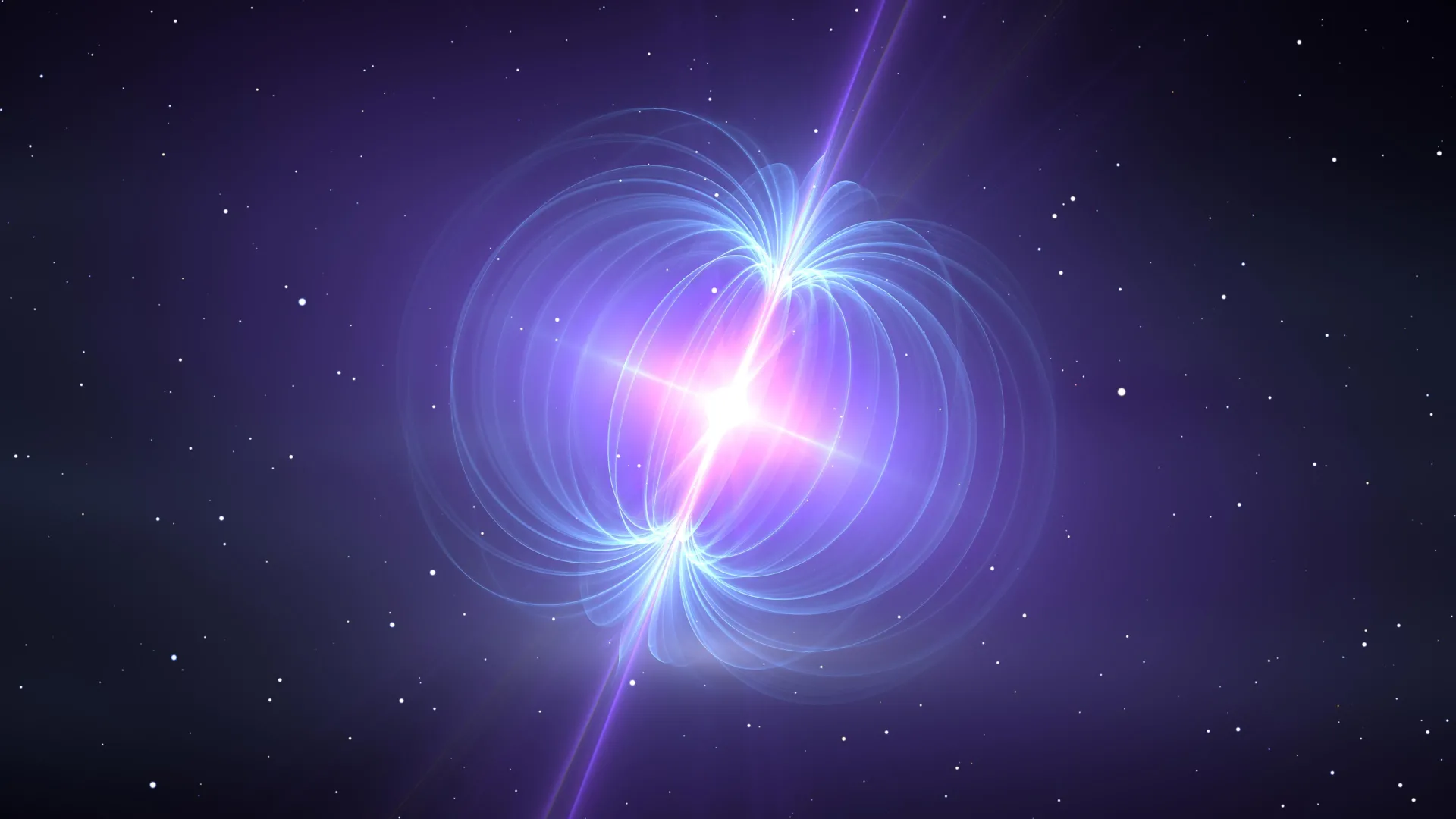
The primary theory proposed by the research team is that the collision resulted in the birth of a magnetar—a neutron star possessing an exceptionally powerful magnetic field. While many neutron star mergers result in the immediate formation of a black hole, the existence of a magnetar as a remnant explains the anomalous data.
"If the remnant of the collision is a magnetar, it could keep bursting for longer," explains Professor Eleonora Troja, a lead researcher on the project and a co-corresponding author of the paper. "Magnetars are rapidly spinning neutron stars with huge magnetic fields. When they damp their magnetic power into the surroundings, they can make any explosion brighter and longer-lasting. When I saw the X-ray data from this new event, I realized something was up."
The magnetic energy released by the newborn magnetar acts as a central engine, injecting energy into the debris cloud created by the collision. This interaction effectively "powers" the X-ray emission, extending it well beyond the duration of the initial gamma-ray burst. This discovery suggests that magnetars may be a more common outcome of binary neutron star mergers than previously hypothesized, providing a new metric for understanding the lifecycle of the densest objects in the universe.
Implications for Multi-Messenger Astronomy
This study marks a significant step forward in the era of multi-messenger astronomy, where scientists use various signals—electromagnetic waves, gravitational waves, and high-energy particles—to construct a complete picture of cosmic events.
The detection of EP250704a highlights the limitations of relying solely on gamma-ray detectors. Because gamma-ray bursts are often beamed in specific directions and have very short duty cycles, many neutron star mergers likely go undetected. By expanding the search criteria to include long-duration X-ray flashes, astronomers expect to increase the rate at which these mergers are identified.
Furthermore, this finding paves the way for a more integrated approach to gravitational wave astronomy. Gravitational waves, which are ripples in the fabric of spacetime, are the direct result of the merger of massive compact objects. If researchers can successfully pair an X-ray flash of this duration with a concurrent gravitational wave signal, they will be able to measure the properties of the resulting magnetar with unprecedented precision.
"Finding more of these X-ray flashes could help reveal how often neutron star mergers create magnetars," says Passaleva. "I am really excited for the next run of gravitational wave observations, when we could finally pair one of these X-ray flashes with a burst of gravitational waves from the same source."
A Global Collaborative Effort
The success of this investigation underscores the necessity of international cooperation in modern astrophysics. The study was the result of a diverse, multi-institutional effort involving researchers from Beijing Normal University, the Chinese Academy of Sciences, the University of Rome Tor Vergata, and the University of Hong Kong, among others.
The project was supported by significant research grants, including the European Research Council (ERC) Consolidator grant, which provided the resources necessary for Professor Troja’s team to maintain a state of constant readiness. The use of the VLT, under the large program titled "QUEENB: a QUEst for Elusive Neutron star and Black hole mergers," demonstrates how long-term planning and strategic allocation of observational time can lead to transformative discoveries.
As the Einstein Probe continues its mission to survey the X-ray sky, the astronomical community anticipates that this event will serve as a template for future discoveries. By re-evaluating historical data and maintaining high-cadence monitoring of the sky, astronomers are poised to fill in the gaps of our current understanding of neutron star dynamics. The transition from viewing neutron star mergers as brief, transient blips to seeing them as complex, sustained astrophysical events marks a maturation of the field, moving us closer to unraveling the extreme physics that govern the most violent corners of our universe.









Leave a Reply