
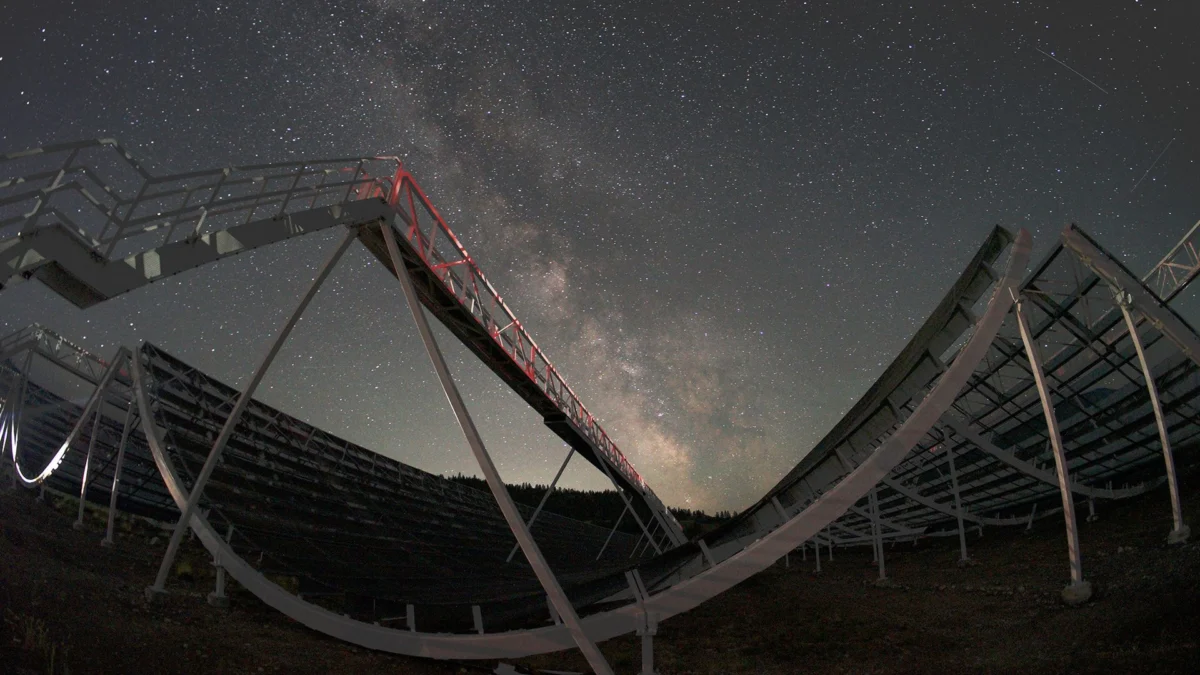
Astronomers have achieved a major milestone in observational cosmology, successfully demonstrating that a powerful Canadian radio telescope can map the distribution of hydrogen gas in the ancient universe using exclusively its own internal data. Following a rigorous seven-year validation process, this breakthrough paves an entirely independent pathway toward unraveling the mysteries of dark energy and the accelerated expansion of the cosmos.
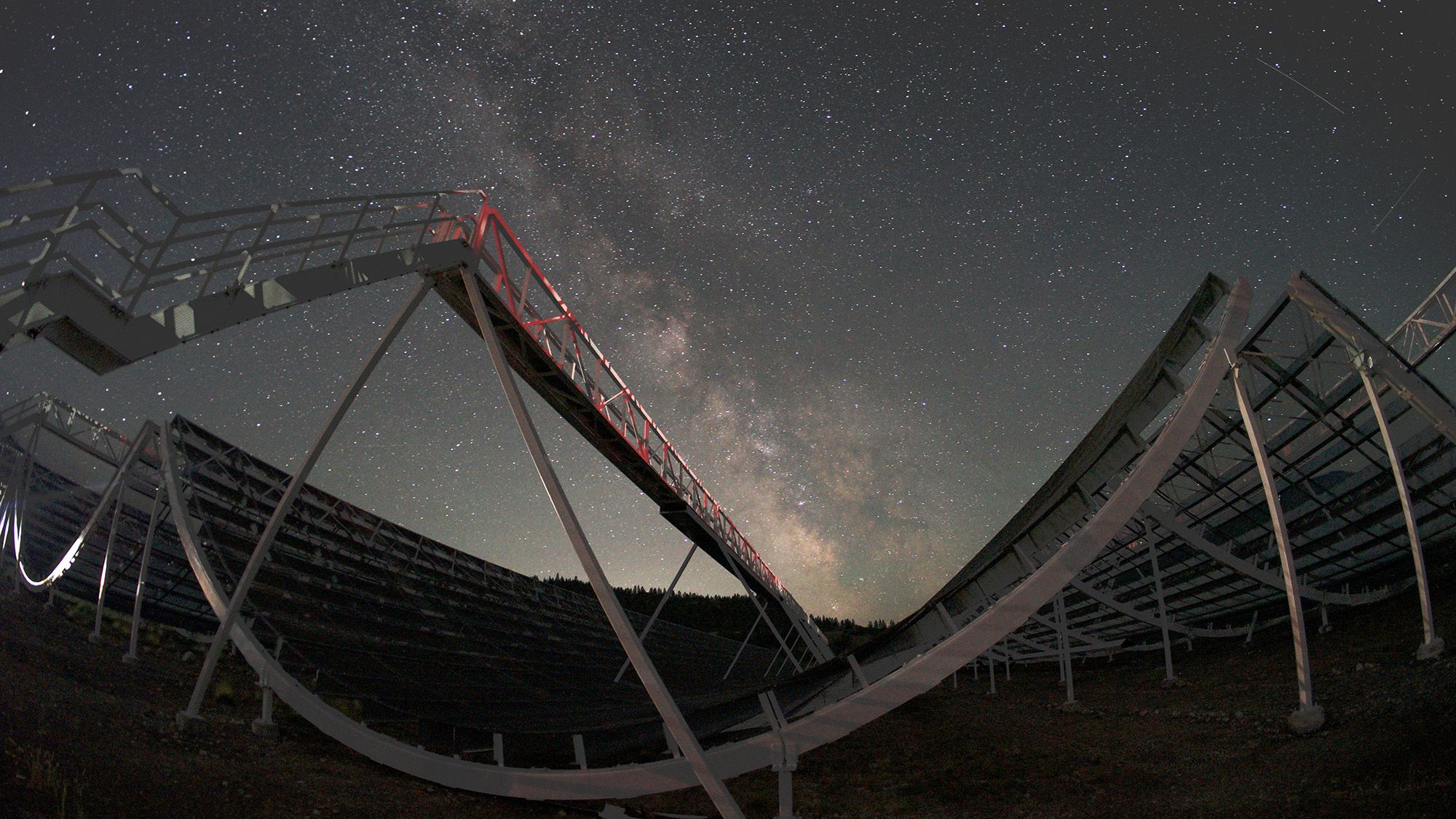
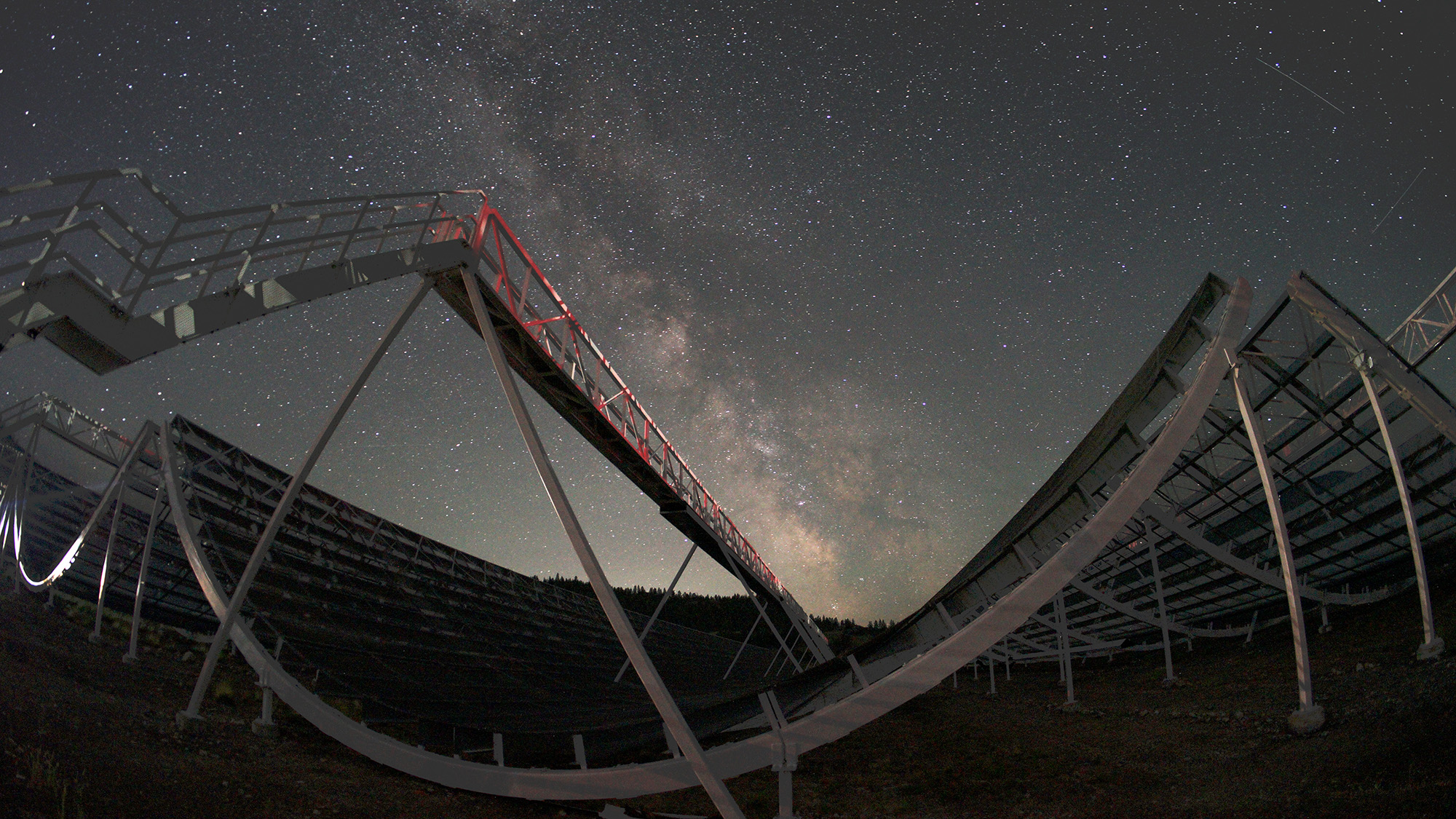
The achievement centers on the Canadian Hydrogen Intensity Mapping Experiment (CHIME), an innovative radio telescope array situated at the Dominion Radio Astrophysical Observatory in British Columbia. Unlike traditional dish telescopes that mechanically point toward specific targets, CHIME features a stationary, half-cylinder design resembling giant snowboarding half-pipes. This unique architecture allows the instrument to scan a large swath of the northern sky every single day as the Earth rotates, gathering unprecedented volumes of data regarding the large-scale structure of the cosmos.
For years, astrophysicists relied heavily on cross-correlation techniques—combining data sets from multiple independent telescopes—to verify the accuracy of massive radio surveys. However, the latest findings prove that CHIME can achieve high-fidelity cosmological maps entirely on its own. This self-sufficiency marks a pivotal transition for the facility, establishing it as a primary, standalone engine for modern astronomical discovery.
The Chronology of CHIME: From Concept to Standalone Powerhouse
The journey toward this milestone spans more than a decade of international collaboration, engineering ingenuity, and intensive data processing.
The conceptual foundation of CHIME began in the early 2010s, drawing expertise from researchers across institutions including the University of British Columbia, McGill University, the University of Toronto, and the National Research Council of Canada. Construction of the array commenced soon after, with first light achieved in 2017.
From its inception, the telescope was designed with two primary scientific goals: detecting fast radio bursts (FRBs)—enigmatic, millisecond-long bursts of cosmic radio waves from distant galaxies—and mapping neutral hydrogen gas across cosmological distances. While CHIME quickly established itself as a prolific finder of FRBs, mapping the faint signal of neutral hydrogen proved computationally and technically formidable.
Neutral hydrogen is the most abundant element in the universe. By charting its distribution across billions of light-years, scientists can trace the large-scale cosmic web of matter. This spatial arrangement acts as a sensitive cosmic ruler, enabling researchers to measure the history of the universe’s expansion. However, detecting these faint hydrogen signals requires filtering out overwhelming foreground noise, including emissions from our own Milky Way galaxy and terrestrial radio interference.
Between 2018 and 2021, the CHIME Collaboration focused on refining calibration algorithms and mitigating systematic errors. The sheer volume of data generated by the array—terabits per second—demanded the development of custom-built digital signal processors and advanced supercomputing infrastructure.
By 2022 and 2023, preliminary internal data analyses began showing promising consistency. Over the subsequent two years, researchers meticulously cross-checked the telescope’s internal consistency, culminating in the recent definitive proof that CHIME can produce reliable, high-precision cosmological maps without external dataset calibration.
Understanding Hydrogen Intensity Mapping and Dark Energy
To comprehend the significance of CHIME’s achievement, one must examine the fundamental puzzle of cosmic acceleration. In 1998, two independent teams of astronomers discovered that the expansion of the universe is not slowing down under the influence of gravity, as was long assumed, but is instead speeding up. This mysterious repulsive force driving the expansion has been dubbed "dark energy," which currently constitutes roughly 68 percent of the total mass-energy content of the universe.
Despite its dominance, the true nature of dark energy remains one of the greatest unresolved problems in modern physics. Is it a cosmological constant, a static energy density inherent to space itself, or is it a dynamic field that evolves over cosmic time?
To answer this, astronomers must map the geometry and expansion history of the universe across vast epochs. This is where hydrogen intensity mapping becomes essential. Traditional galaxy surveys rely on identifying and cataloging individual galaxies, a process that becomes increasingly difficult and observationally expensive at great distances.
Hydrogen intensity mapping bypasses the need to resolve individual galaxies. Instead, it measures the collective, aggregated radio emission of neutral hydrogen gas over large cosmic volumes. By observing how this gas is distributed—particularly through a phenomenon known as baryon acoustic oscillations (BAOs)—scientists can use the universe’s structure as a standard ruler to measure distances and expansion rates across billions of years.
Technical Innovations and Overcoming Systematic Challenges
Operating a transit telescope like CHIME presents monumental data-handling hurdles. Because the telescope does not move, it captures a continuous stream of the overhead sky. The incoming signals must be instantly digitized, channelized, and correlated across thousands of antenna elements in real time.
The primary obstacle in self-calibrating radio interferometers is isolating genuine cosmological signals from instrumental artifacts and bright foregrounds. Radio emissions from the Milky Way are orders of magnitude brighter than the faint hydrogen signal from the distant early universe. Furthermore, subtle variations in receiver gain, temperature fluctuations, and polarization leakage can introduce systematic errors that mimic or obscure true cosmic structures.
By developing sophisticated new calibration pipelines and statistical modeling techniques, the CHIME team successfully isolated the instrument’s internal noise characteristics from the genuine sky signal. This allows the telescope to measure power spectra—statistical representations of how matter is clumped together at different spatial scales—with high precision and zero reliance on external optical or radio surveys.
Implications for Future Cosmology
The validation of CHIME as an independent mapping instrument opens expansive new avenues for astrophysical research. With its newfound autonomy, the telescope can accelerate its survey cadence and refine its measurements of cosmic expansion without waiting for complementary data from other facilities.
Furthermore, this self-sufficiency enhances the global network of cosmological observatories. As upcoming next-generation facilities, such as the Square Kilometre Array (SKA) and other large-scale radio arrays, come online over the next decade, the methodologies pioneered by the CHIME Collaboration will serve as a vital blueprint for processing massive radio datasets.
For the broader scientific community, the milestone reinforces confidence in radio interferometry as a premier tool for probing the dark universe. As researchers dig deeper into the CHIME data archive, the resulting maps of ancient hydrogen promise to shed new light on the timeline of cosmic evolution, bringing humanity one step closer to understanding the unseen forces that shape our reality.









Leave a Reply