

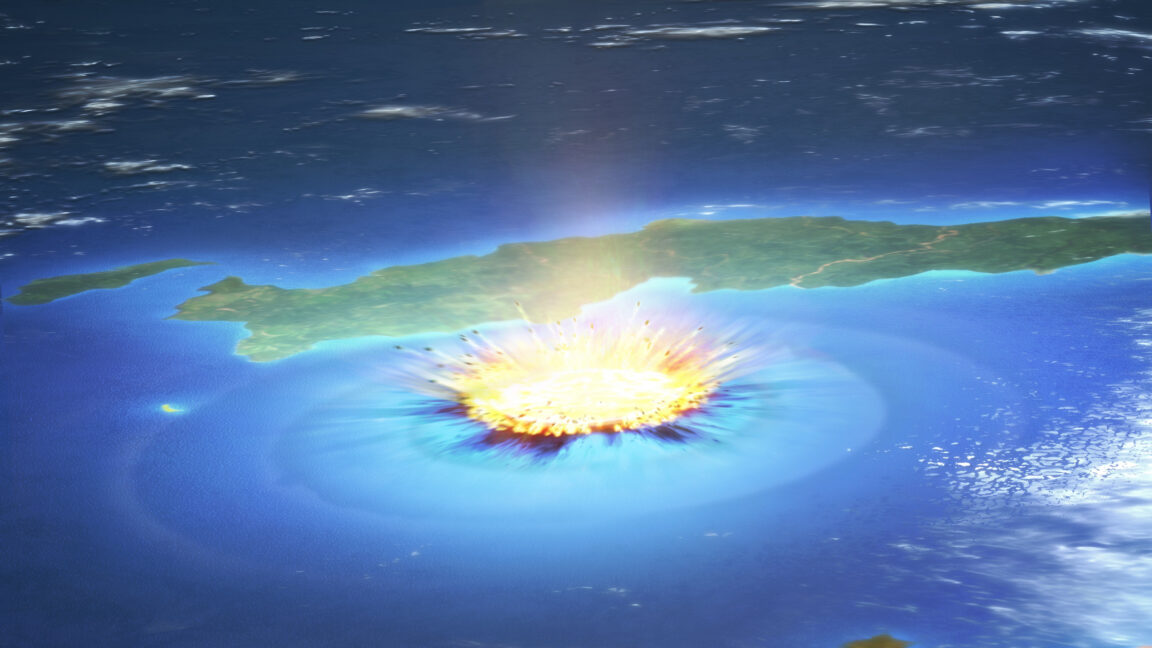
Sixty-six million years ago, a mountain-sized asteroid measuring roughly 10 kilometers across slammed into the shallow seas of what is now the Yucatán Peninsula in Mexico. The cataclysmic impact of the Chicxulub asteroid ended the Cretaceous period, wiped out the non-avian dinosaurs, and triggered a global mass extinction that erased approximately 75 percent of all plant and animal species on Earth. The immediate aftermath was defined by unimaginable violence: global wildfires, massive tsunamis, toxic atmospheric fallout, and a prolonged impact winter caused by debris blocking out the sun.
Yet, beneath the surface chaos and centuries of ecological devastation, the violent collision forged an unexpected cradle of habitability. According to a landmark study recently published in the journal Communications Earth & Environment, the intense thermal energy generated by the impact created a colossal subterranean hydrothermal system. Led by geologist and planetary scientist Annemarie Pickersgill of the SUERC Centre for Isotope Sciences at the University of Glasgow, a team of researchers discovered that this mineral-rich, heated water system persisted for an astounding eight million years—four times longer than previously estimated. This extended window of warmth and chemical nutrients provides compelling new evidence that impact craters on Earth and other rocky planets may have served as vital incubators for early microbial life.
Unlocking the Subterranean Core: The 2016 Scientific Drilling Project
The foundational understanding of the Chicxulub crater’s interior mechanics largely stems from an ambitious 2016 offshore and onshore scientific drilling expedition. Led jointly by the International Ocean Discovery Program (IODP) and the International Continental Scientific Drilling Program (ICDP), researchers bored deep into the peak ring of the crater—the circular ridge of shattered rock thrust upward during the collision—recovering continuous core samples that preserved a physical history of the impact zone.
When the asteroid struck, the sheer kinetic energy fractured the Earth’s crust down to depths of 35 kilometers (nearly 22 miles). This immense pressure vaporized and melted enormous volumes of rock. As the shockwaves subsided and the surrounding ocean waters rushed back into the collapsing cavity, the superheated, fractured bedrock was exposed to seawater.
The introduction of seawater into the porous, newly melted subterranean rock initiated a massive geothermal engine. Cold ocean water seeped deep into the crust, where it was heated by the residual thermal energy of the impact, and then circulated back upward through hydrothermal vents. In the freezing depths of the post-impact ocean—darkened by atmospheric debris and devoid of photosynthetic life—these mineral-rich thermal plumes offered a lifeline. They provided a stable source of heat, chemical energy, and vital nutrients, attracting extremophilic microorganisms that were otherwise struggling to survive the global biosphere collapse.
Dating the Depths: The Potassium-Argon Isotope Analysis
While scientists long suspected that impact-induced hydrothermal systems formed in the wake of major asteroid strikes, quantifying their exact lifespans has historically presented a formidable challenge. Previous models and preliminary analyses of the Chicxulub core samples suggested that the hydrothermal activity wound down relatively quickly, lasting perhaps around two million years.
To refine these estimates, Dr. Pickersgill and her research team turned to high-precision geochronology, specifically focusing on potassium-argon (K-Ar) dating of feldspar minerals recovered from the drill cores. Feldspar is a ubiquitous rock-forming mineral that contains potassium, a radioactive isotope (potassium-40) that decays at a precisely measured rate into argon-40.
Because argon is a gas, it completely escapes from minerals when they are molten or exposed to extreme heat. However, once the rock cools and solidifies below a certain temperature threshold, the argon gas becomes trapped within the crystal lattice. By measuring the ratio of remaining potassium-40 to accumulated argon-40, scientists can determine the exact amount of time that has elapsed since the mineral last cooled.
Applying this rigorous isotopic technique to samples retrieved from roughly one kilometer beneath the surface, the team discovered undeniable geochemical signatures of prolonged thermal activity. The data revealed that the hydrothermal system remained heated from the moment of impact 66 million years ago until approximately 58 million years ago, maintaining a robust circulation of warm water for an unbroken span of eight million years.
Chronology of a Thermal Oasis: Computer Simulations and Cooling Rates
To better understand how this subterranean environment evolved over its multi-million-year lifespan, Pickersgill’s team paired their empirical rock-dating data with advanced computer simulations modeling hydrothermal fluid dynamics within the crater.
The simulations reconstructed the thermal decay of the Chicxulub peak ring over deep time:

- Years 0 to 2.3 Million Post-Impact: At a depth of one kilometer, temperatures remained intensely high. It took between 1.5 and 2.3 million years for the local subterranean environment to cool down to 90°C (194°F).
- Years 2.3 to 5 Million Post-Impact: The cooling trend continued steadily, with temperatures dropping below 50°C (122°F) around the five-million-year mark. This thermal window was exceptionally well-suited for mesophilic and thermophilic microorganisms to establish stable, thriving colonies.
- Years 5 to 8 Million Post-Impact: Fluid flow began to significantly diminish after six million years as the underlying energy source dissipated and mineral precipitation clogged the subterranean pathways. By the eight-million-year mark, hydrothermal activity had entirely ceased, mirroring the timeline established by the potassium-argon isotope analysis.
"Longer periods of hydrothermal activity will generate extended windows of opportunity for prebiotic chemical reactions to occur, life to develop, and micro-organisms to thrive and propagate beyond their point of origin," Pickersgill noted in the published findings.
With eight continuous million years of warmth, steady fluid flux, and a rich cocktail of dissolved minerals, the Chicxulub crater provided more than enough time for microbial populations to colonize the vent systems, evolve complex metabolic pathways, and establish resilient ecosystems far removed from the devastated surface world.
Broader Implications for Astrobiology and Planetary Evolution
While the new data confirms that the Chicxulub impact crater possessed all the physical and chemical requirements for a long-lasting habitable zone, researchers emphasize that this specific study measures potential habitability rather than definitively proving the presence of active biological communities within the crater core. Nevertheless, the implications of an eight-million-year hydrothermal lifespan extend far beyond the history of our own planet.
Impact craters are ubiquitous geological features across the inner solar system. Ancient impact basins are preserved on the surfaces of Mars, the Moon, Mercury, and the icy moons of the outer solar system. Because the early Earth—and potentially early Mars—was frequently battered by much larger impactors during the Late Heavy Bombardment, the discovery that even a moderately sized impact like Chicxulub could sustain a hydrothermal system for nearly a decade of millions of years suggests that impact basins were major drivers of prebiotic chemistry and early biological evolution.
"Chicxulub is still relatively small compared to the impact basins expected on early Earth and observed on other planetary bodies," Pickersgill explained. "It is therefore possible that these larger impacts could have created even longer-lived hydrothermal systems and, hence, could have been able to maintain the temperatures and fluid flux required for habitable environments for a minimum of several million years."
As planetary scientists continue to analyze data from Mars rovers exploring ancient impact craters like Jezero and Gale, the findings from Chicxulub offer a compelling geologic framework. They demonstrate that destructive cosmic impacts, long viewed solely as harbingers of global annihilation, simultaneously acted as thermal engines capable of nurturing life through its most fragile developmental stages, ensuring that even in the face of planetary catastrophe, life could find a way to endure and flourish.









Leave a Reply