
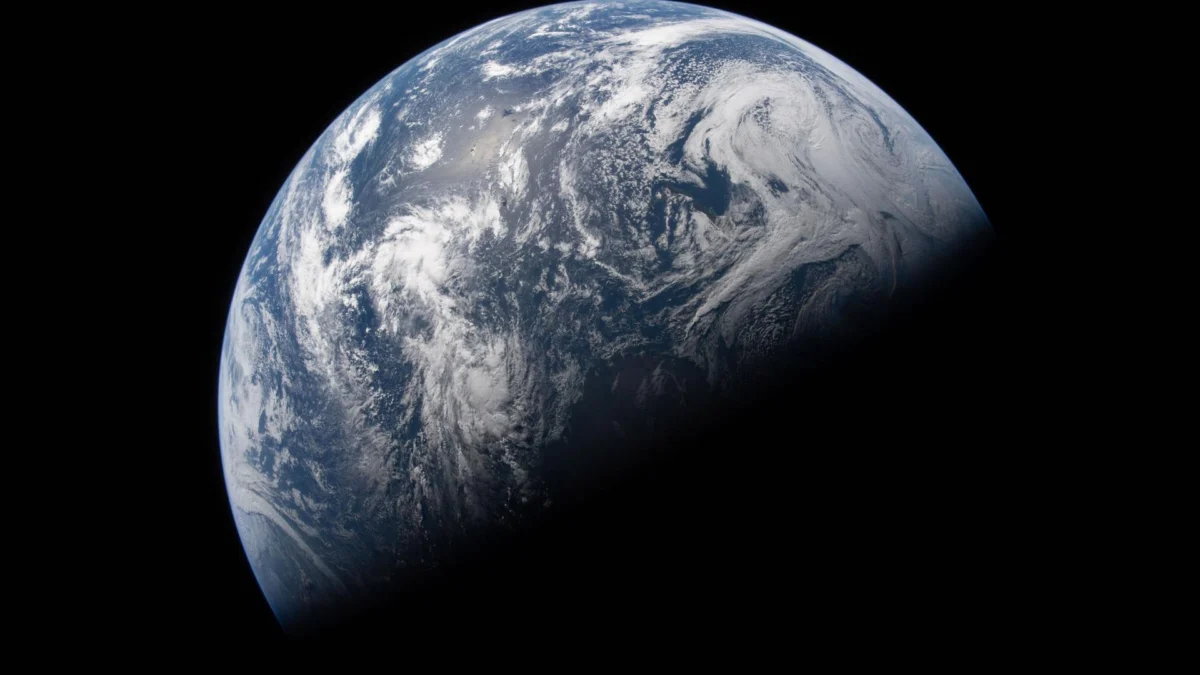
Earth has never been a pristine, mathematically flawless sphere. Because of its constant rotation, the planet experiences a centrifugal force that pushes outward at the equator while gravity pulls inward, resulting in an oblate spheroid shape. This natural phenomenon means that Earth bulges slightly around the equator and flattens out marginally at the poles. For centuries, geodesists and geophysicists have mapped these subtle deviations, understanding that the planet’s topography and mass distribution are in a constant state of dynamic equilibrium.
However, new scientific research reveals that human-caused climate change is actively altering this fundamental geometry. As global temperatures rise and anthropogenic greenhouse gas emissions drive unprecedented environmental shifts, massive volumes of ice stored in Earth’s polar ice sheets and mountain glaciers are melting at an accelerating rate. This redistribution of planetary mass is not merely raising global sea levels; it is fundamentally shifting the planet’s gravitational and rotational dynamics, causing Earth to become progressively rounder over time.
The Mechanics of Planetary Mass Redistribution
To understand how climate change can alter the shape of an entire planet, scientists must look at the way mass is distributed across Earth’s surface. For millennia, immense quantities of water were locked away in solid form at the extreme northern and southern latitudes. The sheer weight of these polar ice sheets exerted immense gravitational and mechanical pressure on the underlying crust, depressing the land beneath them and contributing to the planet’s oblate shape.
As global warming takes hold, centuries of accumulated ice are rapidly transitioning from solid to liquid. Billions of metric tons of meltwater from Greenland, Antarctica, and alpine glaciers are flowing away from the poles. Under the influence of gravity and ocean currents, this water is redistributing globally, migrating primarily toward the equatorial regions and lower latitudes.
This monumental shift in mass acts like a planetary redistribution system. When heavy ice masses at the poles diminish and water spreads more uniformly across the globe’s vast ocean basins, the localized gravitational pull at the poles decreases while equatorial mass slightly increases. Consequently, the flattening effect at the poles is subtly reversing, nudging Earth’s geometry closer to a true, uniform sphere. While the alteration is minute on a day-to-day human scale, highly sensitive satellite altimetry and geodetic measurements have proven that the planet’s oblateness—its deviation from a perfect sphere—is measurably decreasing.
A Historical Timeline of Geodetic Discovery
The realization that Earth’s shape is dynamic rather than static is the result of decades of technological advancement in satellite geodesy. The historical progression of measuring Earth’s geometry highlights how far science has advanced in detecting these subtle climatic impacts:
- Late 17th Century: Sir Isaac Newton and Christiaan Huygens independently theorize that Earth must bulge at the equator due to centrifugal force generated by its rotation, disproving the ancient Greek notion of a perfect sphere.
- 1950s–1960s: The dawn of the space age allows scientists to launch artificial satellites like Vanguard 1. By tracking perturbations in satellite orbits, researchers gain the first precise measurements of Earth’s gravitational field and its precise oblate shape.
- 2002: NASA and the German Aerospace Center launch the Gravity Recovery and Climate Experiment (GRACE) twin satellites. GRACE revolutionizes geosciences by allowing scientists to track monthly changes in Earth’s gravity field, revealing precise data on ice sheet mass loss and groundwater depletion.
- 2018: GRACE-FO (Follow-On) is launched to continue the critical mission of monitoring global mass redistribution with unprecedented accuracy.
- Present Day: Modern geodetic studies synthesize decades of satellite data, explicitly linking ongoing polar ice melt to measurable shifts in Earth’s oblateness and global shape parameters.
Supporting Data and Quantitative Observations
The quantitative evidence supporting this planetary transformation comes from high-precision spaceborne instruments. Satellites equipped with laser altimetry and microwave radar can measure the height of the ocean surface and land ice sheets down to the centimeter.
Data from missions like GRACE and its successor, GRACE-FO, indicate that Greenland and Antarctica combined have lost trillions of metric tons of ice since the early 2000s. To put this into perspective, the global ocean has absorbed more than 90% of the excess heat trapped by greenhouse gases, resulting in thermal expansion alongside the influx of melted glacial water.
As this immense volume of water shifts away from the poles, geophysicists analyze spherical harmonics—mathematical equations used to describe the shape and gravitational field of a sphere. Changes in the lowest-degree spherical harmonic coefficients, particularly the $J_2$ term which measures Earth’s dynamical ellipticity, provide a direct index of the planet’s flattening. Analyses of these coefficients over the past thirty years show a clear, statistically significant trend: the rate of polar flattening is decreasing, directly mirroring the acceleration of polar ice loss.
Scientific and Institutional Consensus
The intersection of climate science and geodesy has garnered significant attention from major international scientific bodies. Climatologists, oceanographers, and geophysicists increasingly collaborate to interpret the cascading effects of global warming, moving beyond traditional atmospheric metrics to monitor solid-earth responses.
According to leading researchers in cryospheric science, tracking these geometric shifts provides an independent, foolproof validation of climate models. While temperature records and sea-level gauges can be subject to local anomalies or instrument calibration challenges, the redistribution of planetary mass is a closed system. Gravity does not lie; the planet’s physical dimensions react inexorably to the mass loads placed upon it.
Furthermore, space agencies view these findings as a crucial reminder of the interconnectedness of Earth’s systems. The atmosphere, oceans, cryosphere, and solid Earth are not isolated compartments; an energetic imbalance in the atmosphere immediately triggers physical consequences that resonate down to the planet’s bedrock and gravitational profile.
Broader Implications and Future Outlook
The revelation that climate change is making Earth rounder carries profound implications for both science and society. On a practical level, understanding these minute shifts is vital for maintaining the accuracy of global navigation satellite systems (GNSS), maritime navigation, and orbital mechanics. Satellites orbiting Earth rely on precise models of the planet’s gravitational field to maintain their trajectories and deliver accurate positioning data to smartphones, aircraft, and automated shipping vessels worldwide. As Earth’s mass distribution changes, these gravitational models must be continuously updated.
More importantly, the phenomenon serves as a stark, macro-level indicator of the sheer scale of human influence on Earth. For most of human history, geological forces such as tectonic plates, earthquakes, and vulcanism were viewed as the primary drivers of large-scale physical change to the planet’s structure. Today, anthropogenic climate change has joined those ranks, exerting a measurable physical force capable of altering the very geometry of the globe.
As global greenhouse gas emissions continue to challenge international mitigation frameworks, the melting of polar ice caps shows few signs of immediate deceleration. Consequently, Earth will continue on its trajectory toward a subtly rounder profile. While the change itself poses no direct physical threat to human life—people will not feel the planet shifting shape—it stands as a monumental testament to the profound footprint humanity has left upon the world. Tracking this ongoing transformation will remain a vital tool for scientists striving to quantify the true cost of a warming planet and forecast the future of Earth’s dynamic systems.





Leave a Reply