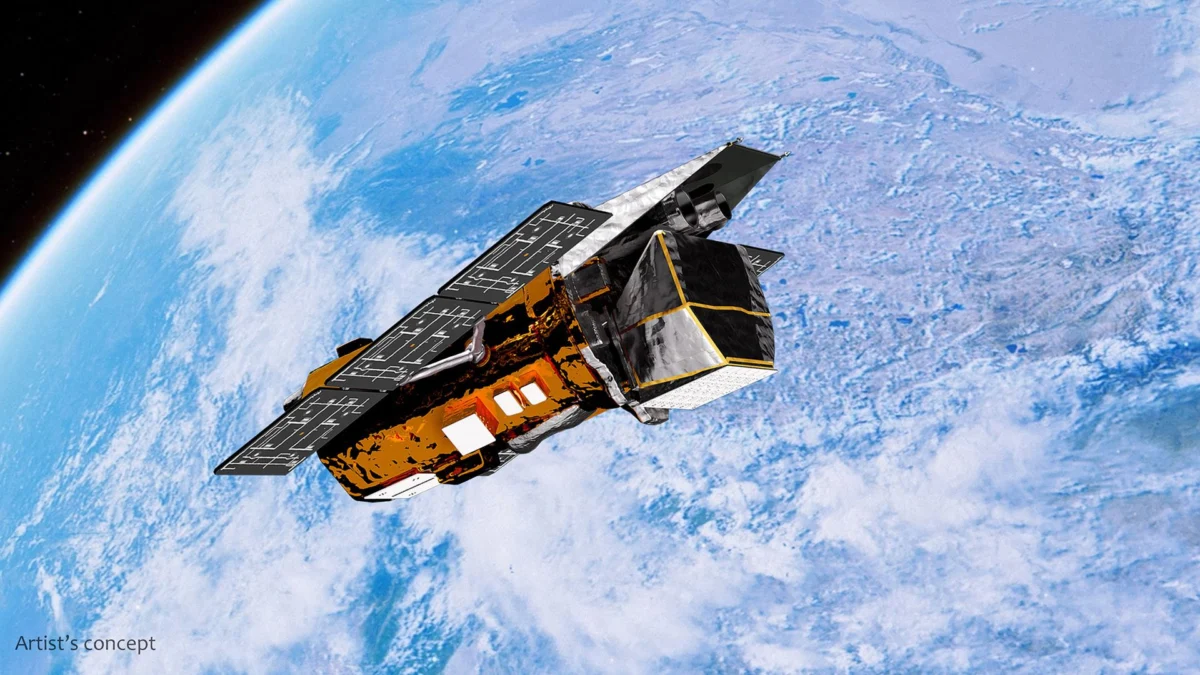
The Neil Gehrels Swift Observatory, a cornerstone of high-energy astrophysics and transient astronomy, has officially ceased science operations. NASA announced that the pioneering space telescope concluded its remarkable twenty-year mission on Tuesday, October 20, after orbital decay rendered the spacecraft unable to maintain the stability required for reliable cosmic measurements. Launched in November 2004, the observatory far exceeded its initial two-year design life, transforming humanity’s understanding of the most violent and energetic phenomena in the universe, including gamma-ray bursts, supernovae, and tidal disruption events.
With orbital degradation accelerating, mission controllers made the difficult decision to shut down the instruments. In the coming weeks, atmospheric drag will pull the satellite further downward until it crosses the threshold of no return, culminating in a controlled or semi-controlled, yet fiery, disintegration upon re-entering Earth’s atmosphere. The conclusion of the Swift mission marks the end of an era for multi-wavelength astronomy, closing the chapter on an observatory that fundamentally altered how scientists study the transient and dynamic universe.
The Chronology of a Legendary Mission
The origins of the Swift mission date back to the late 1990s, when NASA, alongside international partners in the United Kingdom and Italy, conceived a dedicated spacecraft designed to solve the enduring mystery of gamma-ray bursts (GRBs). These bursts are the most luminous electromagnetic events known to occur in the universe, releasing more energy in a matter of seconds than our sun will emit over its entire 10-billion-year lifespan. However, because they are entirely unpredictable and typically last anywhere from a fraction of a second to several minutes, capturing them required unprecedented technological agility.
On November 20, 2004, a Delta II rocket successfully carried the Swift observatory into low-Earth orbit from Cape Canaveral Air Force Station in Florida. The spacecraft was uniquely engineered with three primary instruments: the Burst Alert Telescope (BAT), the X-ray Telescope (XRT), and the Ultraviolet/Optical Telescope (UVOT). This tripartite instrument payload allowed Swift to autonomously detect a gamma-ray burst, calculate its coordinates within seconds, and swivel its entire body to point its high-resolution X-ray and optical telescopes at the target before the afterglow faded.
In 2018, NASA officially renamed the spacecraft the Neil Gehrels Swift Observatory to honor its former principal investigator and visionary astrophysicist, Dr. Neil Gehrels, who passed away in 2017. Under his leadership, and the continued guidance of subsequent mission scientists, Swift evolved from a dedicated GRB-hunting machine into a versatile, all-sky observatory capable of responding rapidly to alerts from across the astrophysical community, including gravitational wave detections and cometary flybys.
Supporting Data and Scientific Milestones
Over its twenty-year tenure, the Swift observatory compiled an unprecedented catalog of cosmic observations. The spacecraft’s Burst Alert Telescope detected more than 1,500 gamma-ray bursts, providing the foundational data that confirmed these events are the birth cries of stellar-mass black holes or the mergers of neutron stars.
Furthermore, Swift’s rapid-response capability enabled astronomers to catch the optical afterglows of GRBs originating billions of light-years away. By measuring the redshift of these afterglows, Swift helped researchers map the early universe, providing insights into the star-formation history of the cosmos during the epoch of reionization.
Beyond gamma-ray bursts, the observatory shattered expectations by monitoring thousands of active galactic nuclei, tracking stellar flares, and observing comets as they passed through the inner solar system. Notably, Swift played a critical role in the multi-messenger astronomy revolution. In August 2017, when the Laser Interferometer Gravitational-Wave Observatory (LIGO) and the Virgo collaboration detected gravitational waves from a binary neutron star merger designated GW170817, Swift was among the primary space-based telescopes tasked with locating the electromagnetic counterpart, successfully capturing the ultraviolet emission from the kilonova.
Official Responses and Perspectives from the Scientific Community
The closure of the mission prompted reflections from leaders within NASA and partner institutions around the globe, highlighting the profound legacy left by the spacecraft and its international team.
Dr. Nicola Fox, associate administrator for the Science Mission Directorate at NASA Headquarters in Washington, emphasized the transformative nature of the observatory. "Swift revolutionized time-domain astronomy," Fox noted in a statement. "Before Swift, studying fleeting cosmic explosions was a matter of extreme luck and slow reaction times. Swift automated the process, turning hours or days of waiting into mere seconds. The wealth of data it leaves behind will fuel astrophysical research for generations to come."
Project scientists and engineers who spent decades managing the spacecraft expressed both sorrow at its demise and pride in its longevity. Dr. Jamie Kennea, a lead researcher on the Swift team at Penn State University, highlighted the resilience of the hardware and the dedication of the operations crew. "We designed this spacecraft for a two-year baseline mission, hoping it might last five years if we were fortunate," Kennea stated. "To have kept this observatory productive for over twenty years is a testament to the exceptional engineering of the spacecraft bus and the tireless dedication of the science operations center. Watching it come to the end of its life is bittersweet, but we celebrate an extraordinary bounty of scientific discovery."
International partners from the UK Space Agency and the Italian Space Agency (ASI), both of which contributed critical instrumentation and ground-station support, similarly lauded the cooperative spirit that sustained the mission through two decades of budgetary shifts and technical upgrades.
Broader Impact and Implications for Future Astrophysics
The retirement of the Neil Gehrels Swift Observatory leaves a temporary vacuum in space-based, rapid-response high-energy monitoring, underscoring the challenges of maintaining continuous coverage of the dynamic universe. While facilities like the Neil Gehrels Swift Observatory have paved the way for modern time-domain astronomy, the astrophysics community faces the pressing task of developing successor missions to ensure that transient phenomena do not go unnoticed.
The implications of Swift’s data extend far beyond the immediate field of gamma-ray burst physics. By proving the viability of autonomous, rapid-pointing spacecraft, Swift set the design standard for future astronomical missions. Concepts currently under development within NASA and other space agencies incorporate the lessons learned from Swift’s automated slewing capabilities to monitor the sky for near-Earth objects, supernovae, and high-energy transients.
As the spacecraft descends toward its final re-entry, its physical presence in orbit will be lost, but its digital footprint will endure. Terabytes of archival data collected by the BAT, XRT, and UVOT instruments remain publicly accessible, serving as a permanent library for researchers seeking to unravel the mysteries of stellar death, black hole formation, and the fundamental physics of the cosmos. The mission’s conclusion marks not a full stop, but the transition of a legendary observatory from an active instrument of discovery into an everlasting scientific legacy.