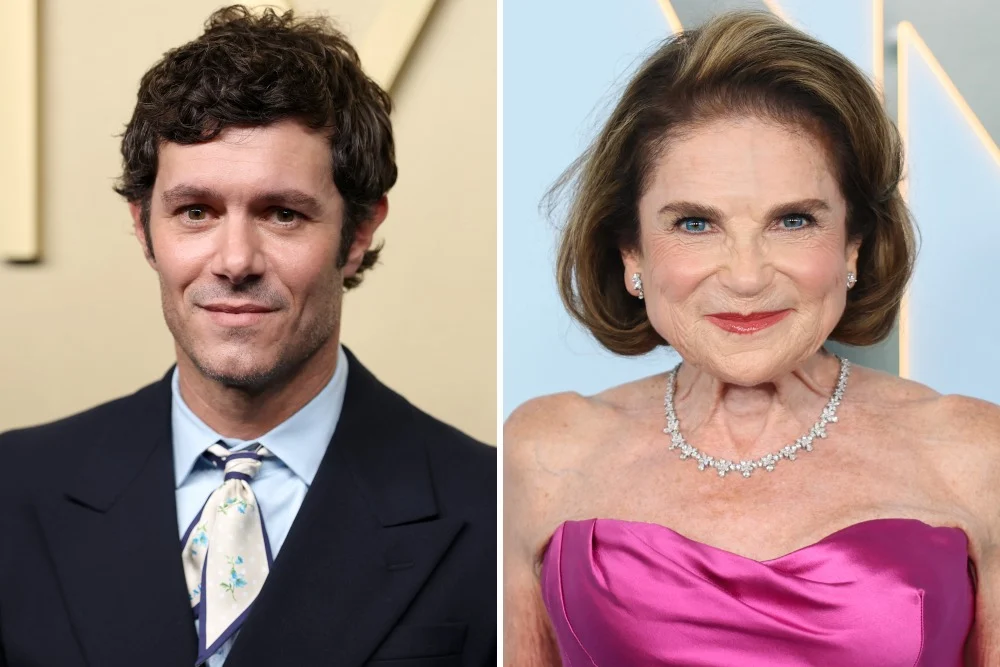
The recent public discourse surrounding the Netflix series Nobody Wants This has shifted from the show’s narrative reception to a wider debate regarding the intersection of celebrity, political activism, and the sensitivities of the ongoing Israel-Gaza conflict. The tension centers on remarks made by the show’s lead actor, Adam Brody, and the subsequent rebuttal from his co-star, Tovah Feldshuh, highlighting the polarized nature of discussions regarding the Middle East within the entertainment industry.
The Origins of the Controversy
The friction began last month during a feature interview in GQ magazine. Adam Brody, who portrays the central character Rabbi Noah Roklov in the hit Netflix romantic comedy, broke his silence regarding the Israel-Gaza conflict. While Brody had historically refrained from discussing the geopolitical crisis in a public forum, he utilized the platform to articulate a firm stance.
"Put me down as thinking it’s a genocide," Brody stated during the interview. "Put me down as wanting a free Palestine. It’s awful that it’s taken so much death and misery, but it does feel like it’s reaching a breaking point that it should have a while ago."
These remarks, coming from an actor playing a prominent Jewish religious figure, immediately drew significant attention. The term "genocide" remains a highly contentious point of international legal and political debate, and Brody’s utilization of the phrase sparked immediate reactions from various segments of the public and the Jewish community.
Tovah Feldshuh’s Rebuttal
On Sunday, Tovah Feldshuh, who plays the character of Bina Roklov—the mother of Brody’s character—offered a sharp critique of her co-star’s comments in an interview with The New York Post. Feldshuh, a veteran stage and screen actress, characterized the accusation of genocide against the Jewish people as "wild."
"It’s right out of Hitler’s playbook," Feldshuh remarked. "You take the victim, and you make the victim the perpetrator."
Feldshuh’s statement emphasizes a sentiment shared by many who view the current defensive actions taken by Israel in the Gaza Strip as a matter of national survival rather than an offensive act of ethnic erasure. She further noted that when such accusations originate from individuals within the Jewish community, it carries a unique weight and potentially deeper implications for communal cohesion.
Beyond the immediate critique, Feldshuh offered a broader perspective on the geopolitical relationship between the United States and Israel. "I believe that the perseverance of the existence of the state of Israel is crucial to the well-being of the democratic world and of the free world," she asserted. She argued that the bilateral relationship is mutually beneficial, stating, "Of course, Israel needs the United States, [but] the United States needs Israel, believe me."
She further identified what she termed the "horseshoe effect," a political theory suggesting that the far-left and far-right can converge on certain ideologies—in this instance, she argued, a convergence of socialism and antisemitism. Despite these profound ideological differences with her co-star, Feldshuh maintained a professional boundary. "My job, as Bina but also as Tovah, is to love the people on set at my place of work, to be kind," she added.
Creator Erin Foster and the Environment on Set
The show’s creator, Erin Foster, has also been forced to address the fallout from Brody’s comments. Earlier this month, while appearing as a guest on the "Not Skinny but Not Fat" podcast, Foster attempted to contextualize the disagreement within the framework of a modern workplace.
"I think our work environment, our set is very similar to dinner tables around the world where people are having debate and discussion and disagreeing," Foster said. "And, you know, while I love Adam, I also disagree with him, and that’s okay."
Foster’s approach reflects a broader trend in the entertainment industry, where showrunners and producers are increasingly tasked with navigating the personal political activism of their talent. Her comments suggest an effort to preserve the professional integrity of the production while acknowledging that the personal views of cast members are distinct from the creative output of the show itself.
Contextualizing the Israel-Gaza Conflict
To understand the intensity of this exchange, one must consider the broader historical context of the conflict. Since the escalation of hostilities following the October 7, 2023, attacks by Hamas, global public opinion has become deeply fragmented.
Data from the United Nations and various international human rights organizations have highlighted the devastating humanitarian toll in Gaza, which has served as the basis for international calls for an immediate ceasefire. Conversely, the Israeli government and its supporters point to the necessity of dismantling Hamas’s military infrastructure to ensure the security of Israeli citizens, citing the ongoing threats posed by regional militant groups.
The use of the word "genocide" in this context has become a flashpoint. In December 2023, South Africa brought a case against Israel to the International Court of Justice (ICJ), alleging that Israel’s actions in Gaza constitute genocide. Israel has vehemently rejected these claims, arguing that it is acting in self-defense under international law and that its military strategy is designed to minimize civilian casualties while targeting combatants.
Broader Industry Implications
The exchange between Brody and Feldshuh is emblematic of a wider phenomenon occurring across Hollywood and the global media landscape. Actors, writers, and directors are increasingly expected to leverage their public platforms for political advocacy, a trend that often leads to internal conflict within productions.
The "Nobody Wants This" situation mirrors similar debates that have emerged in other high-profile productions over the past year. When high-profile talent expresses views that are perceived as deeply offensive or fundamentally aligned with opposing political ideologies, the production often faces public pressure to distance itself or, conversely, to uphold the freedom of speech of its employees.
The conflict also highlights the specific pressures on Jewish actors and creators, who find themselves navigating a spectrum of views on Zionism, the policies of the current Israeli government, and the rise of global antisemitism. The "horseshoe effect" mentioned by Feldshuh is a frequent talking point among those who believe that modern anti-Zionist activism often crosses the line into antisemitic rhetoric.
Conclusion
As "Nobody Wants This" continues to find success on streaming platforms, the discourse surrounding the personal views of its cast remains a salient reminder of the political volatility of the current era. The ability of the production team and the cast to maintain professional decorum despite fundamental ideological disagreements remains a point of interest for both fans of the show and observers of industry culture.
While the debate between Brody and Feldshuh is unlikely to be resolved through public commentary, it serves as a microcosm of the larger societal dialogue. It raises questions about whether the workplace can truly function as a neutral ground for political dissent, and whether high-profile figures can maintain artistic collaboration while standing on opposite sides of one of the most polarizing geopolitical issues of the 21st century. For now, the production appears to be operating under a "disagree to agree" framework, though the incident underscores how deeply the ripples of global conflict have penetrated even the most lighthearted corners of the entertainment world.