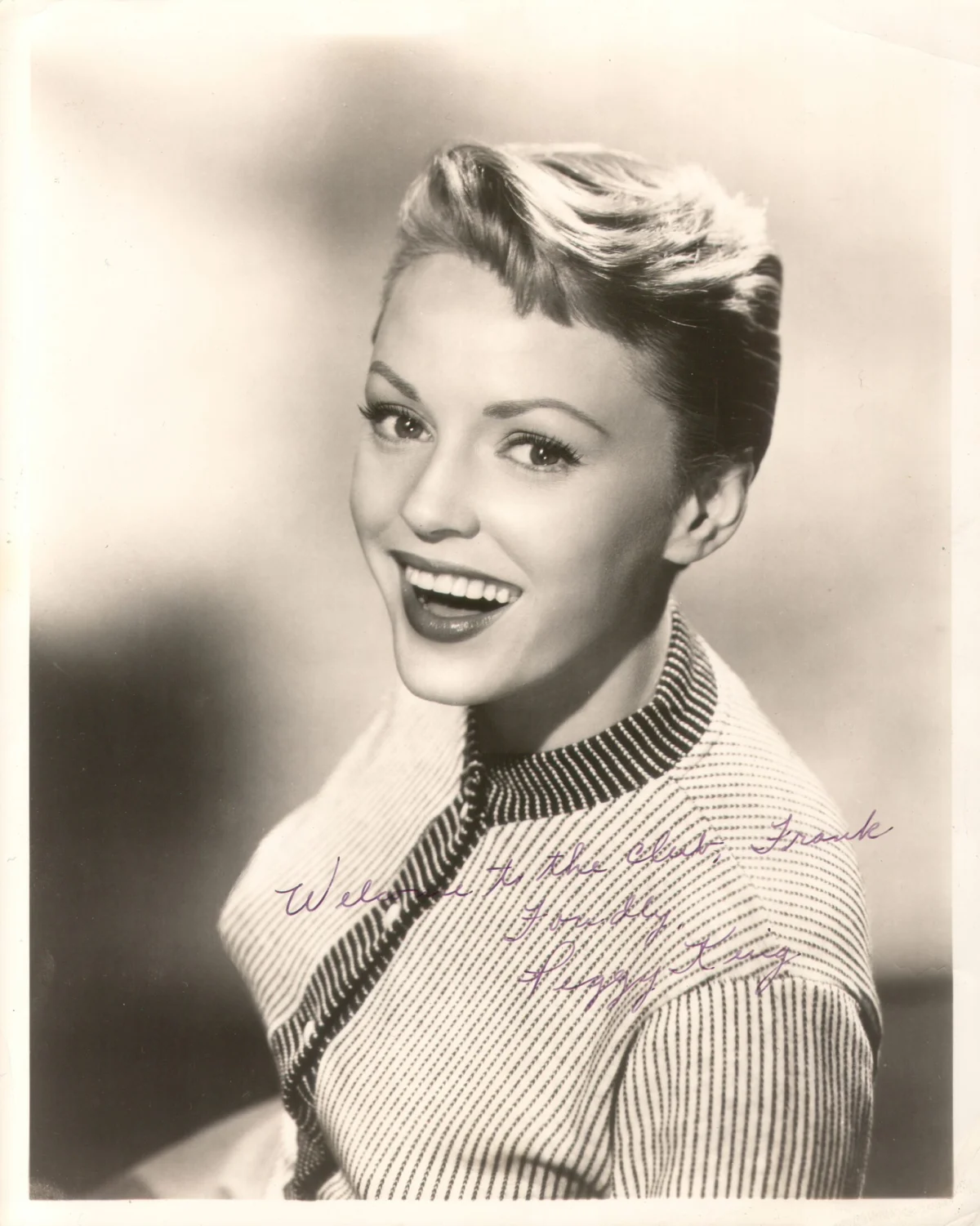
The passing of the celebrated vocalist and actress, who remained an active performer well into the 21st century, was confirmed by her publicist, Alan Eicher. King died on Sunday at the Saunders House Assisted Living facility in Wynnewood, Pennsylvania, following a battle with Alzheimer’s disease. Her death marks the conclusion of a career that spanned the golden age of American television, the transition to color broadcasting, and the enduring legacy of the Great American Songbook.
The Rise of a Television Icon
Born on February 16, 1930, in Greensburg, Pennsylvania, to Floyd Henry King and Margaret Finan, Peggy King’s journey to national prominence began in the radio studios of Cleveland, Ohio. Her early vocal training and natural charisma allowed her to transition seamlessly into the emerging medium of television. After graduating from Ravenna High School, King moved with purpose, quickly establishing herself as a reliable and charismatic presence in the industry.
Her big break came in 1954 when she secured a regular spot on "The George Gobel Show." It was here that host George Gobel famously bestowed upon her the moniker "Pretty Perky Peggy King." The nickname was not merely a marketing gimmick; it captured the essence of her stage persona—an effervescent, energetic, and impeccably polished singer who embodied the optimistic spirit of post-war America. Her tenure on the show lasted until 1957, during which time she became a household name across the United States.
A Career in Chronology
To understand the breadth of King’s influence, one must look at the timeline of her professional ascent:
- Early 1950s: King begins her professional trajectory in radio before signing a contract with MGM in 1952.
- 1954–1957: The "George Gobel Show" era. This period solidified her status as a premier television entertainer.
- 1955: A banner year. King was nominated for an Emmy Award for Best Female Singer and performed "Count Your Blessings" at the 27th Academy Awards ceremony.
- 1958: King reaches the pinnacle of television prestige by co-hosting the Emmy Awards.
- 1960s–1990s: A prolific period of guest appearances on late-night talk shows and dramatic series, ranging from "The Tonight Show Starring Johnny Carson" to "Dragnet."
- 2010: Induction into the Broadcast Pioneers Hall of Fame.
- 2016: Release of her final studio album, "Songs a la King."
The Recording Studio and the "Cry Me a River" Connection
While television made her a face, music made her an artist. Mitch Miller, the influential A&R executive at Columbia Records, signed King to a long-term contract that resulted in two best-selling albums and a series of successful singles.
However, her discography is perhaps most famous for a missed opportunity that remains a point of historical intrigue. Composer Arthur Hamilton specifically wrote the torch song "Cry Me a River" with King’s voice in mind. In a decision that has been debated by music historians for decades, Miller refused to let King record the track. The song was later immortalized by Julie London, becoming a jazz standard. Despite this, King’s ability to interpret standards remained a hallmark of her career, and she continued to record and perform live, maintaining a rigorous schedule in Philadelphia, New York, and Los Angeles until 2014.
Diversity of Talent: From Musicals to Dramas
King’s versatility was a defining characteristic of her professional life. In the 1950s, when performers were often expected to stay in their lane, King crossed the boundaries between variety comedy, musical theater, and dramatic acting.
Her credits in musical television include starring roles in "Hans Brinker or the Silver Skates" alongside teen idol Tab Hunter, and a televised musical adaptation of "Jack and the Beanstalk," which featured a star-studded cast including Joel Grey, Celeste Holm, and Cyril Ritchard. Beyond music, she demonstrated dramatic capability in projects such as the 1957 thriller "Zero Hour!"—the film that served as the basis for the parody "Airplane!"—where she played a stewardess opposite Dana Andrews and Linda Darnell.
Her television appearances read like a directory of the most significant programs in broadcast history. From the variety stages of Bob Hope’s "Chevy Show," "The Steve Allen Show," and "The Garry Moore Show" to the panel-driven format of "What’s My Line?" and the legendary late-night couch of Johnny Carson, King was a ubiquitous presence. She also proved her acting chops in gritty procedural dramas like "Maverick" and "Dragnet," demonstrating that her appeal extended far beyond musical performance.
Legacy and Industry Recognition
King was a pioneer for women in the television industry. She was among the first group of entertainers to be honored with a star on the Hollywood Walk of Fame, an acknowledgment of her contribution to the evolution of the medium. Her 2010 induction into the Broadcast Pioneers Hall of Fame served as a retrospective validation of a career that had, by that point, spanned more than half a century.
Her influence was not limited to performance. In the advertising world, she was the voice behind a highly successful commercial jingle for Hunt’s Tomato Sauce, a reminder that during the 1950s, the line between celebrity and commercial pitch-person was blurred in ways that laid the foundation for modern brand endorsements.
Analysis: The Impact of the "Perky" Archetype
The death of Peggy King prompts a reflection on the specific archetype she represented. The "perky" female entertainer of the 1950s was a cultural construct that provided audiences with a sense of stability and cheer following the trauma of the Second World War. King’s ability to inhabit this role without appearing disingenuous is what separated her from many of her contemporaries. She was technically proficient, possessing a clear, resonant voice that suited the pop-jazz standards of the era.
By maintaining her career well into the 2010s, King bridged the gap between the black-and-white television era and the modern digital age. Her final album, "Songs a la King," was not merely a nostalgia piece; it was a testament to her enduring commitment to the craft of singing. As the generation of performers who defined the infancy of television begins to pass, King’s life stands as a case study in the longevity of talent. She navigated the transition from radio to live television, then to filmed television, and finally to the digital distribution of music, all while maintaining a consistent artistic identity.
Official Responses and Family
The news of her passing has been met with quiet mourning within the industry, as many of her contemporaries have already passed. Her family, including her daughter, Suzy Rudofker, and her son-in-law, Dwain Goforth, have requested privacy during this time.
Publicist Alan Eicher, who managed the communication regarding her health in her final years, noted that King’s spirit remained connected to her music until the end. For those who grew up in the 1950s, her death is a final closing of a chapter on an era of television defined by live performances, big orchestras, and the kind of wholesome, high-energy entertainment that "Pretty Perky Peggy King" helped to define.
A Concluding Perspective
Peggy King’s legacy is preserved not only in her recordings and television archives but in the history of the Hollywood Walk of Fame and the Broadcast Pioneers Hall of Fame. She was a woman who arrived in the industry during its most experimental phase and succeeded by being more than just a face; she was a performer who understood the mechanics of the stage, the nuances of the recording studio, and the importance of professional longevity.
As the industry reflects on her life, the consensus remains that she was a consummate professional who helped set the standards for what a television entertainer could achieve. From her early days in Cleveland to the spotlight of the Academy Awards, her career was a long, sustained performance of grace, talent, and, as her signature nickname suggested, an enduring perkiness that never faded, even in her later years. She leaves behind a catalog of work that continues to provide a window into a pivotal era of American popular culture, ensuring that her voice will remain part of the historical record for generations to come.