The debate surrounding artificial intelligence in modern education has long been anchored by a false binary: should students be permitted to use emerging technologies, or should they be strictly prohibited from doing so? For the past several years, educators across the globe have struggled with this deceptively simple question on a daily basis. However, as generative artificial intelligence has quietly woven itself into the fabric of the digital tools students utilize for searching the web, drafting essays, creating multimedia, translating languages, organizing complex projects, and receiving instantaneous feedback, the boundary line between "using AI" and "not using AI" has grown increasingly porous and difficult to define.
More importantly, treating artificial intelligence adoption as a simple yes-or-no proposition fails to provide students with the nuanced guidance they require. It does little to help learners understand the diverse, context-dependent roles that AI can—and should—play in the educational ecosystem. Recognizing this pedagogical blind spot, institutions are beginning to pivot away from restrictive prohibitions toward frameworks that foster genuine digital literacy. A prime example of this evolution is unfolding at Zion-Benton Township High School District 126, where educators and administrators have moved beyond outdated binary policies to establish a dynamic, shared language for artificial intelligence-supported learning.

The Evolution of AI Implementation: A Three-Year Chronology
The journey at Zion-Benton Township High School District 126 did not happen overnight; it was the result of a deliberate, multi-year progression that mirrored the rapid advancement of generative technologies themselves. The district’s timeline offers a roadmap for how secondary education institutions can systematically integrate new tools into their curricula without sacrificing academic integrity.
The initiative began in 2023, a pivotal year marked by the sudden mainstream ubiquity of large language models. During this initial exploratory phase, district leadership and pioneering educators focused primarily on understanding the technology. Teachers experimented with generative tools to assess their capabilities, uncover potential security and privacy risks, and determine what kinds of academic disruptions might lie ahead. It was largely a technology-focused conversation, centered on the existential questions of cheating, plagiarism, and detector reliability.
By 2025, the conversation matured. Transitioning from abstract exploration to practical application, the district launched structured pilots across select classrooms and grade levels. Educators stopped asking whether students were using AI and instead began observing how students naturally interacted with it. Teachers tested specific use cases—such as using AI for brainstorming, structuring outlines, or formatting bibliographies—to evaluate the tangible impact on student engagement and critical thinking.
As the 2026 school year approached, the district broadened its strategic focus toward comprehensive AI literacy and deep instructional integration. By this point, it had become glaringly obvious that teachers needed something far more sophisticated and practical than a blanket rule or a simplistic label like "AI allowed" or "AI prohibited." They required a nuanced vocabulary to answer a much more challenging question: How much artificial intelligence involvement is genuinely appropriate for the specific learning objectives students are being asked to master?
The Fallacy of the Blanket Policy: Analyzing Three Distinct Assignments
To understand why traditional binary policies fail, one must examine how artificial intelligence intersects with daily classroom instruction. Consider three hypothetical, yet highly common, high-school writing assignments, each requiring a fundamentally different pedagogical approach.
In the first scenario, an English literature teacher wants to evaluate whether a student can independently construct a persuasive argument from scratch and support it with primary source evidence. Here, the core competency being measured is the student’s unassisted cognitive processing, outlining ability, and rhetorical skill. Introducing generative artificial intelligence into this specific workflow would bypass the very mental exercise the teacher aims to assess.

In the second scenario, students have already drafted their individual arguments independently. However, once their foundational thinking is complete, the instructor invites them to utilize an AI tool to generate counterarguments. The students are then tasked with analyzing these AI-generated opposing viewpoints, identifying logical fallacies, and formulating defenses against them. In this context, AI serves as an interactive sparring partner, enhancing critical analysis rather than replacing it.
In the third scenario, an advanced composition or computer science class explicitly studies the mechanics, ethics, and limitations of generative AI. Students are asked to use the technology extensively to draft initial content, critically evaluate its outputs, heavily revise inaccuracies, meticulously document their exact prompting process, and write a reflective defense of the final editorial decisions they made.
In all three scenarios, artificial intelligence plays a radically different role. Labeling all three experiences simply with the broad brushstroke of "AI allowed" obscures those vital distinctions and confuses students regarding behavioral expectations. Conversely, implementing a blanket prohibition across all three scenarios would eliminate golden opportunities for students to develop the sophisticated AI literacy they will inevitably require in higher education and the modern workforce.

The Birth of the Districtwide AI Use Scale
Recognizing this operational tension, the Zion-Benton Township High School District 126 AI Advisory Committee set out to solve the communication gap. Their solution was the development of a comprehensive, districtwide AI Use Scale designed to establish consistency across every classroom, department, and course offering.
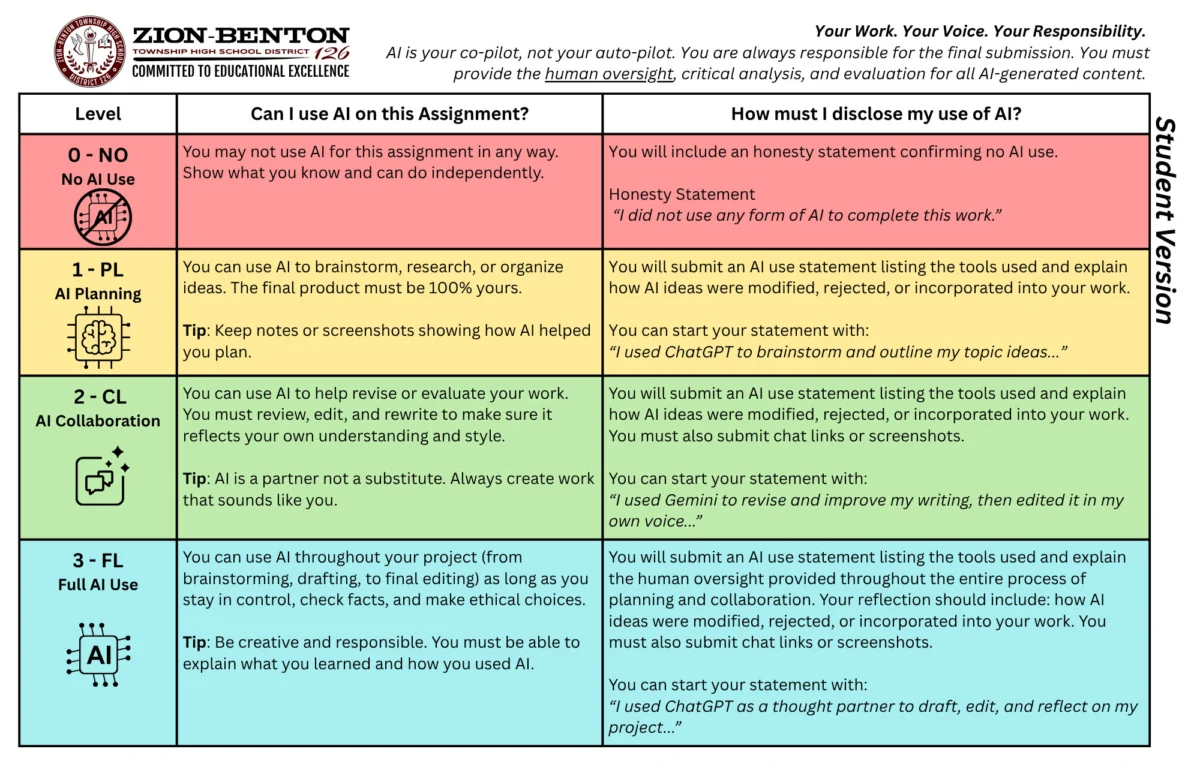
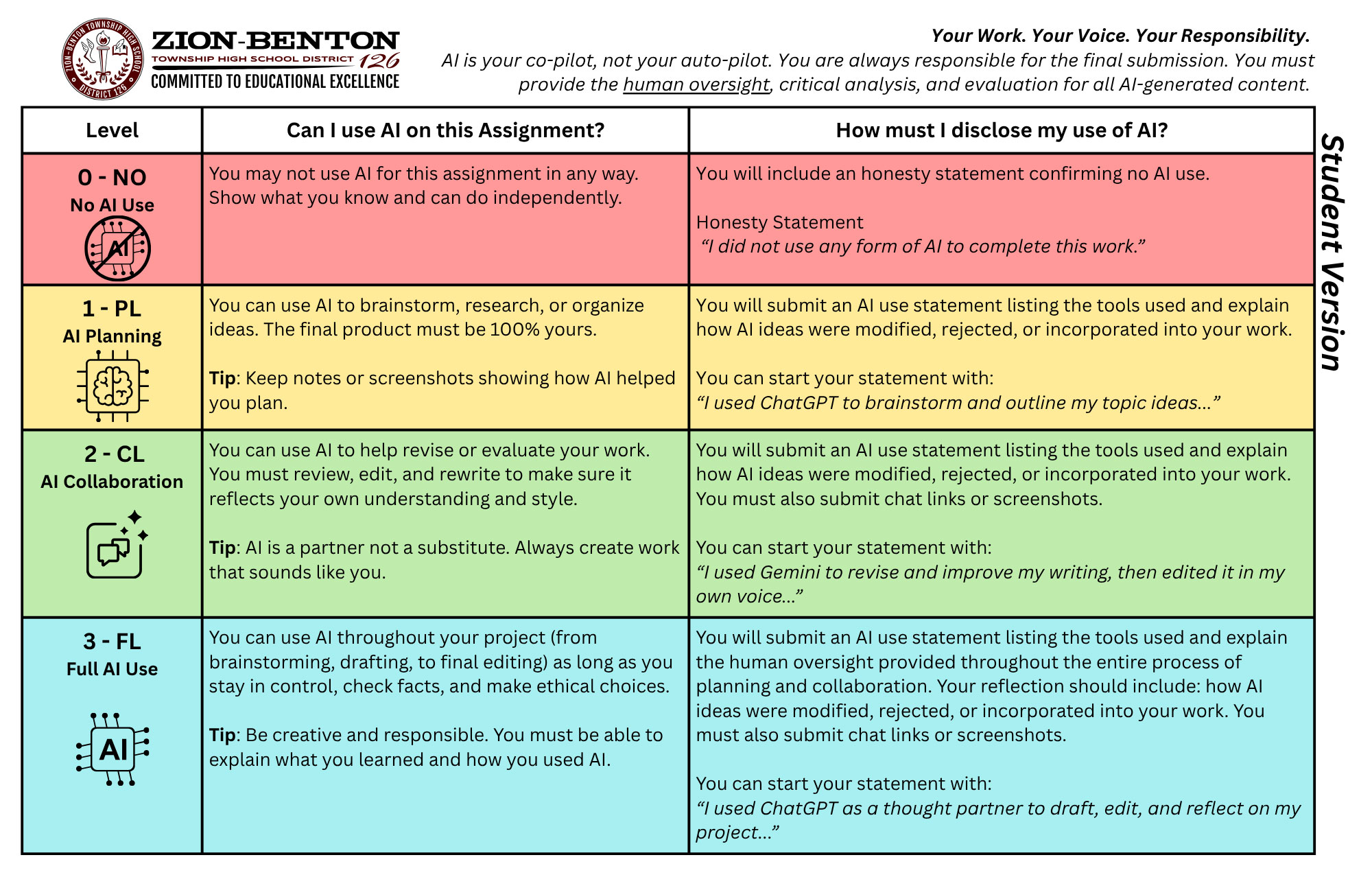
The newly minted scale breaks artificial intelligence integration down into four distinct, easily understood levels:
- Level 0: No AI. Artificial intelligence tools are strictly off-limits. This level is reserved for foundational assignments where students must demonstrate unassisted mastery of basic skills, recall, or independent cognitive processes.
- Level 1: AI Planning. Artificial intelligence is utilized solely in the preliminary stages of an assignment. Students may use AI for brainstorming topics, organizing thoughts, outlining structures, or checking scheduling, but the execution and composition remain entirely human-driven.
- Level 2: AI Collaboration. Artificial intelligence acts as a co-pilot throughout the assignment. Students develop their core work independently but actively engage with AI tools for feedback, generating counter-perspectives, refining grammar, or troubleshooting code.
- Level 3: Full AI Use. Artificial intelligence is deeply integrated into the entire workflow. Students utilize AI to generate primary outputs, which they must then critically evaluate, heavily edit, fact-check, and defend through transparent documentation of their prompting and decision-making processes.
This scale is deliberately designed to be visually prominent, displayed prominently in classrooms and referenced consistently by educators across diverse content areas. The overarching objective is not to make surveillance or policing easier for faculty members, but rather to make academic expectations transparent, teachable, and predictable for students.

Broader Data, Industry Context, and Educational Implications
The initiative undertaken by Zion-Benton Township High School District 126 reflects a wider, urgent shift occurring across the American K-12 and higher education landscapes. According to recent surveys by educational research organizations, over 75% of secondary school teachers report that students regularly utilize generative artificial intelligence for schoolwork, whether officially sanctioned or not. Yet, fewer than 30% of school districts nationwide have provided their instructional staff with formal frameworks or professional development regarding how to manage AI integration effectively.
Education analysts and policy experts point out that restrictive bans—reminiscent of early school policies regarding handheld calculators or Wikipedia—ultimately prove ineffective and counterproductive. Prohibitions fail to prepare students for a job market where fluency in prompting, evaluating machine-generated data, and recognizing algorithmic bias are rapidly becoming baseline professional requirements. By establishing clear scalar guidelines, districts like Zion-Benton are offering a pragmatic middle ground that safeguards academic rigor while embracing technological evolution.
Furthermore, educational psychologists emphasize that transparent instructional scales reduce student anxiety. When learners understand precisely where an assignment falls on the AI Use Scale, ambiguity is eliminated, reducing accidental plagiarism and fostering a culture of academic honesty. Students learn to view AI not as a forbidden shortcut to cheat the system, but as a calibrated instrument whose application must be ethically managed depending on the learning goals at hand.

Looking Ahead: The Future of AI Literacy in Classrooms
As generative artificial intelligence continues its relentless march of advancement—evolving from text-based models to multimodal systems capable of synthesizing complex audio, video, and synthetic data—schools face an escalating imperative to adapt their pedagogical frameworks.
The success of the Zion-Benton Township High School District 126 model suggests that the future of education does not lie in resistance or uncritical acceptance, but in intentionality. By moving away from binary definitions of "allowed" and "prohibited," educators can reclaim their role as facilitators of critical thinking. As teachers continue to refine the AI Use Scale in daily practice, they are demonstrating that the most important question facing modern education is no longer whether students can use artificial intelligence, but rather how thoughtfully, transparently, and skillfully they learn to navigate it.