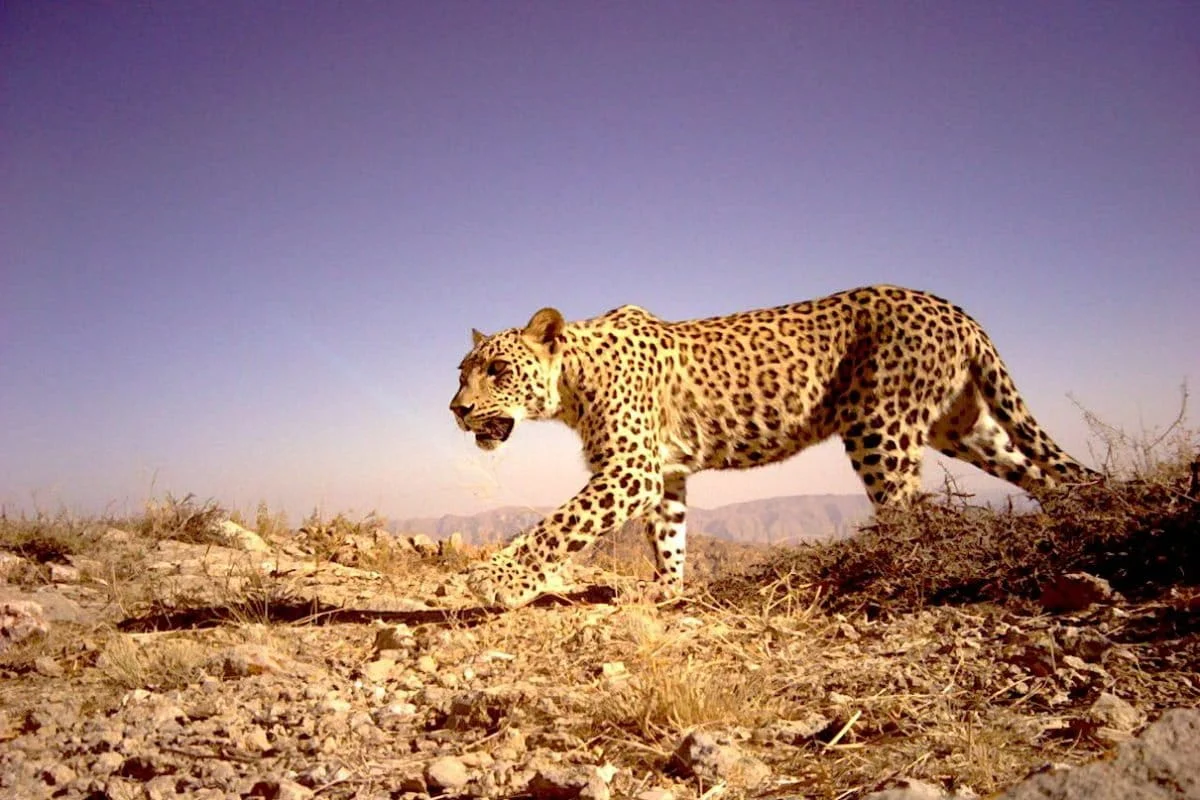
The rugged and geopolitically fractured landscape of the Caucasus region—spanning southern Russia, Georgia, Armenia, and Azerbaijan—harbors one of the world’s most elusive and imperiled big cats: the Persian leopard (Panthera pardus tulliana). With a global population estimated at fewer than 1,100 individuals, the subspecies clings to survival across steep mountain ranges and heavily militarized borders. Among the few recent recordings of these apex predators, the story of a single male leopard named Aren has captured the attention of international scientists and conservationists. Presumed to have journeyed approximately 240 kilometers (150 miles) across harsh, mountainous terrain on just three legs, Aren’s grueling migration highlights both the resilience of wildlife and the severe, lingering threats posed by human conflict zones.
A Rare and Fragile Presence in the Caucasus
Over the past two decades, sightings of the Persian leopard in the South Caucasus have been exceedingly rare. Wildlife monitoring data indicates that Georgia has recorded a mere three sightings in the last 20 years, while Armenia has documented only ten. The vast majority of the remaining Persian leopard population—roughly 80 percent—resides within the borders of Iran, with smaller, fragmented groups scattered across Turkmenistan, Turkey, and the Caucasus.
Historically, Persian leopards were heavily hunted and nearly extirpated from the Caucasus during the Soviet era. Today, the animals face a modern gauntlet of environmental degradation, illegal poaching, human-wildlife conflict, and the invisible hazards of past and present geopolitical conflicts.
The Journey of Aren: From Conflict Zones to National Parks
The saga of Aren began in the rugged borderlands between Armenia and Azerbaijan. Initially monitored by the World Wide Fund for Nature (WWF) and local rangers within the ARPA Protected Landscape in the Vayots Dzor Province of south-central Armenia, Aren was first documented as a healthy young male with all four limbs intact. Researchers believe he originally crossed into the region from Azerbaijan’s Nakhchivan exclave.
However, the political borders dividing these nations are heavily contaminated with decades-old landmines. During a subsequent sighting by park rangers, Aren was missing a limb—an injury wildlife experts strongly attribute to a landmine detonation. Despite this catastrophic handicap, the resilient predator embarked on an astonishing cross-country migration.
Tracking data and camera traps trace Aren’s movement north through the Ijevan Forest in Armenia’s Dilijan Province, eventually crossing the international border into Georgia. Continuing along the Trialeti Ridge, he ultimately arrived in Georgia’s Algeti National Park. Navigating a cumulative route spanning hundreds of kilometers through deep winter snow, steep canyons, and dense forests, Aren demonstrated an almost unbelievable capacity for survival. Camera trap footage even captured him successfully launching himself out of a cave base to hunt prey, adapting his ambush techniques to accommodate his three-legged physique.
The Lethal Legacy of Border Infrastructure
Aren’s severe injury underscores a broader, underreported crisis in wildlife conservation: the ecological toll of military infrastructure and border fortifications. Throughout the Caucasus, thousands of kilometers of aging infrastructure continue to fragment habitats.
During the Soviet era, extensive barrier systems—such as the Sistema network featuring barbed wire and signal fencing—were erected across the region. Though much of this infrastructure is no longer electrified, the tangled, deteriorating wire and lingering minefields continue to trap and mutilate wildlife. Large mammals, including Persian leopards, brown bears, and Caucasian deer, frequently suffer severe lacerations, amputations, or death from abandoned munitions and physical barriers.
While some observers historically argued that minefields inadvertently protected certain areas by deterring human poachers and developers, conservationists strongly reject this notion. Experts emphasize that landmines prevent essential wildlife monitoring, kill prey species indiscriminately, and pose fatal hazards to migrating animals that do not recognize political boundaries.
Conservation on the Frontlines: The Struggle of Underfunded NGOs
Protecting species that traverse international boundaries requires coordinated conservation efforts, yet organizations operating in the Caucasus face severe financial and administrative hurdles. Prominent local NGOs, such as the Centre for Biodiversity Conservation & Research (NACRES)—founded in Georgia in 1991 as the Noah’s Ark Centre for the Recovery of Endangered Species—operate on extremely limited budgets and skeleton crews.
Led by zoologist Bejan Lortkipanidze, NACRES works alongside international bodies like the WWF to maintain camera-trap networks, monitor ecosystem health, and collaborate with forestry departments. However, these grassroots efforts have been strained by broader geopolitical shifts, including funding contractions and the recent closure of international aid programs like USAID.
Field conservationists operate under grueling conditions, often slogging through heavy winter snowpacks to maintain remote monitoring equipment. When asked what could be achieved with adequate resources, Lortkipanidze noted that priorities would include establishing a centralized monitoring hub, expanding rural education and outreach in remote areas like the Tusheti region, and implementing proactive mitigation measures to reduce human-wildlife conflict.
Human-Wildlife Conflict and Retaliatory Killings
Beyond physical barriers and landmines, Persian leopards face persistent pressure from rural communities. As natural prey populations fluctuate and human settlements expand into traditional wildlife corridors, leopards occasionally prey on livestock, putting them on a direct collision course with farmers.
This proximity frequently results in human-wildlife conflict. While direct poaching has decreased due to stricter penalties, retaliatory killings remain a hidden threat. Farmers attempting to protect livestock from wolves or stray dogs sometimes deploy poison baits, snares, or jaw traps, which can indiscriminately kill endangered leopards. Conservationists emphasize that mitigating these conflicts requires community-level engagement, compensation programs for livestock losses, and localized education on how to safely coexist with large carnivores.
Broader Implications and the Imperative of Hope
The persistence of Persian leopards in the Caucasus—typified by the remarkable journey of Aren—serves as a powerful indicator of ecosystem health. Because large cats act as umbrella species, safeguarding their habitats indirectly protects an array of other native flora and fauna.
While the geopolitical landscape of the Caucasus remains tense and complex, the dedication of local scientists and field researchers offers a vital counterweight to environmental degradation. Journalism and conservation science in these regions often highlight the capacity for nature to heal when given even the narrowest margins, challenging humanity to rethink how political borders interact with the natural world.
Ultimately, the survival of animals like Aren challenges desensitization to conflict and environmental loss. As conservationists continue their tireless monitoring work amid tight budgets and fractured landscapes, the endurance of the Persian leopard stands as a testament to the resilience of the natural world—and a reminder of the shared responsibility to protect cross-border ecosystems for future generations.