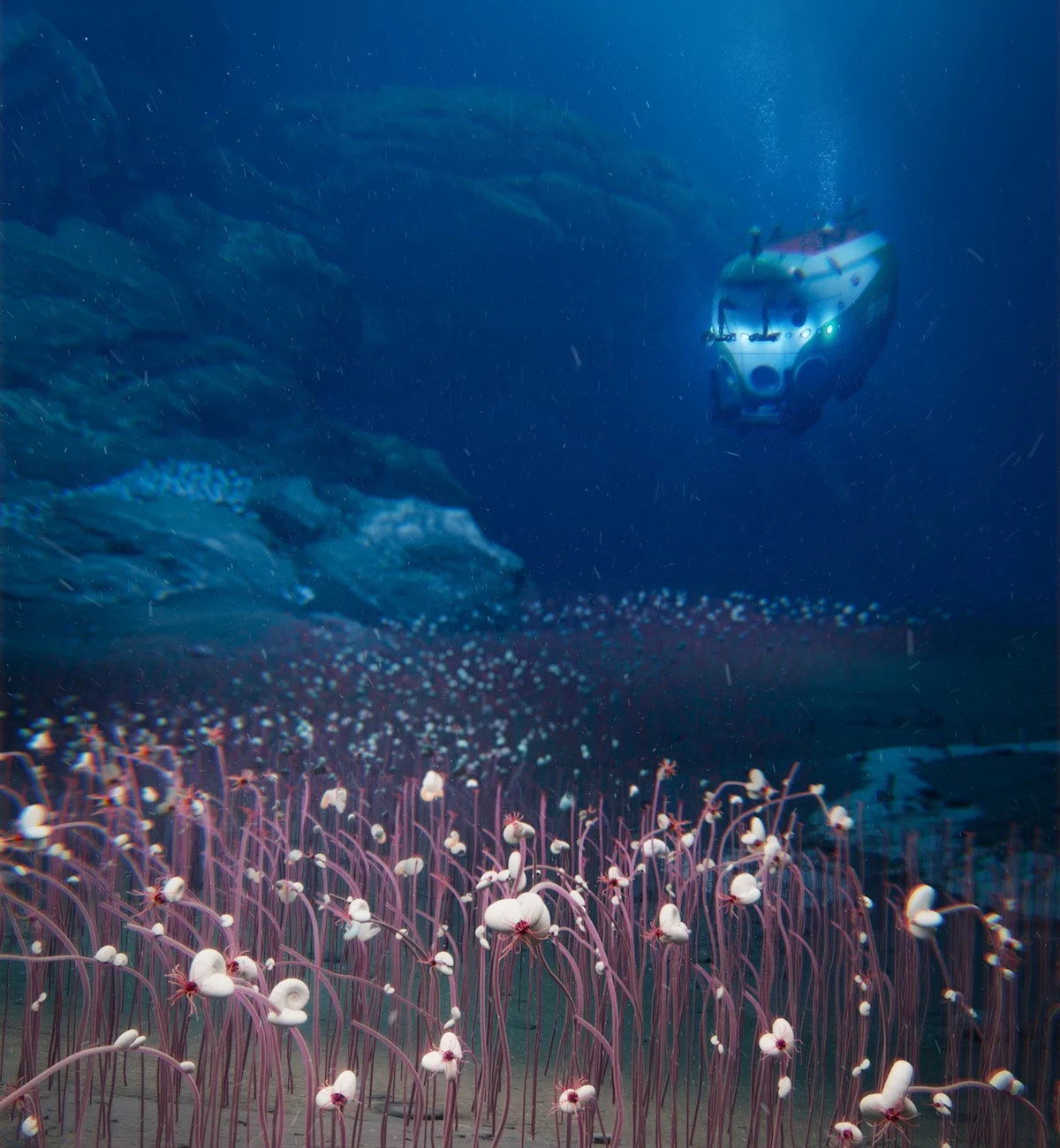
Deep beneath the surface of the western Pacific Ocean, in the crushing darkness of the Mariana Trench, marine researchers have made a groundbreaking discovery that challenges long-held scientific assumptions about the absolute limits of life on Earth. Operating the manned submersible Fendouzhe, a team of scientists from the Institute of Deep-sea Science and Engineering at the Chinese Academy of Sciences documented a massive, sprawling ecosystem of mollusks, tubeworms, and other invertebrates thriving nearly six miles below sea level.
Published in the journal Nature under the title "Flourishing chemosynthetic life at the greatest depths of hadal trenches," the study details how thousands of animals survive in conditions previously thought to be too hostile and nutrient-poor to support complex biological communities. The discovery not only establishes a new depth record for animal life on Earth but also forces oceanographers to rethink global carbon cycling models and the true prevalence of life in the planet’s least-explored environments.
Unprecedented Discoveries in the Abyss
The Mariana Trench, a crescent-shaped scar in the Earth’s crust, plunges deeper than Mount Everest is tall. For decades, scientists understood that the hadal zone—regions of the ocean deeper than 3.7 miles (6,000 meters)—harbored microbial life, but the existence of large, complex animal communities dependent on chemical energy rather than sunlight remained largely hypothetical.
During a series of 23 dives conducted last year in the Mariana Trench, as well as supplementary expeditions to the Kuril-Kamchatka Trench and the western Aleutian Trench, the Fendouzhe submersible revealed a starkly different reality. Rather than the barren, desolate wasteland historically described by lone visitors like filmmaker James Cameron—who descended to the Challenger Deep in 2012—the researchers encountered vibrant, densely populated oases.
The newly identified communities stretch across an astonishing distance of 1,553.4 miles, existing at depths ranging from 3.6 to 5.92 miles. High-definition video footage captured by the submersible revealed fields of siboglinid tubeworms growing up to a foot long, dense mounds of clams and bivalves, free-floating marine worms, spiky crustaceans, sea lilies, and sea cucumbers.
The Mechanics of Hadal Survival: Chemosynthesis
Because sunlight cannot penetrate beyond approximately 3,300 feet (1,000 meters) into the ocean, the creatures of the hadal zone cannot rely on photosynthesis to fuel the food web. Instead, these subterranean ecosystems are entirely dependent on a process known as chemosynthesis.
According to the study’s findings, the deep-sea colonies are sustained by fluids rich in hydrogen sulfide and methane. These chemical-laden fluids are transported upward along active geological faults that traverse the deep sediment layers of the trenches. Isotopic analysis performed by the research team indicated that the methane is produced microbially from organic matter that has drifted down from the upper layers of the ocean over millennia.
The tubeworms and bivalves cluster closely around snow-like microbial mats that feed on these chemical seeps. This geological and biological interplay creates a localized, self-sustaining food web completely detached from the solar-powered surface world.

Lead author Xiatong Peng noted that the geological similarities shared among the world’s hadal trenches suggest these chemosynthetic communities are likely far more widespread than previously anticipated. Mengran Du, a marine geochemist and co-author of the study, described the experience of witnessing the ecosystem firsthand.
"What makes our discovery groundbreaking is not just its greater depth—it’s the astonishing abundance and diversity of chemosynthetic life we observed," Du said. "Unlike isolated pockets of organisms, this community thrives like a vibrant oasis in the vast desert of the deep sea."
A Brief Chronology of Deep-Sea Exploration
The journey to understanding the hadal zone has spanned more than half a century, marked by technological leaps in submersible engineering:
- 1960: Oceanographer Jacques Piccard and US Navy Lieutenant Don Walsh become the first humans to reach the bottom of the Mariana Trench, descending in the bathyscaphe Trieste. They report seeing a flatfish, proving life can exist at extreme pressures, though systematic exploration remains limited for decades.
- 2012: Filmmaker and explorer James Cameron completes a historic solo descent to the Challenger Deep in the Deepsea Challenger submersible, describing the environment as desolate and alien.
- 2020s: Advanced manned submersibles like China’s Fendouzhe enable routine, high-precision scientific dives into previously inaccessible trenches, allowing for detailed sampling, mapping, and high-resolution video documentation.
- July 2025: Researchers publish their landmark findings in Nature, formally documenting the deepest and most extensive chemosynthetic animal communities ever discovered.
Scientific Implications and Paradigm Shifts
The discovery of these extensive chemosynthetic communities forces a significant revision of deep-ocean carbon cycling models. Previously, scientists believed that deep-sea benthic communities relied almost exclusively on "marine snow"—the steady shower of organic detritus falling from the upper photic zone. The realization that substantial animal biomass is locally synthesized via chemical energy from within the Earth’s crust demonstrates that hadal trenches play a more active, complex role in global biogeochemical cycles than previously understood.
Furthermore, the findings broaden the known physiological envelopes of multi-cellular life. Enduring hydrostatic pressures exceeding 1,000 times that at sea level, combined with near-freezing temperatures and absolute darkness, requires extraordinary cellular and biochemical adaptations. Biologists anticipate that studying the proteins, enzymes, and cellular membranes of these mollusks and tubeworms could yield valuable insights for biotechnology and medicine.
Conservation Concerns Amid the Rush for Deep-Sea Minerals
The release of the study coincides with intense geopolitical and economic debates regarding the future of the world’s oceans. Nations and private corporations are currently locking horns over the regulation of deep-sea mining, an emerging industry targeting vast polymetallic nodule deposits strewn across the abyssal plains and trench slopes. These minerals—including nickel, cobalt, copper, and manganese—are prized for their use in renewable energy technologies and electric vehicle batteries.
However, marine scientists and conservation organizations have issued repeated warnings that industrial mining operations could irreparably damage fragile, slow-growing ecosystems in some of the planet’s final untouched wildernesses. Heavy machinery traversing the seafloor risks destroying delicate habitats, kicking up sediment plumes that could choke filter-feeding organisms, and disrupting the very geological faults and fluid pathways that sustain chemosynthetic life.
The International Seabed Authority (ISA) has spent years attempting to draft a comprehensive regulatory framework for commercial deep-sea mining, yet mandatory safety rules and environmental safeguards remain unfinalized. Environmental advocates argue that discoveries like the Fendouzhe deep-sea oases highlight how little humanity understands about the ocean floor, making a precautionary approach essential before industrial exploitation begins.
As research vessels continue to probe the abyssal trenches of the Pacific and beyond, the deep ocean continues to reveal its hidden complexities. The revelation that life not only survives but flourishes under extreme geological conditions underscores the resilience of nature—and the urgent responsibility humanity bears to protect these dark, mysterious ecosystems from irreversible anthropogenic harm.