Editor’s Note: This is a sponsored posting.
The rapid expansion of municipal curbside food scrap collection programs has been one of the most significant shifts in North American waste management over the past decade. According to data from BioCycle’s comprehensive nationwide surveys, the number of U.S. households with access to dedicated food waste collection surged to 14.9 million in 2023. This represents a robust 49 percent increase from the 10 million households documented just two years prior. As municipalities scramble to meet aggressive climate goals, the infrastructure for organics diversion—comprising composting facilities and anaerobic digestion plants—has scaled alongside these programs. However, a critical bottleneck has emerged that threatens to undermine these environmental gains: the persistent gap between program availability and actual household participation.
In many jurisdictions, reported participation rates vary drastically. While some cities boast near-universal adoption, others struggle to maintain engagement above the 30 percent threshold. This disparity is not merely a logistical inconvenience; it is an environmental imperative. Organic waste constitutes approximately 24 percent of the material currently entering U.S. municipal landfills. The Environmental Protection Agency (EPA) has consistently highlighted that the anaerobic decomposition of this food waste is the primary driver of fugitive methane emissions from landfills, accounting for roughly 58 percent of such releases. Given that methane is a potent greenhouse gas with a global warming potential significantly higher than carbon dioxide over a 20-year horizon, an unused or underutilized green bin is far from a neutral outcome. It represents a missed opportunity for climate mitigation that directly impacts municipal carbon footprints.
The Chronology of Adoption and the "Yuck Factor"

The transition to household organics recycling has been marked by a steep learning curve. The initial phase, roughly between 2015 and 2019, focused on the "rollout" model: municipalities provided bins, distributed educational pamphlets, and launched public awareness campaigns. By 2021, the focus shifted to optimization. Planners realized that simply providing the infrastructure was insufficient if the resident experience was suboptimal.
The primary barrier, often overlooked in policy documents, is the "yuck factor." When food scraps—which possess high water content—are placed directly into a large curbside cart, the decomposition process accelerates. As produce breaks down, it releases liquid leachate that pools at the bottom of the bin. This moisture promotes rapid bacterial growth, foul odors, and the attraction of pests, including rodents and flies. For the average household, the necessity of scrubbing a large, unwieldy plastic bin every week becomes a significant deterrent. Eventually, the manual labor required to maintain the hygiene of the bin outweighs the resident’s commitment to the program, leading to a quiet, gradual cessation of participation.
Data and Evidence from the Field
While comprehensive academic studies isolating "bin cleaning" as a primary reason for program abandonment are still emerging, behavioral data from pilot programs offer compelling insights. In the 2023–2024 period, the Essex County Council in the United Kingdom implemented a targeted intervention known as the Food Recycling Project. Recognizing that the barriers to entry were often psychological and tactile, the council provided over 375,000 households with a comprehensive toolkit. This package included instructional signage for general waste bins, educational leaflets, and, crucially, a supply of compostable liners.
The results were statistically significant: food recycling tonnage rose by an average of 21 percent within the first three months compared to a control group, more than double the council’s initial target of 10 percent. While the campaign was multi-faceted, the data suggests that providing a tool to contain the waste and simplify the process significantly lowers the friction of participation. However, such programs also highlight a systemic limitation: municipal budgets are rarely equipped to provide a permanent subsidy of liners or containment tools. This creates an ongoing reliance on disposable solutions that may not be financially sustainable for local governments.

The Role of Structural Innovation
The challenge of maintaining participation requires a shift in how we approach the "container" itself. If the goal is to keep the bin dry and odor-free, the solution must address the fundamental physics of the waste. As noted in the MITRE-Gallup survey, which analyzed the habits of nearly 10,000 U.S. households, the average household generates approximately 8.8 cups of food waste per week—a volume that does not necessarily require the massive capacity of a standard 64-gallon curbside cart.
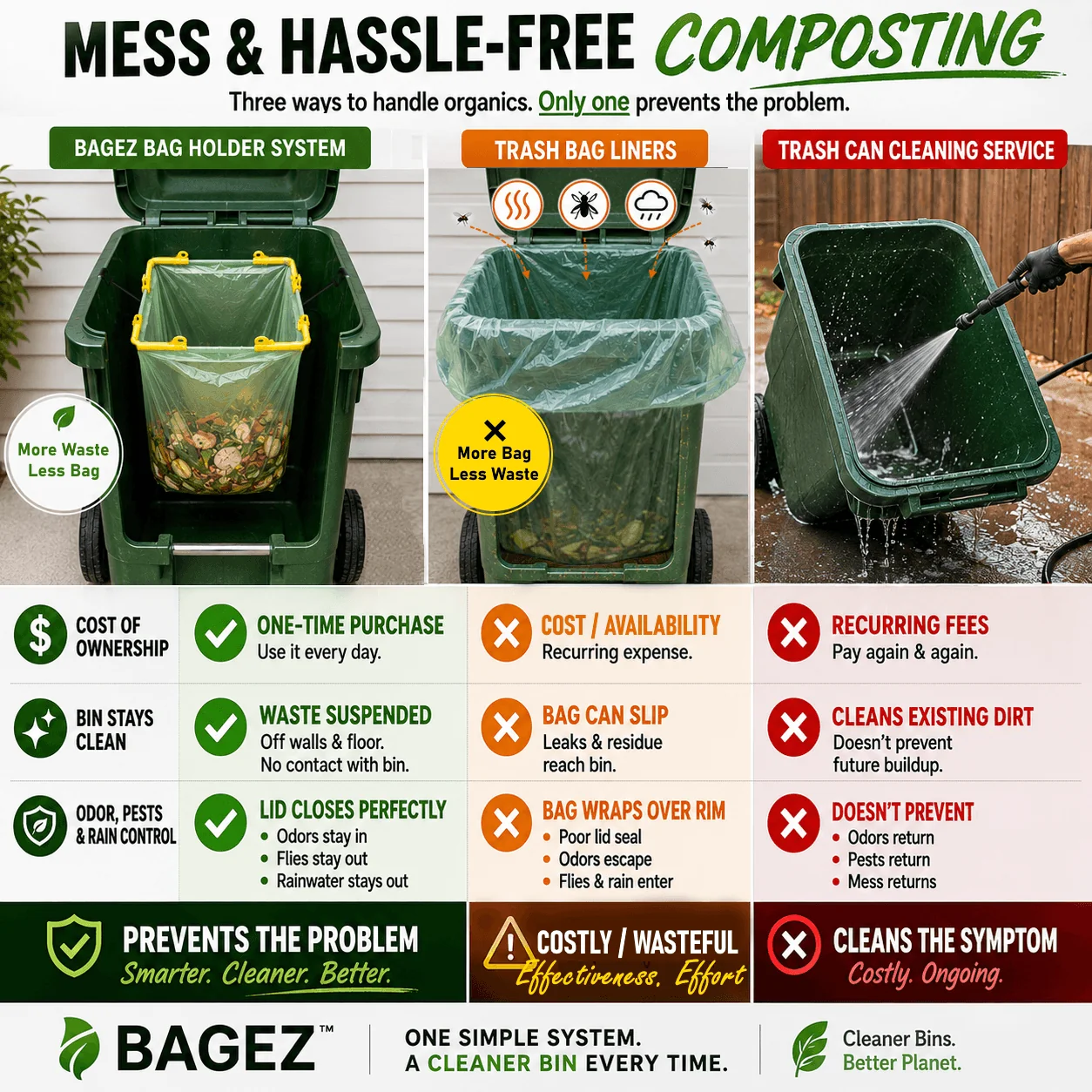
Innovation in this space, such as the BagEZ system, targets this mismatch. By utilizing a reusable, folding steel rack that suspends a bag within the bin, the system prevents the waste from coming into contact with the bin’s walls and base. This suspension allows for critical airflow, facilitating the evaporation of condensation and preventing the accumulation of leachate. When the waste is contained in a suspended, right-sized bag, the interior of the curbside cart remains dry.
This structural change has profound implications for waste management:
- Improved Hygiene: By eliminating the pooling of liquids, the environment becomes significantly less attractive to disease vectors like flies and rodents.
- Reduced Maintenance: Because the bin remains dry, the requirement for frequent, labor-intensive cleaning (hosing or scrubbing) is minimized, effectively removing the primary chore that leads to program dropout.
- Enhanced Efficacy of Odor Control: Methods like the application of baking soda or diatomaceous earth are vastly more effective in a small, contained, and dry environment than when spread across the surface of a large, damp, and porous bin.
Broader Implications for Municipal Policy

The success of municipal diversion programs hinges on the "last mile" of waste management—the household kitchen and the curb. If the resident finds the process repulsive, the program will inevitably fail to achieve the diversion rates required to meet 2030 climate targets.
Fact-based analysis suggests that municipalities should broaden their focus from simple collection logistics to user-experience engineering. Providing, or recommending, the use of simple, durable hardware that keeps bins clean is a low-cost, high-impact strategy. Furthermore, residents must be better educated on the specific requirements of their local haulers. As indicated by the Earth911 recycling directory, contamination remains a significant issue; using the wrong type of liner or an unapproved bag can lead to the rejection of an entire load at a composting facility.
The economic and environmental math is clear: the cost of cleaning or replacing bins, combined with the loss of diversion capacity, far outweighs the investment in simple, reusable tools that keep the system running smoothly. By removing the "yuck factor," municipalities can convert passive, hesitant participants into consistent, long-term practitioners of organic waste diversion.
Conclusion: Sustaining the Momentum
As urban centers continue to expand their organics collection services, the focus must remain on the durability of participation. The transition from a "rollout" mindset to a "retention" mindset is essential. By addressing the physical realities of organic waste—moisture, odor, and pests—through simple, effective, and sustainable hardware, the gap in participation can be closed.

The environmental necessity of diverting food waste from landfills is no longer a matter of debate; it is a critical component of modern municipal infrastructure. As we look toward the next five years of waste policy, the most successful programs will be those that recognize that the path to a cleaner, greener future begins with a simple, clean, and well-managed green bin. By making the process easier for the average household, we ensure that the environmental benefits of diversion are realized at the scale the climate crisis demands. For those interested in optimizing their home composting setup, further information on the BagEZ system and its application in residential settings can be found at bagez.com.