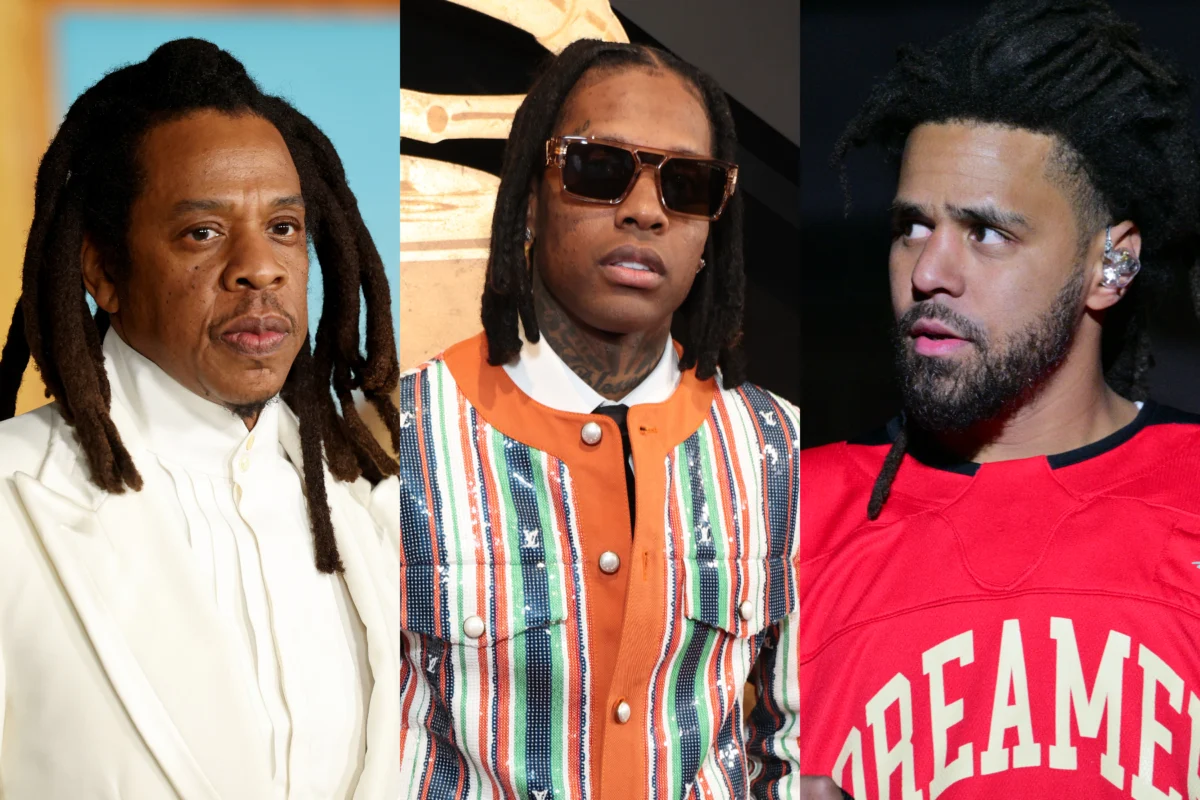
The legal battle surrounding Grammy-winning rap artist Lil Durk has taken a dramatic turn as industry titans Jay-Z and J. Cole step forward to support his latest bid for freedom. In a bold legal maneuver filed in federal court, the Chicago-born artist—legally known as Durk Banks—has offered to sign over all future music royalties and earnings as financial security to guarantee his appearance at an upcoming trial scheduled for August 2027. This high-stakes financial package is further bolstered by a $1 million appearance bond offer from Sony Music Entertainment.
The coordinated effort by some of hip-hop’s most influential figures aims to convince U.S. District Judge Michael Fitzgerald that the 34-year-old artist poses no flight risk and deserves pretrial release. The defense argues that the financial implications of the agreement are absolute: if Banks were to violate his release terms and flee, both he and his family would be left entirely destitute. This comprehensive bail proposal arrives in the wake of a complex legal journey that has seen major victories for the defense, yet leaves lingering federal racketeering charges hanging over the artist’s head as the judicial process presses forward.
The Chronology of the Case and Legal Separation of Charges
The origins of this federal case stretch back to allegations connecting Banks to a violent feud rooted in the hip-hop community. Prosecutors initially charged Banks, alongside co-defendants Deandre Wilson and David Lindsey, in connection with a murder-for-hire plot. The indictment alleged that the conspiracy led to the stalking and fatal shooting of 24-year-old Saviay’a Robinson—also known as Lul Pab—on August 19, 2022, in Los Angeles. Robinson was the cousin of Quando Rondo (Tyquian Bowman), whom prosecutors claimed Banks targeted in retaliation for the 2020 killing of Banks’ close friend and protégé, King Von.
While Wilson and Lindsey were subsequently convicted of conspiracy to commit stalking, stalking, and stalking resulting in death—though acquitted of the murder-for-hire charges—Banks faced his own high-profile trial in late summer. In September, a federal jury acquitted Banks of all counts in that initial trial.
However, the legal jeopardy did not end with the verdict. Two months prior to the summer proceedings, federal prosecutors filed a third superseding indictment introducing brand-new counts against Banks, including murder in aid of racketeering activity and firearms possession in furtherance of murder in aid of racketeering. The government alleged that Banks operated a broader criminal enterprise linked not only to Robinson’s death in Los Angeles but also to a 2022 killing in Chicago and an alleged attempted murder in Atlanta in February 2019. Recognizing that these late-stage charges were introduced too close to the trial date, Judge Fitzgerald severed them into a separate legal proceeding, which is currently docketed for August 2027 in Los Angeles.
High-Profile Advocacy from Jay-Z and J. Cole
In an effort to sway the court during the upcoming bond hearing, hip-hop icons Jay-Z and J. Cole submitted formal letters to Judge Fitzgerald, offering deeply personal insights into Banks’ character, rehabilitation, and dedication to his community.
Jay-Z, writing to the federal judge, recalled meeting Banks years prior and being immediately struck by his discipline and seriousness. The Roc Nation founder noted that Banks displayed a genuine curiosity about spirituality and spoke about his faith with sincerity. Crucially, Jay-Z emphasized Banks’ commitment to lifting up young artists from impoverished neighborhoods in Chicago, providing them with a legitimate pathway into the music industry rather than leaving them behind in cyclical environments where options are limited and risks are high. "He was kind, respectful, and focused on his career," Jay-Z wrote, urging the court to recognize the artist’s efforts to help others escape adverse conditions.
Similarly, J. Cole—who collaborated with Banks on the quadruple-platinum, Grammy-winning track "All My Life"—shared a revealing behind-the-scenes story regarding the creation of the song. Cole admitted that he initially resisted the collaboration because he felt the positive, uplifting message was "too obvious" for his established introspective persona, asking instead for a grittier, street-level track that would present a greater artistic challenge. However, Banks persisted, explaining that he genuinely wanted to champion a message of maturity, growth, and peace.
Cole highlighted the profound impact of that vision, recalling a visit to a juvenile detention center in Cleveland where detained youth gravitated toward Banks’ music and story. "They relate to his story and his struggle so much," Cole wrote, emphasizing Banks’ willingness to fight for a positive message even when it meant pushing back against an artist he respected. Both rap moguls implored the court to factor these community-focused contributions and personal evolutions into the equation when deciding whether to grant bond.
An Unusual Stance from the Victim’s Family
Adding another layer of complexity to the pretrial release motion, the defense submitted a letter from Andrea Robinson, the mother of the late Saviay’a Robinson. Dated September 28, 2026, Robinson’s letter offered a perspective rarely seen in violent crime prosecutions of this magnitude.
"On behalf of the family of Saviay’a Robinson, we do not object to Durk Banks being granted bond if it is deemed appropriate by the honorable court," Robinson wrote. While not a formal endorsement, the absence of an objection from the victim’s family removes a significant emotional and procedural hurdle that prosecutors typically leverage to argue against pretrial release. Legal analysts note that while victim sentiment is not legally binding on federal judges, courts frequently take the family’s position into account when evaluating community safety and the overall context of granting bond.
Defense Strategy: Weak Evidence and Double Jeopardy Arguments
In the formal legal filings submitted ahead of a critical federal court hearing scheduled for November 4 in Los Angeles, Banks’ defense team built a multi-pronged argument centered on common sense, the weakness of the government’s remaining case, and potential constitutional protections against double jeopardy.
The defense asserted that Banks has virtually no incentive to flee or tamper with witnesses. They pointed out that the upcoming August 2027 trial involves the exact same underlying homicide and relies on the same cooperating witnesses who already testified during the August and September trials—proceedings that ultimately concluded with his acquittal.
"Common sense confirms that a rational defendant is less likely to flee or tamper with potential witnesses when he knows that the evidence against him is too weak to convict him of a charge, even where that charge carries with it a serious sentence," defense attorneys argued in court documents.
Furthermore, the legal team raised the possibility of filing a motion to dismiss the remaining racketeering and firearms charges on double jeopardy grounds. They argued that the earlier acquittal could legally bar the government from prosecuting certain foundational issues a second time. According to the defense, a rational defendant is even less inclined to violate release conditions when there is a viable legal argument that the prosecution itself may be barred by constitutional protections.
Implications and the Road Ahead to August 2027
The upcoming bond hearing on November 4 will serve as a crucial battleground for both sides. Federal prosecutors, who have aggressively pursued racketeering and conspiracy charges against the artist, are expected to mount a robust opposition to the defense’s bail proposal, likely arguing that the severity of the racketeering allegations and the potential for a lengthy prison sentence still constitute an unacceptable flight risk and a danger to the community.
The stakes for Banks, his family, and his corporate partners at Sony Music are immense. The willingness of major industry entities to tie their financial stability directly to his compliance underscores the extraordinary industry backing he retains despite his legal troubles. If Judge Fitzgerald accepts the unprecedented bail package—which includes the surrender of all future royalties, a $1 million corporate bond, and supportive testimonies from cultural icons and the victim’s family—Banks will await his day in court outside the confines of federal custody.
Conversely, should the court side with federal prosecutors and deny bond, Banks faces nearly three additional years of federal detention as he prepares for the complex racketeering trial slated to begin in late summer 2027. As the legal teams prepare their final arguments for the November hearing, the case continues to stand as one of the most high-profile intersections of modern hip-hop culture, corporate liability, and the federal judicial system.