The enduring global fascination with Antoni Gaudí’s monumental Basílica de la Sagrada Família has entered a new era of digital documentation, drawing the attention of architectural historians, digital creators, and millions of online viewers worldwide. Standing as one of the most ambitious and protracted engineering endeavors in human history, the basilica transcends traditional cultural and religious categories. It routinely commands the focus of historical archives, travel documentaries, architectural analyses, and religious broadcasts alike.
Most recently, the construction-focused YouTube channel The B1M turned its lens toward Barcelona to examine the intricate realities of finishing Gaudí’s masterpiece. Guided by creator Fred Mills, the feature highlights a structure that continues to defy conventional architectural classification, blending rigorous engineering with an ethereal spatial experience that leaves modern commentators searching for words.
Main Facts and Architectural Marvels
Commissioned in the late 19th century, the Sagrada Família is unlike any other religious or secular building erected in modern history. Its design integrates complex geometry, biomimetic structural forms, and profound theological symbolism. The interior features soaring columns that mimic forest canopies, branching out to support an intricate vaulting system that distributes weight with revolutionary efficiency. Natural light floods the central nave through meticulously designed stained-glass windows, shifting hues throughout the day to transform the interior into a dynamic, living canvas.
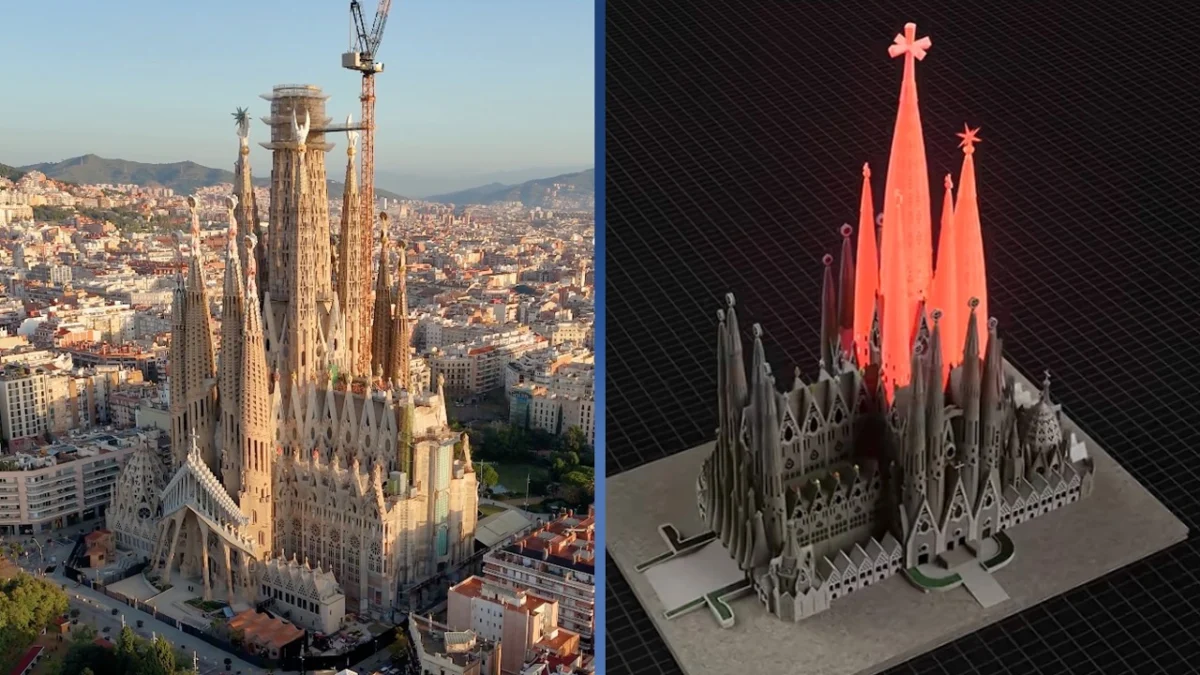
While standard tourists visit the basilica at a staggering rate of approximately 1,500 people per hour, specialized access grants documentary crews a deeper look into the mechanics of its realization. From the pinnacle’s massive newly assembled cross down to the basement workshops where physical and digital models test structural tolerances, the project represents a bridge between historical craftsmanship and contemporary engineering.
Chronology of a Century-Long Build
The realization of the Sagrada Família is defined by a uniquely extended timeline, marked by visionary design, tragic disruption, and modern technological acceleration:
- 1882: Construction of the basilica begins under architect Francisco de Paula del Villar.
- 1883: Antoni Gaudí takes over the project, fundamentally redesigning the architectural plans to reflect his signature organic style.
- 1926: Gaudí dies tragically at the age of 73 after being struck by a tram in Barcelona, leaving behind incomplete blueprints, sketches, and scale models.
- 1936–1939: The Spanish Civil War breaks out; rioters break into Gaudí’s workshop, destroying many of his original plaster models and documents, which complicates future construction efforts.
- Late 20th Century: Construction resumes incrementally, relying on subsequent architects to interpret Gaudí’s remaining vision through modern technological advancements, including computer-aided design (CAD) and stereolithography.
- 2024–2026: Key structural milestones are achieved, including the topping-out of major towers, bringing the century-old project within sight of final completion.
Supporting Data and Technological Integration
The sheer scale of the Sagrada Família project is reflected in its longevity and the resources required to advance it. Now spanning over 140 years of active construction, the project has outlasted generations of builders, artisans, and engineers.
To bridge the gap between Gaudí’s fragmentary 1920s blueprints and 21st-century safety and structural standards, contemporary architects utilize advanced parametric design software and CNC stone-cutting machinery. These technologies allow modern builders to fabricate complex double-ruled surfaces—such as hyperbolic paraboloids and helicoids—that Gaudí originally envisioned using hanging chain models. Stone blocks, sourced from quarries across Europe and the Americas, are pre-stressed and custom-milled to fit together with millimeter precision, accelerating a workflow that once relied entirely on manual stonemasonry.
Official Responses and Local Dynamics
As the project approaches its projected completion date within the decade, city officials and neighborhood associations in Barcelona have engaged in ongoing discussions regarding the basilica’s final phases. The impending construction of the grand façade and its main entrance—along with surrounding urban planning adjustments—has periodically generated localized debates concerning tourism management, traffic flow, and the preservation of historic residential blocks surrounding the UNESCO World Heritage site.
Representatives of the Junta Constructora de la Sagrada Família maintain that coordination with local municipal authorities remains a priority. The board emphasizes that while tourism provides the primary funding stream for construction costs, balancing visitor capacity with community well-being is essential as the basilica enters its final chapter.
Broader Impact and Implications
The persistent appeal of the Sagrada Família to digital creators, architects, and the general public speaks to a deeper cultural desire for permanence and radical creativity in an increasingly standardized world. As Fred Mills observed during his site visit, the experience of standing within the basilica evokes an emotional resonance that stretches beyond physical construction techniques.
Even as modern technology brings a 144-year-old construction project to its culmination, the Sagrada Família remains fundamentally untethered to the architectural conventions of the contemporary era. Its impending completion marks the end of a singular historical epoch in human building, ensuring that Gaudí’s audacious vision will continue to inspire awe, academic study, and digital documentation for generations to come.