
The landscape of cyber extortion has undergone a chilling transformation, shifting from purely technical sabotage to the targeted psychological and physical intimidation of corporate employees and their loved ones. According to the 2026 Ransomware Risk Report published by identity security firm Semperis, ransomware syndicates are increasingly bypassing the traditional perimeter of enterprise networks to exert direct pressure on individuals. This escalation signals a departure from the "data-for-cash" model that dominated the early 2020s, moving toward a more personal and aggressive form of coercion that leaves organizations and their staff vulnerable in unprecedented ways.

The Shift in Tactics: Beyond the Digital Perimeter
For years, the standard ransomware playbook involved encrypting corporate servers, stealing sensitive data, and demanding payment under the threat of public disclosure or permanent data loss. However, data collected from 1,200 information technology and security professionals across nine countries and eight industry sectors in the first half of 2026 indicates that this strategy is no longer sufficient for attackers.
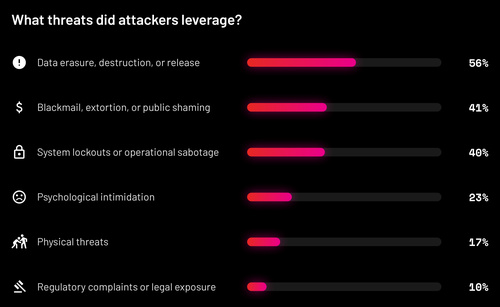
While data destruction and exfiltration remain the most frequent threats—reported by 56% of organizations that suffered a disruptive incident—a significant portion of attacks now incorporate human-centric threats. The report reveals that 23% of victimized organizations faced psychological intimidation, while 17% encountered direct physical threats against executives or their family members. This shift suggests that attackers are leveraging personal information harvested during initial data breaches to craft highly personalized extortion campaigns, effectively turning the employee’s private life into a secondary attack vector.
AI: The Dual-Edged Sword in Modern Extortion
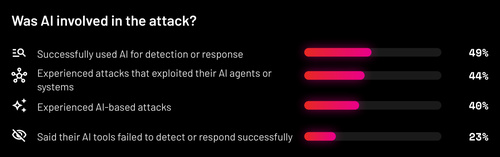
The proliferation of artificial intelligence (AI) has provided malicious actors with a powerful toolkit to automate and refine these attacks. The Semperis report highlights that 84% of respondents experienced attacks where AI played a central role. This figure is split between two distinct categories: 40% of incidents involved attackers utilizing AI to improve their efficiency, while 44% involved the exploitation of the organization’s own internal AI agents or systems.
This "AI-on-AI" warfare creates a volatile security environment. When an organization integrates AI to optimize workflows, customer service, or data analysis, they inadvertently create new entry points. Attackers are finding ways to manipulate these systems, potentially using them to bypass traditional security controls or to generate highly convincing phishing lures that bypass human detection.
Chris Inglis, former U.S. national cyber director and a strategic adviser at Semperis, noted the complexity of identifying these AI-driven threats. "Many attacks are not perceived as being aided and abetted by AI because they’re just too slick, too sophisticated," Inglis remarked. The fluidity of these attacks makes traditional signature-based detection methods increasingly obsolete, requiring a shift toward identity-centric security architectures that focus on verifying the legitimacy of users and systems rather than just policing the network perimeter.
A Chronology of Escalating Extortion
The evolution of these tactics can be traced back to the early 2020s, when ransomware shifted from "spray and pray" indiscriminate attacks to "Big Game Hunting," targeting large enterprises capable of paying multi-million dollar ransoms. By 2023, the industry saw the rise of "double extortion," where attackers would steal data before encrypting it, ensuring a payout even if the victim had offline backups.

By 2024 and 2025, the rise of Large Language Models (LLMs) and automated scripting tools allowed attackers to scale their operations. They began to automate the reconnaissance phase, using AI to scan for vulnerabilities at a speed human analysts could not match. The current 2026 landscape represents the third phase of this evolution: "multi-vector extortion." In this phase, the technical breach is merely the opening move. Once the enterprise system is locked, the threat actor pivots to the human element—using social media scraping, deepfake technology, and personal data to terrorize stakeholders.
Analysis of Defensive Preparedness
The survey provides a sobering look at how organizations are attempting to defend against these sophisticated threats. While 49% of respondents claimed success in using AI-driven security tools for detection and incident response, nearly half of that group—or 23% of the total survey population—reported that their AI security tools failed to prevent or identify the intrusion.

These statistics suggest that while AI is an essential component of modern defense, it is not a panacea. The failure rate of AI tools in these specific instances points to a lack of "AI hygiene." Organizations are deploying AI tools without adequately securing the underlying data models or the identity permissions that govern how those agents access corporate resources. Furthermore, the report emphasizes that these findings are limited to organizations that have already experienced a disruptive attack, meaning these numbers reflect a "survivorship bias"—the reality for organizations that failed to detect an attack at all remains largely hidden from the data.
The Broader Implications for Corporate Policy
The inclusion of physical and psychological threats in the extortion toolkit forces a fundamental rethink of corporate crisis management. Historically, ransomware was treated as an IT problem—a matter of restoring backups and negotiating with the attacker through a third-party firm. Now, it must be treated as a physical security and human resources crisis.

When an attacker threatens an employee’s family, the response protocol must change. It requires coordination with law enforcement agencies, private security detail for high-value targets, and mental health support for affected staff. The psychological toll on employees who find themselves in the crosshairs of global cybercriminal syndicates is significant, potentially leading to long-term talent retention issues and a culture of fear within the organization.
Moreover, the legal and regulatory landscape is likely to shift. Governments, already struggling to regulate the use of AI in commercial sectors, are now faced with the reality that these same systems are being weaponized against private citizens. There is growing pressure for legislation that would mandate higher standards for the protection of personal data, as this data serves as the ammunition for the intimidation tactics observed in the report.

Strategic Recommendations for Organizations
To mitigate these risks, industry experts suggest a multi-layered approach that moves beyond traditional perimeter security. The following strategies are increasingly viewed as essential:
- Identity-First Security: Since attackers are moving from systems to people, the focus must shift to securing the identity of every user. This includes rigorous Multi-Factor Authentication (MFA), strict Principle of Least Privilege (PoLP) policies, and continuous monitoring of privileged access.
- AI Hardening: Organizations must treat their internal AI agents as high-value assets. This involves auditing the data feeds used to train these models and ensuring that AI-driven automated responses are subject to human-in-the-loop (HITL) oversight.
- Crisis Communication and Human Support: Organizations should establish a clear communication plan that addresses not just the technical restoration of systems, but the protection of the people involved. This includes training for employees on how to protect their personal digital footprint and clear policies on what to do if they or their families are contacted by threat actors.
- Enhanced Threat Intelligence: Companies must invest in intelligence that tracks not only known ransomware groups but also the evolving methodologies of these groups, particularly their increasing focus on psychological warfare.
Conclusion
The 2026 Semperis report serves as a critical warning that the ransomware crisis has evolved beyond the walls of the data center. By integrating AI into their operations and expanding their target profile to include the families of employees, cybercriminals have successfully raised the stakes of digital extortion. As organizations continue to digitize their operations, they must ensure that their security strategies are equally robust in protecting the human element, which remains the most vulnerable—and most valuable—component of the modern enterprise. The era of viewing ransomware solely as a technical challenge is over; it is now a comprehensive threat to the well-being of the entire corporate ecosystem.