
The modern threat landscape has breached a deeply personal threshold, as cybercriminal syndicates systematically expand their targeting parameters from corporate infrastructure to the private lives of enterprise employees and their families. According to comprehensive new findings published in the Semperis 2026 Ransomware Risk Report, bad actors are no longer content with locking down servers, encrypting databases, or exfiltrating corporate intellectual property. Instead, they are increasingly deploying aggressive psychological intimidation, direct blackmail, and even physical threats against executives, IT personnel, and their loved ones to force rapid ransom payouts.
This alarming evolution in extortion tactics coincides with the widespread exploitation of artificial intelligence. Ransomware operators are seamlessly weaponizing AI to orchestrate more sophisticated, harder-to-detect breaches while simultaneously subverting the internal AI systems that organizations deploy for their own operational efficiency. Commissioned by identity security and crisis management firm Semperis and executed by research firm Censuswide during the first half of 2026, the study surveyed 1,200 information technology and cybersecurity professionals. Spanning nine countries and eight distinct industry sectors, the research specifically targeted organizations that had suffered at least one disruptive ransomware attack, offering a harrowing glimpse into the realities of modern cyber extortion.

The Changing Anatomy of Cyber Extortion
For decades, the standard playbook for ransomware operators involved penetrating a corporate network, deploying malicious encryption software to lock administrative and operational systems, and demanding a cryptocurrency payment in exchange for the decryption keys. Over time, as enterprise backup and recovery postures improved—allowing organizations to restore operations without paying ransoms—cybercriminals adapted. They introduced "double extortion," threatening to leak sensitive corporate data, trade secrets, or customer PII (Personally Identifiable Information) on dark web leak sites if the ransom was withheld.
The findings from the 2026 Semperis report signal a darker, more intrusive chapter: "triple" and "quadruple" extortion strategies. By shifting the locus of pressure from the boardroom directly to the living room, attackers aim to bypass the rational calculation of corporate risk management committees. When an employee or executive realizes that their family’s safety, privacy, or psychological well-being is directly tied to a corporate IT failure, the pressure to acquiesce to extortion demands multiplies exponentially.
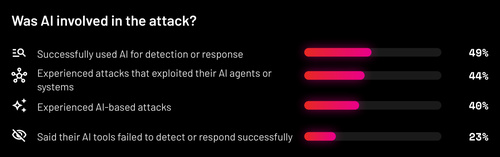
According to the report’s data metrics, data erasure, destruction, or public release remains the most frequently reported threat, cited by 56% of respondents. Traditional blackmail, extortion, and public shaming closely follow at 41%, while operational sabotage and system lockouts account for 40%. However, the inclusion of human-centric threats highlights a sinister tactical shift: psychological intimidation was reported by 23% of victims, and explicit physical threats directed at executives and their families surfaced in 17% of the analyzed incidents.
Artificial Intelligence as a Dual-Edged Sword
Compounding the psychological and physical strain on targeted organizations is the pervasive integration of artificial intelligence into the cyberattack lifecycle. The 2026 report reveals that an overwhelming 84% of respondents experienced attacks that leveraged AI in some capacity. However, the report’s granular breakdown illustrates a critical distinction in how AI is utilized on the digital battlefield.
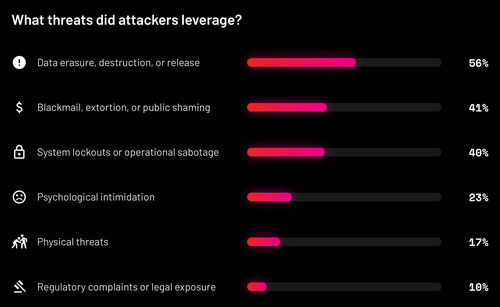
Out of the total respondents, 40% encountered attacks where threat actors directly utilized AI tools to optimize phishing campaigns, accelerate vulnerability scanning, or automate lateral movement within enterprise networks. More alarmingly, 44% of respondents reported attacks that actively manipulated, poisoned, or hijacked the victim organization’s own AI agents and autonomous systems. This means that enterprises rushing to adopt machine learning and generative AI tools to streamline productivity and defense are inadvertently introducing complex, vulnerable attack surfaces that sophisticated criminal syndicates know precisely how to exploit.
Chris Inglis, former U.S. National Cyber Director and currently a strategic adviser to Semperis, emphasized the profound challenge that AI-driven sophistication introduces to modern security operations centers (SOCs). Commenting on the stealth and precision of contemporary campaigns, Inglis noted in the report that many attacks go unrecognized as AI-assisted simply because they are executed with an unprecedented level of sleekness and computational efficiency. Traditional signature-based detection mechanisms often fail to flag these anomalies, leaving organizations blind until the payload has successfully executed.
Defensive AI Under Scrutiny

As artificial intelligence reshapes the mechanics of cyber intrusions, organizations have increasingly turned to AI-powered defenses to counter automated threats. Yet, the survey results regarding defensive AI performance paint a complex and mixed picture of enterprise readiness.
Among the surveyed organizations, 49% reported that they successfully leveraged AI for rapid threat detection and automated incident response. These enterprises found that machine learning models could analyze telemetry data at speeds impossible for human analysts, effectively intercepting malware before it achieved widespread deployment.
Conversely, 23% of respondents admitted that their defensive AI tools failed to detect or respond to the attacks successfully. Experts note that these failures often stem from inadequate training data, model drift, adversarial machine learning evasion techniques deployed by hackers, or a fundamental misalignment between commercial AI security tools and legacy enterprise infrastructure. This technological gap underscores that while AI is an indispensable tool in modern cybersecurity, it is far from a silver bullet.
Methodology and Scope of the 2026 Research
To understand the broader implications of the Semperis 2026 Ransomware Risk Report, analysts must evaluate the specific parameters under which the data was gathered. Censuswide conducted the survey during the first half of 2026, capturing insights from 1,200 IT and security leaders. The participant pool spanned critical global markets across nine countries and encompassed eight major industry sectors, including financial services, healthcare, manufacturing, and retail.
A vital methodological detail emphasized in the report is that the sample population was strictly limited to organizations that had suffered at least one disruptive ransomware attack. Unlike general market surveys that attempt to measure the macro-level probability of an enterprise getting hacked, the Semperis report focuses exclusively on post-incident victim experiences. Consequently, the data reflects the severity, tactical evolution, and remediation challenges faced by organizations already compromised, providing an unfiltered look at the bleeding edge of cybercrime.

Broader Industry Implications and the Future of Defense
The convergence of AI-driven exploitation and personal intimidation tactics marks a critical inflection point for global cybersecurity policy, corporate governance, and insurance markets. Security leaders argue that traditional perimeter defenses—firewalls, endpoint detection and response (EDR) tools, and identity access management (IAM)—are no longer sufficient if attackers can bypass them entirely by targeting the psychological well-being of employees outside the office.
This shifting paradigm necessitates a fundamental redesign of executive protection and crisis management programs. Enterprises must expand their security awareness training beyond phishing simulations to include comprehensive digital hygiene and personal privacy protection for high-risk personnel and their families. Measures such as scrubbing executive home addresses and personal phone numbers from data broker sites, implementing multi-factor authentication on personal accounts, and establishing dedicated secure communication channels during crises are rapidly transitioning from optional perks to mandatory corporate security protocols.

Furthermore, the involvement of AI in both launching and subverting corporate networks highlights the urgent need for robust AI governance frameworks. Organizations deploying autonomous agents must subject them to rigorous red-teaming exercises to identify potential blind spots and manipulation vectors before threat actors can weaponize them.
As ransomware syndicates continue to professionalize and adopt ruthless tactics reminiscent of organized crime, the demarcation line between professional liability and personal safety has effectively dissolved. The findings from Semperis serve as a sobering wake-up call for the global business community: securing the enterprise no longer begins and ends at the corporate firewall; it requires safeguarding the human beings who power the modern digital economy.