MONTREAL — In a major realignment of international partnerships, Canadian Prime Minister Mark Carney announced Friday that he expects to finalize negotiations by June to establish Canada as the European Union’s first-ever "associate member." The landmark diplomatic and economic pivot emerged at the conclusion of a high-stakes, two-day summit in Montreal, where Canadian and European leaders formally launched the "Alliance for the Future."
The sweeping initiative is designed to fortify economic resilience, secure critical supply chains, and reinforce national sovereignty in an increasingly volatile global order. The push toward closer integration has been dramatically accelerated by mounting trade pressures and aggressive rhetoric from U.S. President Donald Trump, whose administration has imposed tariffs and repeatedly threatened traditional Western allies. By cementing a closer structural relationship with Brussels, Ottawa aims to diversify its economic dependencies away from Washington, which accounted for a staggering 71.7% of Canada’s merchandise exports in 2025.
A New Strategic Architecture
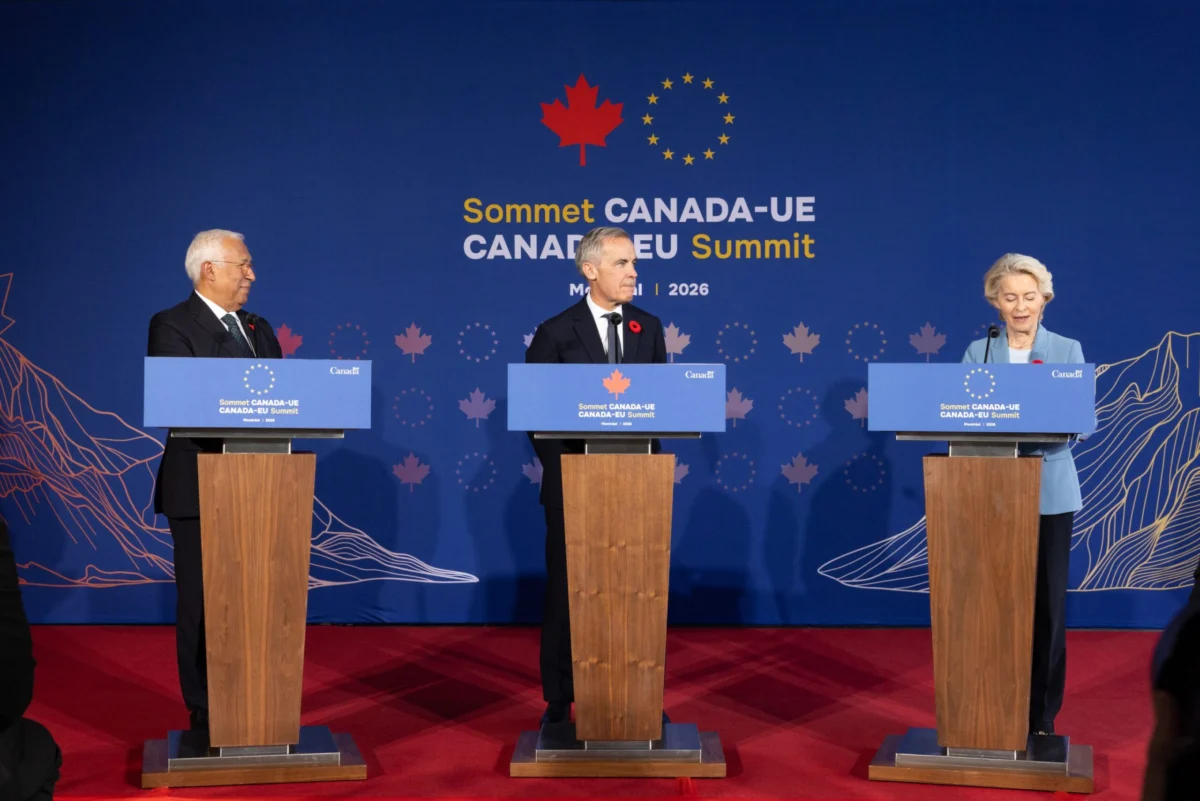
Speaking alongside European Commission President Ursula von der Leyen and European Council President António Costa, Prime Minister Carney emphasized that the new partnership is rooted in shared democratic values and a common vision of the international rules-based order.
"What brings us together goes far beyond geography. We see the world through the same eyes," von der Leyen declared during the joint press conference, underscoring the permanence of the geopolitical shift. "These headwinds won’t stop blowing. This change is permanent."
While Carney and von der Leyen championed the concept of "associate membership" throughout the summit, the official joint declaration ultimately stopped short of codifying the exact title. Instead, the document outlines a commitment to define an "ever-closer association" ahead of the next formal EU-Canada summit scheduled for 2027. Despite the nuance in nomenclature, both sides confirmed that the practical mechanics of the relationship will grant Canada unprecedented access to European institutional frameworks, regulatory alignment, and cooperative security mechanisms.
The timeline for implementation is aggressive. Canadian Cabinet ministers and European commissioners are slated to hold preparatory bilateral meetings in March. These discussions will pave the way for Prime Minister Carney to attend European Council meetings in June, where he intends to conclude the formal negotiation phase. António Costa confirmed the invitation and noted that comprehensive details regarding the institutional structure of the association will be unveiled at that time.
Background Context and Economic Diversification
The drive toward institutional integration builds upon the Comprehensive Economic and Trade Agreement (CETA), the landmark free-trade pact provisionally applied in 2017 that successfully eliminated the vast majority of tariffs between Canada and the EU. However, while CETA focused primarily on traditional goods and market access, the new "Alliance for the Future" addresses modern geopolitical and economic vulnerabilities, spanning digital trade, artificial intelligence, critical minerals, and strategic security.
The urgency of this diversification strategy is underscored by Canada’s heavy reliance on the U.S. market. With Prime Minister Carney publicly stating his ambition to double Canada’s exports to non-U.S. markets over the next decade, the Montreal summit delivered a series of concrete bilateral agreements designed to break down regulatory barriers and stimulate transatlantic growth.
Among the key economic deliverables announced on Friday was the conclusion of a comprehensive digital trade agreement aimed at streamlining cross-border e-commerce and reducing administrative friction for tech startups. Highlighting the tangible benefits of the partnership, Carney pointed to a new agreement enabling the European Investment Bank (EIB) to finance Canadian critical minerals projects. This arrangement injects vital European capital into Canada’s mining sector, securing a reliable supply of raw materials essential for green technologies and advanced manufacturing.
Furthermore, Canada will officially integrate into a premier European supercomputing initiative. Carney noted that access to Europe’s advanced JUPITER supercomputer will exponentially accelerate Canadian scientific research, estimating that complex calculations requiring six months on Canada’s current domestic systems could be completed in a single day. Additional economic measures include a newly finalized competition agreement to curb anti-competitive practices and preliminary explorations into linking instant-payment systems to facilitate faster, cheaper cross-border financial transactions.
Broader Horizons and Strategic Security
Beyond trade and technology, the Alliance for the Future establishes a comprehensive framework for geopolitical cooperation, defense, and energy security. The leaders agreed to commission a feasibility study regarding the large-scale export of Canadian liquefied natural gas (LNG) to Europe, a move that could permanently alleviate European reliance on volatile energy markets. Discussions also advanced on the deployment of new undersea telecommunication and data cables connecting Canada, Europe, and Asia, bypassing vulnerable traditional chokepoints.
In the realm of human capital and cultural exchange, Ottawa and Brussels agreed to initiate negotiations expanding Canadian participation in Erasmus+, the prestigious European student exchange program, while exploring measures to facilitate seamless study and work mobility for young professionals across the Atlantic.
Security and defense cooperation formed a critical pillar of the summit’s agenda. Amid rising global tensions and growing concerns regarding cyber warfare, the two sides established a new border security framework and pledged enhanced collaboration in cybersecurity, Arctic defense, and coordinated efforts to counter foreign interference.
Crucially, the alliance is intentionally structured to remain open to other like-minded democracies. António Costa stressed that the partnership is envisioned as a unique geopolitical category—distinct from any existing EU external relationship. "Our relationship is so special that we want to create something new: to go beyond a simple association, everything short of full EU membership," Costa stated.
Geopolitical Implications and Washington’s Reaction
The aggressive diplomatic momentum toward a Canada-EU bloc has predictably drawn sharp criticism from Washington. President Trump has publicly suggested that Canada’s pursuit of associate membership could be interpreted as a "hostile act," warning that he might impose retaliatory tariffs on European goods if the arrangement is deemed unfriendly to U.S. economic interests.
When pressed by reporters on whether the United States might eventually be invited to join the alliance, Prime Minister Carney declined to directly answer, firmly rejecting the premise that the pact is inherently antagonistic toward any single nation.
"It is about reinforcing sovereignty. Why? So we can live our lives as we choose, our people can live their lives as they choose and have the full freedoms that people enjoy in the European Union and in Canada," Carney asserted. "It’s not against anything, it’s for."
Analysts suggest that Carney’s careful framing reflects a delicate diplomatic balancing act. As protectionist policies and unpredictable trade maneuvers continue to disrupt traditional post-war alliances, middle powers like Canada are increasingly compelled to hedge their strategic bets. By anchoring its economy more firmly to the European regulatory and technological sphere, Ottawa is signaling a permanent recalibration of its foreign policy—one designed to insulate its national sovereignty and economic future from the domestic political whims of its southern neighbor.