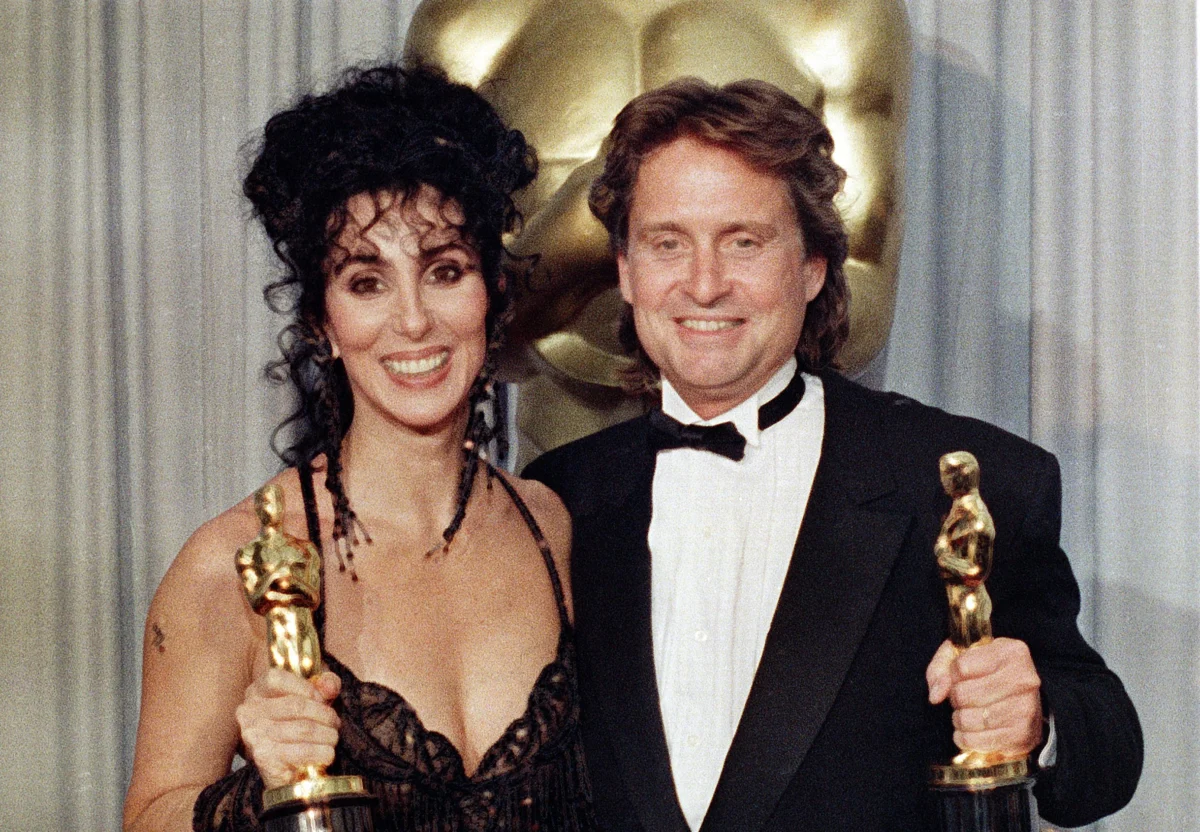
The enduring prestige of the Academy Awards often brings with it decades of whispered controversies and lingering debates, none more persistent than the competitive tension surrounding the 1988 Best Actress race. Recently, the 60th Academy Awards—an evening defined by the clash between the romantic comedy Moonstruck and the psychological thriller Fatal Attraction—returned to the public discourse when Michael Douglas, in a candid appearance on The Graham Norton Show, reignited a decades-old grievance regarding the victory of Cher over his co-star, Glenn Close.
In response to the viral commentary, a representative for Cher issued a brief, conciliatory statement to Entertainment Weekly, effectively neutralizing any potential for a public feud. The representative stated plainly, "Cher adores Michael Douglas," signaling that the music and film icon remains unfazed by the retrospective critique of her career-defining accolade.
The Context of the 1988 Academy Awards
The 60th Academy Awards, held on April 11, 1988, at the Shrine Auditorium in Los Angeles, served as a significant cultural junction for the film industry. The landscape of the competition was dominated by two distinct cinematic approaches: Norman Jewison’s Moonstruck, a whimsical and poignant exploration of Italian-American life in Brooklyn, and Adrian Lyne’s Fatal Attraction, a visceral thriller that tapped into contemporary societal anxieties.
Both films entered the night with significant momentum, each securing six Academy Award nominations. Among the major categories, both were vying for Best Picture and Best Director. However, the night concluded in a split decision, with Bernardo Bertolucci’s epic The Last Emperor sweeping nine awards, including Best Picture and Best Director, leaving both Moonstruck and Fatal Attraction to compete for secondary honors.
While Cher secured the Best Actress Oscar for her performance as Loretta Castorini, Michael Douglas walked away with the Best Actor statue for his portrayal of Gordon Gekko in Oliver Stone’s Wall Street. The disparity in the outcome for the actresses involved remains a frequent topic of conversation among film historians and critics, primarily due to the trajectory of Glenn Close’s career in the years that followed.
A Legacy of Nominations: The Glenn Close Narrative
The friction cited by Michael Douglas on The Graham Norton Show stems from a perceived injustice regarding the Academy’s failure to recognize Glenn Close, whose portrayal of Alex Forrest in Fatal Attraction is widely considered a defining performance of the 1980s.
By 1988, Close had already established herself as a formidable talent with four Oscar nominations in a relatively short span. Her previous nods included:
- 1983: Best Supporting Actress for The World According to Garp
- 1984: Best Supporting Actress for The Big Chill
- 1985: Best Supporting Actress for The Natural
When she was nominated for Best Actress for Fatal Attraction, it represented her first foray into the lead category. Douglas, speaking on the talk show, expressed his conviction that the Academy missed an opportunity to honor Close at that moment. When Norton reacted with surprise to the mention that Cher had triumphed over her, Douglas offered a blunt, "I know, that’s what we all said!" The remark drew laughter from the audience and a gentle, corrective "Michael, be kind" from Close, who sat beside him.
The narrative surrounding Close’s "Oscar drought" became a central fixture of her career. She would go on to receive four additional nominations for Dangerous Liaisons (1989), Albert Nobbs (2012), The Wife (2019), and Hillbilly Elegy (2021). Her path to recognition culminated in the announcement that the Academy would honor her with an Honorary Oscar at the Governors Awards, a testament to her enduring impact on the craft, despite the lack of a competitive win.
Cher’s Path to the Podium
Conversely, Cher’s victory in 1988 was the culmination of a deliberate and successful transition from music superstar to a respected dramatic actress. Her journey to the stage had begun in earnest with her 1984 Best Supporting Actress nomination for Mike Nichols’ Silkwood.
Her performance in Moonstruck was praised for its balance of comedic timing and emotional depth. The film was a critical and commercial juggernaut, winning not only Best Actress for Cher but also Best Supporting Actress for Olympia Dukakis and Best Original Screenplay for John Patrick Shanley. For Cher, the win cemented her status as a legitimate Hollywood leading lady, allowing her to balance a dual career that few other performers have managed to sustain with such longevity.
Fact-Based Analysis of the "Diss"
When analyzing the exchange between Douglas and Close, it is essential to distinguish between a personal attack and professional opinion. Within the insular community of Hollywood, debates over past awards are commonplace. Douglas’s commentary reflects a long-standing professional camaraderie with Close, whom he has worked with on multiple occasions.
From a statistical standpoint, the 1988 race was incredibly tight. The Academy voting body is composed of thousands of industry professionals with varying priorities—some favoring the emotional resonance of a character-driven comedy, others prioritizing the technical and psychological intensity of a thriller. While Douglas’s preference for his co-star is rooted in his personal experience of their collaboration, the win for Cher was a reflection of a specific consensus reached by the Academy at that time.
The implications of these remarks are largely cultural rather than professional. In the age of social media, any off-the-cuff comment made on a televised program is rapidly disseminated and stripped of its original context. By issuing a swift and polite response, Cher has effectively managed the narrative, preventing a minor instance of "shade" from ballooning into a public relations crisis.
The Broader Impact on Award Season Narratives
This episode highlights the enduring weight of the Academy Awards in the lives of those who participate. Even nearly four decades later, a win or a loss can remain a point of active discussion. The fact that the 1988 Best Actress race continues to generate interest underscores the significance of the performances involved.
For Glenn Close, the upcoming honorary award provides a necessary formal recognition of her contributions to cinema, providing a bookend to the narrative that began with her disappointment in 1988. For Cher, the ability to dismiss the controversy with grace reinforces her reputation as an industry veteran who understands the transient nature of public opinion.
Ultimately, the interaction serves as a reminder of the subjective nature of artistic awards. The Academy’s decisions represent a snapshot of the industry’s values at a specific moment in time. Whether one agrees with the 1988 outcome or aligns with Michael Douglas’s retrospective view, the discussion itself is a byproduct of the high esteem in which both performers are held.
As the film industry moves forward, the legacy of Moonstruck and Fatal Attraction remains secure, with both films occupying significant places in the history of 20th-century cinema. The brief exchange between these legendary figures serves not as a bridge-burner, but as a nostalgic footnote in the ongoing, vibrant history of Hollywood’s most prestigious awards season.