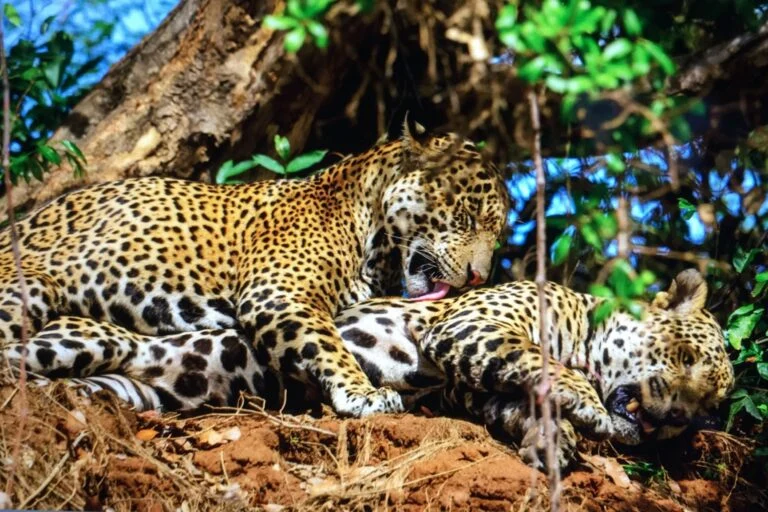
For generations, conventional wisdom among wildlife biologists has cast the jaguar (Panthera onca) as the quintessential solitary phantom of the Americas. Traditional paradigms dictated that these apex predators maintained strictly defended, exclusive territories, intersecting with one another only during the brief, high-tension windows of the mating season or when mothers undertook the arduous task of rearing dependent cubs. Outside of these fleeting encounters, the big cats were thought to actively avoid their own kind, utilizing scent markings and vocalizations to maintain a wide berth across dense tropical forests and sprawling wetlands.
However, a groundbreaking, long-term study conducted in the heart of Brazil’s Pantanal wetland is challenging these foundational assumptions. The research reveals that in environments blessed with exceptional resource abundance, jaguars frequently cast off their solitary reputations, pairing up and engaging in complex, cooperative, and surprisingly peaceful social behaviors that have rarely been documented before in felid conservation science.
Unprecedented Access to the World’s Highest Jaguar Density
The theater for this behavioral revelation is the Brazilian Pantanal, widely recognized as the world’s largest tropical wetland ecosystem. Spanning portions of Brazil, Bolivia, and Paraguay, the Pantanal functions as a seasonal basin that floods extensively during the wet months and dries out between June and October. This unique geography concentrates wildlife into predictable corridors, creating the highest population density of jaguars anywhere on Earth.
So reliable is the presence of Panthera onca along the shaded riverbanks during the dry season that the region has become a global hotspot for ecotourism. Visitors gliding along the waterways in specialized tour boats are granted what is nearly a guarantee: sightings of massive, spotted cats patrolling the mudflats or resting beneath the sprawling canopy.
Yet, this high visibility has proven to be a double-edged sword. While ecotourism provides economic incentives for local conservation and brings global awareness to the plight of the species, a burgeoning influx of visitors also introduces new pressures and stressors to the apex predators’ natural routines. At the same time, this high concentration of jaguars has transformed the region into an outdoor laboratory for field biologists seeking to peer behind the curtain of felid behavior.
A Thirteen-Year Photographic Archive
Capitalizing on the unique accessibility of the Pantanal’s feline residents, scientists with the dedicated Jaguar ID project initiated an intensive daily survey regimen beginning in 2013. Operating primarily through the dry season window from June to October, researchers systematically gathered thousands of photographs and high-definition video recordings.
Because every jaguar possesses a distinct, highly individualized arrangement of rosette patterns—akin to a human fingerprint—the research team was able to catalog and track individual cats over extended periods. Over the course of the thirteen-year monitoring window, scientists successfully identified an astounding 459 individual jaguars. When combined with verified citizen science data harvested from ecotourists, local guides, and regional researchers, this visual repository formed an unprecedented treasure trove of behavioral information.
Valeria Boron, the lead author of the study and senior program adviser for Latin America with WWF UK, noted that previous scientific understandings of jaguar behavior were fundamentally constrained by methodology. Historically, insights into jaguar ecology relied heavily on automated camera traps and molecular genetic testing derived from scat or hair samples. While invaluable for estimating population sizes and tracking broad home ranges, these methods are inherently blind to the nuanced, real-time social dynamics that unfold between living, breathing animals.
Decoding the Interactions: Play, Patrols, and Tensions
Analyzing more than a decade of observational data, Boron and her colleagues discovered a social landscape vastly more intricate than previously imagined. Rather than maintaining hostile isolation, the Pantanal jaguars frequently crossed paths and chose to interact in ways that defied traditional feline taxonomy.
The research team documented 167 distinct instances of jaguar pairs interacting in close proximity. A demographic breakdown of these encounters yielded surprising results: nearly half of all observed interactions (approximately 50%) involved two males. Encounters between a male and a female accounted for 31% of the total observations, while interactions restricted to two females comprised a mere 17%.
When categorizing the nature of these encounters, the researchers discovered a spectrum ranging from cautious neutrality to overt cooperation:

- Neutral Interactions (36.5%): Individuals were observed resting in close proximity or hunting independently within the same localized area without displaying overt hostility or overt friendliness.
- Social Interactions (nearly 39%): Cats engaged in cooperative behaviors that included playful wrestling, mutual grooming (allogrooming), and even coordinated hunting efforts.
- Aggressive Encounters (roughly 25%): Territorial disputes, defensive posturing, and competitive clashes accounted for a quarter of the recorded meetings.
Among the most striking qualitative findings were specific familial observations. In one instance, researchers documented two adult female jaguars—full sisters born to different litters—grooming each other with meticulous care. In another remarkable case, two related male jaguars were observed systematically moving, resting, and patrolling a shared territorial boundary together, challenging the notion that adult males must invariably engage in lethal combat upon meeting.
Gender Dynamics and the Burden of Motherhood
A closer examination of the data revealed a stark behavioral divergence dictated by sex and familial lineage. For male jaguars whose genealogical history was known, relatedness strongly correlated with positive, amicable interactions. Brothers or fathers and sons were significantly more likely to tolerate one another, share space, and engage in social grooming.
Conversely, this pattern of familial amicability did not hold true for female jaguars. Related females showed no statistical preference for peaceful encounters over neutral or aggressive ones. Boron suspects that this behavioral disparity stems directly from the biological realities of maternity and offspring defense.
"That’s the hypothesis that we have," Boron explained during a video interview, pointing out that female jaguars are frequently encumbered with the responsibility of rearing vulnerable cubs. "Because there was a record of infanticide in the area by another female, mothers must adopt an inherently defensive posture." In the high-stakes environment of the Pantanal, where resources are rich but competition remains fierce, an unknown female passing through a mother’s core hunting grounds represents an existential threat to dependent cubs, prompting immediate hostility regardless of biological kinship.
Ecological Abundance as an Enabler of Tolerance
Why would male jaguars, traditionally viewed as fiercely territorial competitors, choose to tolerate—and even cooperate with—one another in the Pantanal? Researchers point to the unique ecological bounty of the wetland ecosystem.
The Pantanal boasts an extraordinarily high density of prey species, including vast populations of capybara—the world’s largest rodent—along with caimans, fish, and livestock in peripheral ranching areas. This cornucopia of calories ensures that nutritional stress is significantly lower here than in fragmented or resource-poor habitats, such as heavily logged tracts of the Amazon or degraded sections of the Central American dry forests.
Stijn Verschueren, a conservation biologist at the University of Bern in Switzerland who was not directly involved with the study, emphasized the critical importance of ecological context when interpreting the findings.
"All observations come from riverbanks in an area with very high prey and jaguar density, so the results don’t necessarily apply to jaguars elsewhere," Verschueren noted via email. He cautions that extrapolating these findings to all jaguar populations globally would be scientifically premature. In landscapes where prey is scarce and home ranges must span hundreds of square kilometers to sustain a single cat, the evolutionary pressures favoring solitary, highly territorial behavior likely remain dominant.
Conservation Implications and Future Horizons
Despite these geographical caveats, conservationists believe the Pantanal study provides vital baseline data that can transform wildlife management strategies. Understanding the social plasticity of jaguars demonstrates that large carnivores possess a far greater behavioral repertoire than previously acknowledged, adapting their social structures to match the carrying capacity and ecological structure of their environment.
Researchers acknowledge that while the current dataset is heavily quantitative, focusing on frequencies and demographic breakdowns, the vast archive of imagery opens the door for deeper qualitative analysis. Boron and her colleagues hope to utilize the Pantanal data to publish more granular, descriptive papers mapping out specific behavioral sequences—such as the developmental trajectory of juvenile social play or the precise mechanics of male coalition-building.
Furthermore, scientists suggest that similar long-term, visually driven monitoring projects could be replicated in other high-density strongholds across the jaguar’s historic range. Potential candidates include the Mamirauá Sustainable Development Reserve in the heart of the Brazilian Amazon, where seasonal flooding similarly compresses wildlife populations into restricted zones of high encounter rates.
As human encroachment, agricultural expansion, and infrastructure development continue to fracture wildlife corridors across Latin America, understanding how jaguars negotiate space, share resources, and interact with one another becomes increasingly critical. The revelation that the phantom of the forest can, under the right conditions, become a social neighbor underscores the remarkable adaptability of Panthera onca—and highlights the urgent necessity of preserving the rich, productive ecosystems that allow such complex behaviors to flourish.