
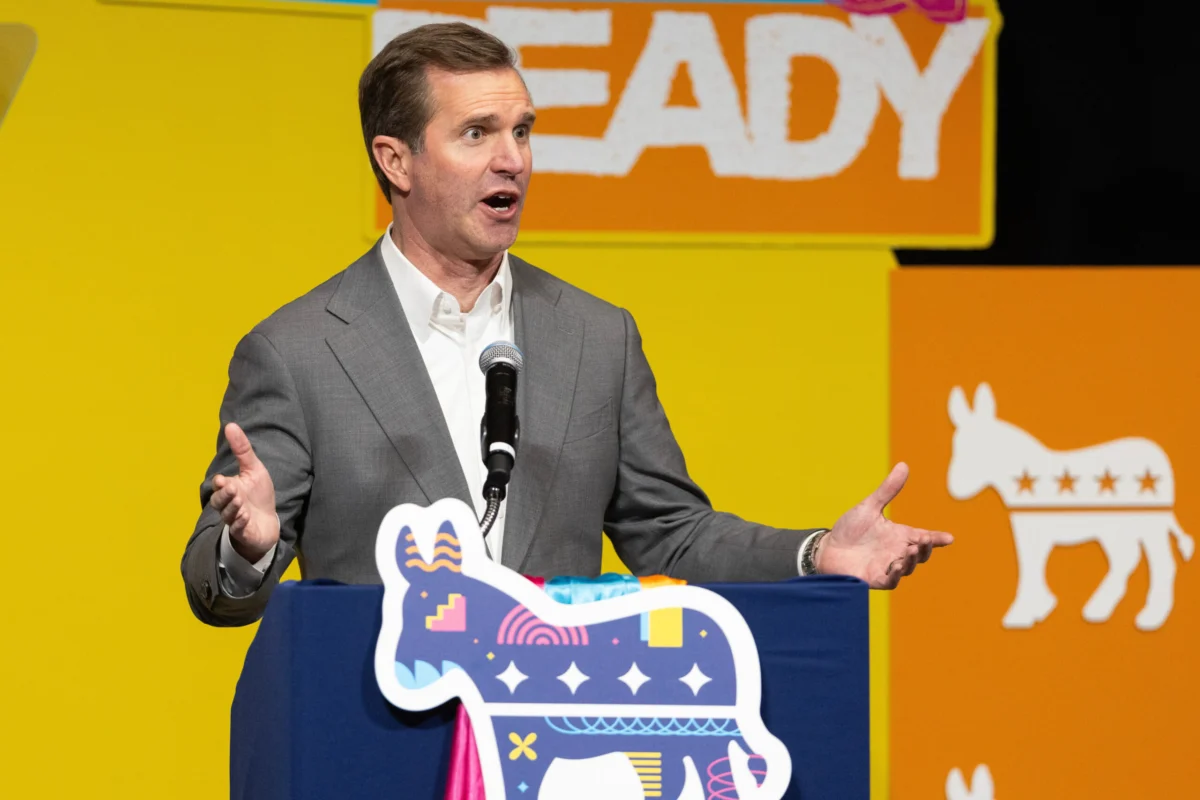
Kentucky Governor Andy Beshear is increasingly making his mark within national Democratic circles, demonstrating a unique ability to garner bipartisan appeal and capture the attention of influential figures, most notably the Rev. Al Sharpton. His recent appearance at the National Action Network (NAN) conference solidified his burgeoning profile, sparking discussions among attendees and political strategists about his potential trajectory in the broader political landscape, including comparisons to former President Bill Clinton’s successful campaigns.
A Governor Forged in a Deep-Red State
Andy Beshear’s political journey is particularly noteworthy given the deeply conservative leanings of his home state, Kentucky. The son of former two-term Governor Steve Beshear, Andy inherited a political lineage rooted in public service. He served as Kentucky’s Attorney General from 2016 to 2019, where he frequently challenged the Republican-controlled legislature and then-Governor Matt Bevin on various policy issues, establishing a reputation as a pragmatic yet firm leader. His ascent to the governorship in 2019 was a significant upset, narrowly defeating incumbent Republican Matt Bevin in a state that had overwhelmingly supported Donald Trump in 2016. Beshear’s victory was attributed to a campaign focused on kitchen-table issues, healthcare, and a moderate stance that resonated with a diverse electorate.
His re-election in 2023 further underscored his unique political resilience. Beshear defeated Attorney General Daniel Cameron, a protege of Mitch McConnell and a candidate heavily endorsed by Donald Trump, by a comfortable margin of over 5 percentage points. This win, in a state where Republicans hold supermajorities in both legislative chambers and where no Democratic presidential candidate has won since Bill Clinton in 1996, cemented Beshear’s status as one of the most popular governors in the country. His high approval ratings, consistently hovering above 60% even amidst partisan political battles, reflect an ability to connect with voters across ideological divides, often prioritizing disaster relief, economic development, and infrastructure improvements over culture war issues. This track record of winning and governing effectively in a challenging political environment is precisely what has begun to attract national Democratic attention.
The National Action Network Conference: A Crucial Platform
The National Action Network (NAN) conference, held annually in New York City, serves as a pivotal gathering for Black civil rights leaders, activists, and a broad spectrum of the Democratic Party’s base. Founded by the Rev. Al Sharpton in 1991, NAN has evolved into one of the most influential civil rights organizations in the United States, playing a critical role in advocating for racial justice, voting rights, and socioeconomic equality. Sharpton himself is a towering figure in the Black community, known for his decades of activism, his nationally syndicated radio show, and his prominent role in national media. An appearance at the NAN conference is often a crucial litmus test for aspiring Democratic presidential contenders, offering a direct conduit to a powerful and discerning demographic within the party. The event provides a platform for candidates to articulate their vision, demonstrate their commitment to racial justice, and build relationships with key community leaders.
Last week’s conference saw a crowded field of potential Democratic hopefuls vying for attention, including other prominent governors often discussed as future presidential candidates, such as California Governor Gavin Newsom and Pennsylvania Governor Josh Shapiro. Yet, it was Beshear who, according to Sharpton, "stood out" among the contenders. Sharpton noted that many attendees, even those with allegiances to other potential candidates, were "struck by Beshear," with some drawing direct comparisons to Bill Clinton’s successful campaign in the 1990s. "The overwhelming majority of delegates there and people I’ve talked to around the country are determined to win," Sharpton stated in an interview. "They see a Southern governor from a red state that relates to them as something that’s appealing. They think he can win and he’s had the courage to stand up on certain issues." This sentiment, focusing on electability and courage, suggests a growing appetite within the Democratic Party for a candidate who can transcend traditional partisan divides and appeal to a broader electorate.
Policy Stances Resonating with a Critical Electorate
Beshear’s ability to connect with the NAN audience stemmed from a combination of his policy positions, his personal demeanor, and his demonstrated willingness to take principled stands on contentious issues. Several key areas particularly resonated:
-
Racial Justice and the Breonna Taylor Case: The 2020 killing of Breonna Taylor, a Black woman shot by Louisville police officers during a botched no-knock warrant, became a national flashpoint for racial justice protests. Beshear, as governor, navigated this highly charged situation, expressing empathy for Taylor’s family and acknowledging the deep pain and systemic issues the case brought to light. His direct comments on the tragedy and his subsequent engagement with Taylor’s mother were particularly well-received by the NAN attendees, demonstrating a sensitivity and willingness to address racial injustice head-on that many found refreshing. While the state’s response to the officers involved drew criticism from some activists, Beshear’s personal outreach and acknowledgment of the injustice stood in stark contrast to the often-defensive posture of some political leaders during that period.
-
Defending Diversity, Equity, and Inclusion (DEI): Beshear’s firm stance against legislative efforts targeting Diversity, Equity, and Inclusion (DEI) programs further underscored his progressive bona fides to the NAN audience. In recent legislative sessions, Republican-controlled legislatures across the country have moved to restrict or ban DEI initiatives in public universities and state agencies, arguing they are discriminatory or divisive. Beshear, however, has consistently vetoed such bills in Kentucky. His vetoes of legislation aimed at dismantling DEI programs, coupled with his public statements emphasizing the importance of creating inclusive environments, positioned him as a defender of civil rights and equitable opportunities, a message that strongly resonated with the NAN’s core mission.
-
Stance on Gun Violence Prevention: Despite governing a state with a strong Second Amendment tradition, Beshear has taken courageous steps to advocate for gun violence prevention. Earlier this month, he vetoed a bill that would have lowered the minimum age to obtain a concealed weapon from 21 to 18 and protected firearm manufacturers and sellers from liability for gun violence. In his veto message, Beshear poignantly connected the legislation to the devastating 2023 bank shooting in Louisville, which claimed multiple lives. "While I believe in the Second Amendment, these pieces of legislation would allow minors under the age of 21 to carry concealed deadly weapons and protect firearm manufacturers and sellers from liability for gun violence," Beshear stated, emphasizing the need to "take steps to protect our people and allow them to seek justice for deadly acts like these families have suffered from." This blend of respecting constitutional rights while advocating for common-sense safety measures demonstrated a nuanced approach that appeals to a broader spectrum of voters, including those concerned about public safety in urban communities.
-
Relatability and Authenticity: Beyond policy, Beshear’s personal conduct at the conference left a lasting impression. Sharpton specifically highlighted an "unscripted moment off the stage" where Beshear, navigating a family scheduling conflict, brought his son with him to the event. This gesture, according to Sharpton, underscored his relatability and down-to-earth demeanor. "I think he comes across as very personable and gives the feeling of being direct and honest," Sharpton observed, pointing to an authenticity that is increasingly valued in today’s political landscape.
Navigating the Crowded Democratic Field
While Beshear’s performance at the NAN conference generated significant buzz, he has yet to achieve the same level of national recognition or media frenzy as other potential Democratic contenders, such as California Governor Gavin Newsom or Pennsylvania Governor Josh Shapiro. Newsom, with his large state and vocal progressive stances, often garners significant media attention, as does Shapiro, who also won a key governorship in a battleground state. These governors frequently appear on national cable news and command larger social media followings.
However, many Democratic strategists believe Beshear’s slower, more deliberate rise could ultimately be an asset. Democratic strategist Eddie Vale suggested, "He may not be the flashy guy right now that people on TV are paying attention to, but that could have a nice, slow steady climb as actual voters start meeting and hearing him." This perspective aligns with a strategy of organic growth and genuine connection, rather than relying solely on media spectacle. The argument is that while others might capture headlines, Beshear is building a foundation of trust and relatability with key demographic groups.
The "Southern Moderate" Archetype: A Subject of Debate
The comparisons to Bill Clinton, a Southern moderate who successfully navigated the Democratic primary and won the presidency, are both a boon and a source of debate for Beshear.
-
Proponents of the "Clinton Model": For many, the idea of a "Southern moderate from a red state" evokes the electability of figures like Clinton and former Vice President Al Gore. This archetype suggests a candidate who can appeal to working-class voters, maintain a strong base within the party, and potentially flip swing states. Vale further argued that Beshear’s appeal lies in his "authenticity." "I think he can do well because he is authentic to him," Vale said. "He isn’t coming across as someone who has changed or is trying to fit a certain role to meet the moment. He is just who he always has been." This consistency, Vale believes, could draw support across various factions of the party, as voters seek genuine leadership in an era often characterized by political shape-shifting.
-
Skeptics and the Evolving Political Landscape: Not all Democrats are convinced that a 1990s-style moderate is the right fit for the current political moment. One Democratic strategist, speaking anonymously, expressed skepticism: "He is a Democratic candidate right out of the 1990s… and I’m not sure our party wants that kind of candidate anymore." Jamal Simmons, another Democratic strategist who worked in the Clinton White House, echoed some of this sentiment, noting that while Clinton was a Southern moderate, he was also a "loud, strong, aggressive" one. Simmons argued that if Beshear intends to compete at the national level, "he can’t just be the safe choice." He needs to "ignite some excitement and passion," suggesting that a purely moderate tone might not cut through the noise of contemporary politics. "Too often now, moderates are moderate not just in policy but in tone," Simmons added. "And I don’t know that a moderate tone sells in this environment." This highlights a significant internal debate within the Democratic Party: whether electability hinges on a centrist appeal or on a more forceful, ideologically driven progressive message.
Kentucky’s Blueprint: Can it Translate Nationally?
Beshear’s sustained popularity in Kentucky offers a potential blueprint for national success, but also reveals the challenges. His ability to win and maintain high approval ratings in a state that consistently votes Republican federally is remarkable. This success is often attributed to his focus on tangible results – economic development, infrastructure projects, and a compassionate response to natural disasters – rather than engaging in divisive culture wars. During his tenure, Kentucky has seen significant economic growth, attracting major investments in manufacturing and technology, a narrative Beshear frequently highlights. He has also been a visible and reassuring presence during crises, from devastating tornadoes to catastrophic flooding, earning praise for his hands-on leadership.
However, translating this state-level popularity to a national primary campaign, where ideological purity and a more aggressive tone often dominate, is a different challenge. The Democratic primary electorate tends to be more progressive than the general electorate, and a candidate perceived as too moderate might struggle to build enthusiasm among core activist groups. The "slow and steady climb" strategy might work for the general election, but a primary requires rapid ignition of passion and clear ideological distinction.
The Road Ahead: Implications for 2028 and Beyond
As discussions about potential White House bids intensify for the 2028 cycle, Beshear’s emerging profile means he will be a candidate to watch closely. His performance at the NAN conference and the subsequent endorsement from Rev. Al Sharpton provide a significant boost, signaling that he has the potential to connect with a crucial segment of the Democratic base. The "Southern moderate" label, while debated, also offers a unique value proposition in an era where Democrats are constantly seeking ways to win back working-class voters and compete in swing states.
The implications for the Democratic Party are significant. Beshear represents a potential pathway for the party to broaden its appeal beyond its traditional strongholds. His success in a red state challenges the notion that only ideologically extreme candidates can win in polarized environments. His consistency and authenticity, as highlighted by strategists like Eddie Vale, could offer a compelling counter-narrative to the perception of politicians as constantly shifting their positions to chase trends.
However, Beshear will need to demonstrate that his moderate tone can indeed "ignite excitement and passion" on a national scale, as suggested by Jamal Simmons. He will have to articulate a clear and compelling vision that distinguishes him from other contenders while maintaining the electability that has defined his career in Kentucky. As Sharpton concluded, warning against underestimating the Kentucky governor, "The Beshear I saw at NAN is a Beshear that should not be ignored." His journey from a deeply red state to the national spotlight will be a fascinating test of contemporary Democratic strategy and the enduring appeal of authenticity in American politics.









Leave a Reply