
On a day when congressional Republicans had meticulously planned to champion the successes of last year’s landmark tax cut legislation, colloquially known as the "One Big Beautiful Bill Act," their carefully orchestrated messaging instead dissolved into an unexpected and protracted theological debate. The cause: a multi-day public spat between the Trump administration and Pope Leo XIV, which saw lawmakers on Capitol Hill scrambling to address the White House’s unprecedented critique of the Vatican, urging a return to conventional political discourse and a clear separation of church and state.
A Pivotal Tax Day Derailed
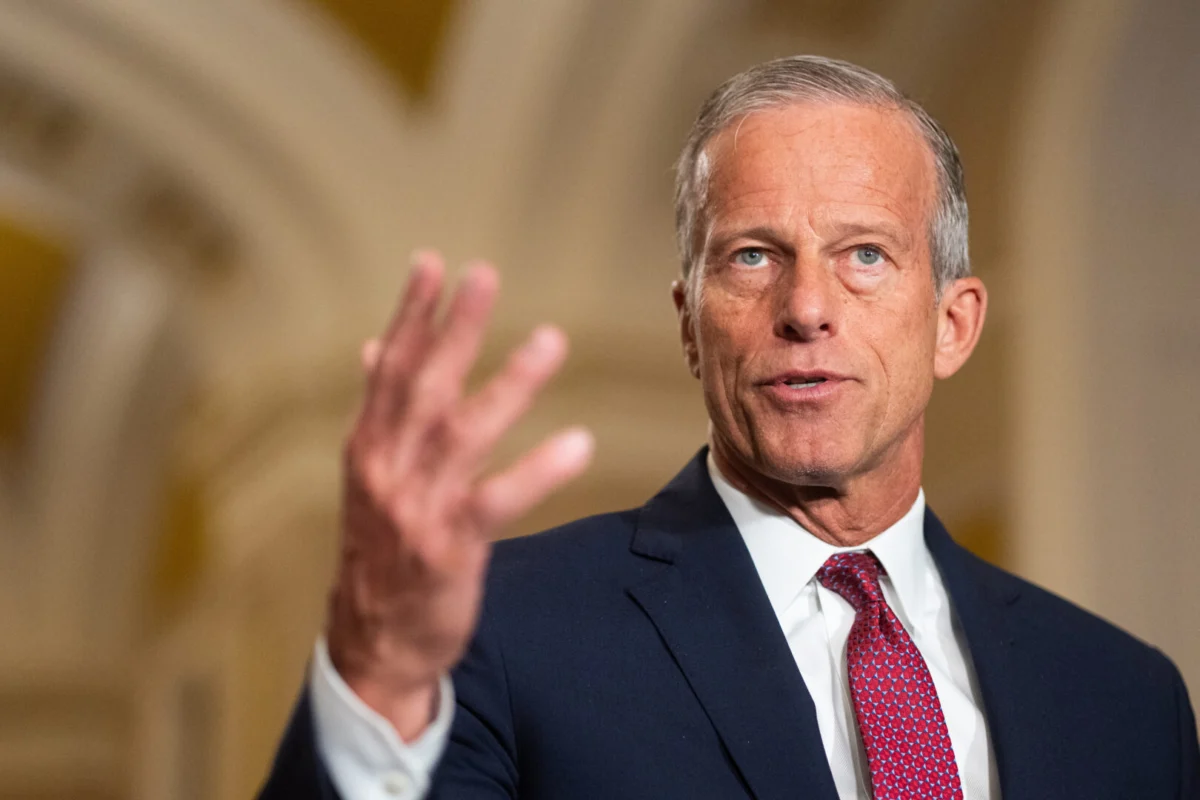
Wednesday, designated as Tax Day, was intended to be a robust platform for the Republican party to underscore its economic achievements, particularly the broad-based tax reductions implemented under the "One Big Beautiful Bill Act." Events were scheduled, press conferences prepared, and talking points distributed, all aimed at highlighting the perceived benefits to American taxpayers. Speaker Mike Johnson, R-La., and Senate Majority Leader John Thune, R-S.D., were poised to lead the charge, framing the tax cuts as a cornerstone of the administration’s economic policy and a tangible win for the American populace. However, the political oxygen that day was swiftly and entirely consumed by the escalating war of words between President Trump and the spiritual leader of the world’s 1.3 billion Catholics.
The controversy began to brew when Pope Leo XIV, the first American-born pontiff, voiced strong disapproval of President Trump’s aggressive rhetoric regarding Iran. The Pope specifically cited Trump’s threat to "wipe out the whole civilization" of Iran last week as "truly unacceptable." This pronouncement from the Vatican, carrying significant moral weight, quickly drew the ire of the White House, setting the stage for a dramatic and highly public confrontation.
The Genesis of the Theological Tussle
The seeds of the current discord were sown when Pope Leo XIV, in a move widely interpreted as a direct challenge to the Trump administration’s foreign policy approach, condemned the President’s confrontational stance towards Iran. The Pontiff’s remarks, delivered from the moral authority of the Holy See, did not merely criticize a policy but questioned its ethical foundations, especially the implied threat of widespread destruction. This put the Trump administration in a difficult position, as it typically seeks to rally evangelical and conservative Catholic support, both domestically and internationally.
President Trump, known for his swift and often unvarnished social media responses, did not hesitate to retaliate. On Sunday, he took to his preferred platform to launch a scathing attack on Pope Leo XIV, branding him "WEAK on Crime, and terrible for Foreign Policy." In a particularly provocative statement that hinted at a perceived instrumental role in the Pope’s ascendancy, Trump added, "If I wasn’t in the White House, Leo wouldn’t be in the Vatican." This assertion, implying presidential influence over papal elections or the stability of the Holy See, was met with widespread astonishment and condemnation from various quarters, including many within his own party.
The following day, Monday, the controversy deepened with the President’s sharing of an AI-generated image depicting him in a Christ-like garment. The image, which quickly went viral, sparked immediate backlash and accusations of blasphemy from critics and even some supporters. Trump later deleted the post, offering a somewhat implausible explanation that the image was intended to portray him as "a doctor." The attempt to clarify did little to quell the furor, instead highlighting the President’s unorthodox communication style and his willingness to push boundaries in public discourse.
By Tuesday, the administration’s defensive posture was further solidified by Vice President JD Vance. Speaking at a Turning Point USA event – a prominent conservative youth organization – Vance staunchly defended the President’s actions. He articulated a perspective that directly challenged the Pope’s authority on theological matters, stating, "It’s very, very important for the pope to be careful when he talks about matters of theology." Vance, a Catholic convert himself, went further, questioning the Pope’s assertion with a rhetorical query: "How can you say that God is never on the side of those who wield the sword? If you’re going to opine on matters of theology… you’ve got to make sure it’s anchored in the truth." This marked a significant escalation, transforming a political dispute into a theological one, with the Vice President effectively positioning himself as a commentator on papal doctrine.
The crescendo of the week’s events occurred on Wednesday, Tax Day, as President Trump once again turned to social media, reposting another AI-generated image, this time depicting Jesus Christ embracing him. His accompanying caption, "The Radical Left Lunatics might not like this, but I think it is quite nice!!!" solidified his defiant stance and indicated no intention of retreating from the theological fray. This final social media salvo cemented the fact that the day’s political agenda for Republicans was irrevocably altered.
Congressional Republicans Caught in the Crossfire
The ongoing theological dispute placed congressional Republicans in an unenviable position. Tasked with promoting the administration’s economic wins, they instead found themselves navigating a minefield of questions about the President’s confrontation with the Pope.
During his Wednesday morning press conference, Speaker Mike Johnson, R-La., was immediately confronted with questions regarding Trump’s social media posts about the Pope. In the Senate, Majority Leader John Thune, R-S.D., faced a similar barrage from reporters, highlighting the pervasive nature of the controversy.
Many Republicans expressed discomfort with the administration’s direct engagement with the Pontiff. Senator Roger Wicker, R-Miss., a Southern Baptist who had personally met Pope Leo XIV during a February delegation to the Vatican, articulated this sentiment clearly: "It’s never a good idea to get into a tit-for-tat with a respected religious leader. I just think it’s to be avoided." His words reflected a broader concern among some Republicans about the optics and potential diplomatic fallout of such a public spat.
Senator Thom Tillis, R-N.C., a self-proclaimed "life-long Catholic," emphasized the importance of separating religious and political spheres. "I wouldn’t expect any pope of any stripe from any country to do a liturgy talking about the sanctity of a war," Tillis stated. "It’s contrary to their teachings, which is why I think politicians are at their best when they don’t mingle politics and religion, and they’re at their worst when they do." This view underscored the traditional separation of roles, suggesting that both sides had overstepped their boundaries.
Senator Thune, an evangelical, echoed the sentiment of distraction and the need for the administration to refocus. "I’d stay focused on the economic issues, the pocketbook issues that I think most Americans care about," he advised the administration, adding pointedly, "Let the church be the church." This perspective highlighted the frustration among some GOP leaders who felt their legislative agenda was being overshadowed by the President’s personal battles.
Rationalizations and Counter-Arguments from GOP Leadership
Despite the clear discomfort among some rank-and-file members, House GOP leadership largely moved to rationalize the administration’s actions, often by shifting responsibility for the dispute to the Pope himself.
Speaker Johnson argued that Pope Leo XIV had initiated the political entanglement. "If you wade into political waters," Johnson asserted, "the pope should expect some political response." He then delved into theological territory, contending that Christian theology, specifically the "just war doctrine," could support military action in Iran. "It is a very well-settled matter of Christian theology. There’s something called the ‘just war doctrine.’ There’s a time to every purpose under heaven," he explained, attempting to provide a theological justification for the administration’s stance and implicitly for its response to the Pope. The just war doctrine, originating in Christian thought, posits that war can be morally permissible under certain strict conditions, such as having a just cause, proper authority, and proportionality.
House Republican Conference Chair Lisa McClain of Michigan, herself a Catholic, expressed little surprise at Trump’s reaction. "Listen, it would be nice if everyone stayed in their lane," she commented, but quickly added, "I think we all know Trump well enough that if the pope is going to have a comment on political issues… I think that it’s pretty predictable that the president would comment." Her statement implied that the Pope, by commenting on geopolitics, had invited the President’s retort.
Other Catholic Republicans adopted nuanced approaches to defend or explain the White House’s comments. Senator John Hoeven, R-N.D., acknowledged the differing roles: "The pope comes from a very different place. He’s about peace and love and all those things. So they have different roles, and both are important. As you know, I’m Catholic. But by the same token, in this case, we have to use force. Iran has given us no choice. There are bad actors in this world, and unfortunately, good guys have to step up and take military action against bad guys." Hoeven’s remarks attempted to reconcile his faith with his political support for a hawkish foreign policy.
Similarly, Senator Mike Rounds, a Catholic from South Dakota, drew a clear distinction between the roles of political and religious leaders. "Look, I think there’s a difference between the role that the pope plays and the role that the president or the vice president has. One is a political position. The other is a position of being, literally a pope, which is a moral guide. Both of them have a role to play in this world," Rounds concluded, striving for an equilibrium between the two powerful figures.
Democratic Voices and the Role of Catholics in Congress
Democrats, predictably, seized on the opportunity to criticize the administration’s handling of the situation and express solidarity with the Pontiff. Senator Richard J. Durbin of Illinois, the second-ranking Democrat in the Senate and a Catholic, holds a unique connection to the dispute as he represents Pope Leo XIV’s hometown of Chicago. Durbin firmly stated, "I think the pope has been clear and within his bounds as a leader of a major church in America." Senator Peter Welch, D-Vt., also a Catholic, offered a more concise and direct endorsement: "I’m with ‘Team Pope’."
The dynamics of this dispute are particularly sensitive given the significant Catholic representation in the United States Congress. In the 119th Congress, 127 House members identify as Catholic, comprising 29 percent of the entire chamber. This demographic is split with 69 Democrats and 58 Republicans, making Catholics the largest Christian denomination represented in the House. The Senate also reflects this, with 24 Catholic senators – 13 Democrats and 11 Republicans. For many Republican lawmakers, particularly those who are Catholic, criticizing the Pope or appearing to sanction such criticism from the White House presents a delicate political tightrope walk, potentially alienating a crucial segment of their base.
Broader Implications and Future Outlook
The unexpected theological feud carries several significant implications, extending beyond the immediate political distraction.
Firstly, it starkly highlights the ongoing tension between religious authority and political power, particularly when the two spheres intersect on matters of morality and international relations. Pope Leo XIV’s intervention on Iran policy underscores the Vatican’s traditional role as a global moral arbiter, a role that often puts it at odds with nation-states pursuing their perceived strategic interests. The Trump administration’s aggressive pushback, particularly Vice President Vance’s theological challenge, suggests a willingness to contest even the Pope’s spiritual authority if it clashes with governmental policy.
Secondly, the episode underscores the internal ideological divisions within the Republican Party. While many conservative evangelicals may rally behind Trump’s strongman image and his perceived defense of American interests, the public confrontation with the Pope presents a dilemma for Catholic Republicans. Their varying responses – from outright disapproval to nuanced rationalization – demonstrate the struggle to reconcile their faith with their party’s leadership. This could expose fault lines within the GOP’s broad religious coalition.
Thirdly, the use of AI-generated images by President Trump adds a modern, controversial dimension to political communication. The ease with which such images can be created and disseminated, coupled with the ambiguity surrounding their intent (e.g., "doctor" vs. "Christ-like"), raises questions about authenticity, manipulation, and the evolving landscape of political messaging in the digital age. The repeated use of religious imagery, particularly depicting the President in close association with Jesus, could be seen as an attempt to bolster his support among religious conservatives, but also risks alienating others.
Finally, the incident served as a significant distraction from the administration’s legislative agenda, particularly on a day specifically earmarked for celebrating economic policy. The desire among many Republicans to "stay in their lanes" and "let the church be the church," as expressed by Senator Thune, indicates a frustration with the administration’s penchant for creating self-inflicted controversies that derail strategic messaging. Senator Hoeven’s plea for the president to "stay focused on the effort with Iran, with the negotiations, with the embargo" further underscores the view that the administration’s focus should remain on pressing foreign policy matters rather than engaging in theological debates.
As Senator Wicker aptly summarized, "I hope that this matter can be dropped now. My suggestion to the president and vice president would be to say that they’re not going to comment." Whether the Trump administration will heed such advice remains to be seen, but the events of Tax Day 2026 will undoubtedly be remembered not for tax cuts, but for an unprecedented and deeply theological clash between Washington and the Vatican.







Leave a Reply