
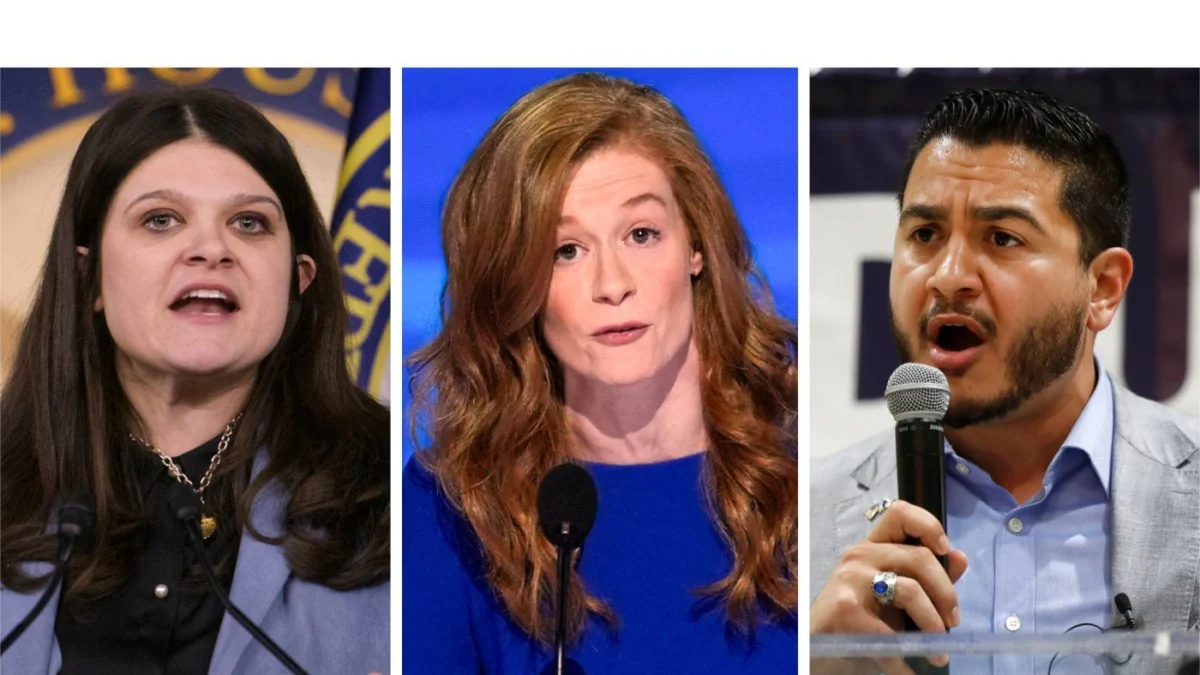
The race for a coveted open U.S. Senate seat in Michigan has intensified, with new polling indicating a statistical tie between two prominent Democratic contenders, Abdul El-Sayed and Mallory McMorrow. The latest survey places them ahead of Representative Haley Stevens, who initially entered the primary as an establishment favorite. This competitive landscape underscores the evolving dynamics within the Democratic Party and highlights Michigan’s pivotal role in the national political arena.
According to an Emerson College Polling/WOOD-TV survey conducted between April 11 and 13, both Abdul El-Sayed, the former Wayne County health director, and State Senator Mallory McMorrow garnered 24 percent support among likely Democratic primary voters in Michigan. El-Sayed, who has secured the backing of progressive icon Senator Bernie Sanders (I-Vt.), saw an impressive 8-point surge in support since a similar poll in January. McMorrow, endorsed by Senator Elizabeth Warren (D-Mass.) and positioning herself as part of a new generation of Democratic leaders, experienced a more modest 2-point increase. The poll’s credibility interval for Democratic primary voters was approximately 4.3 percentage points, indicating the current race is a dead heat at the top.
Conversely, Representative Haley Stevens (D-Mich.), a sitting member of Congress, saw her support dip to 13 percent, down from 17 percent in January. This shift signals a significant challenge for Stevens, who was widely perceived as the early frontrunner due to her existing federal office and fundraising capabilities. A substantial 36 percent of voters remain undecided, though this figure has slightly decreased by 2 points over the past few months, suggesting that voters are beginning to solidify their preferences as the primary season progresses.
Generational Fault Lines Define the Democratic Primary
A compelling aspect of the latest polling data is the pronounced generational divide among Democratic primary voters. Spencer Kimball, executive director of Emerson College Polling, observed "clear generational differences" shaping the contest. Voters under the age of 40 show a distinct preference for El-Sayed, favoring him over McMorrow by a significant 17-point margin. This demographic alignment aligns with El-Sayed’s progressive platform and his appeal to younger, more ideologically driven voters often drawn to figures like Bernie Sanders.
In stark contrast, voters over the age of 50 expressed stronger support for McMorrow, backing her over El-Sayed by a 12-point margin. This demographic trend suggests McMorrow’s message resonates more with older, potentially more moderate segments of the Democratic electorate, who may prioritize experience in state-level politics or a perceived electability in a general election. The preferences of middle-aged voters (40-49) will likely prove crucial in bridging this generational gap and determining the ultimate primary victor.
This generational split highlights a broader tension within the national Democratic Party between its progressive and moderate wings. In Michigan, El-Sayed embodies the former, advocating for bold policy changes often championed by the party’s left flank. McMorrow, while progressive on many social issues, often frames her political identity around a fresh, pragmatic approach, appealing to those seeking a balance between progressive ideals and broader electability. Stevens, by contrast, has historically occupied a more centrist lane, representing a district that encompasses both suburban and more rural areas.
Candidate Profiles and Campaign Narratives
The three leading contenders occupy distinct ideological and strategic lanes within Michigan’s Democratic Party, each bringing a unique set of experiences and appeal to the primary.
Abdul El-Sayed, a physician and public health expert, gained prominence during his 2018 gubernatorial bid, where he ran on a Sanders-esque progressive platform. His campaign for the Senate has similarly emphasized issues like universal healthcare, climate action, and economic justice. His appeal to younger voters and the progressive base is undeniable, fueled by his articulate communication style and a strong online presence. However, El-Sayed’s campaign recently faced criticism from some fellow Democrats following a rally with controversial livestreamer Hasan Piker. This event raised concerns among some party strategists about El-Sayed’s potential electability in a competitive general election, particularly in a swing state like Michigan, where moderate voters often hold the balance of power. His campaign, however, has likely sought to frame this as an attempt to engage with a diverse array of voters and maintain his authenticity.
Mallory McMorrow, a state senator from Royal Oak, burst onto the national scene in 2022 with a viral floor speech defending public education and LGBTQ+ rights, garnering widespread acclaim and establishing her as a powerful voice against divisive rhetoric. Her subsequent endorsements from national figures like Senator Warren solidified her standing as a rising star. McMorrow has presented herself as a pragmatic progressive, capable of winning over a broad coalition of voters. Her campaign is likely to emphasize her legislative record, her ability to connect with everyday Michiganders, and her perceived electability against a Republican opponent. Her strength among older voters suggests a broader appeal beyond the typical progressive base, hinting at her potential to unite different factions of the party.
Haley Stevens, currently representing Michigan’s 11th congressional district, entered the race with the advantages of incumbency and a proven track record of winning competitive elections. Her congressional career has focused on economic development, manufacturing, and STEM education. As an "establishment favorite," she was expected to leverage her fundraising network and existing political infrastructure. However, her declining poll numbers suggest that primary voters may be looking for a different kind of candidate, or that her message is not resonating as effectively as her competitors in a statewide primary context. Stevens’s campaign will likely need to re-evaluate its strategy, perhaps emphasizing her legislative experience, her ability to work across the aisle, and her capacity to deliver federal resources for Michigan. They might also highlight her experience in a competitive general election, a crucial factor in a state like Michigan.
The Broader Political Landscape: Michigan as a National Bellwether
The Michigan Senate race is not merely a local contest; it is a critical battleground in the national struggle for control of the U.S. Senate. The seat, currently held by a retiring Democrat, represents a rare open opportunity for both parties. This makes it one of the most closely watched and heavily invested races in the country.
Michigan has firmly established itself as a quintessential swing state, a microcosm of the national political mood. In recent election cycles, the state has flipped between Republican and Democratic control in presidential elections, elected a Democratic governor (Gretchen Whitmer) and U.S. Senator (Debbie Stabenow), and seen competitive congressional and state legislative races. The state’s diverse demographics – encompassing urban centers, sprawling suburbs, industrial towns, and rural communities – make it a complex and unpredictable electoral landscape.
The Cook Political Report, a nonpartisan election handicapper, rates the 2026 Michigan Senate race as one of only four "toss-ups" among the 35 upper-chamber seats up for grabs. Similarly, Sabato’s Crystal Ball designates it as one of just three such toss-ups. These ratings underscore the high stakes and the expectation of a fiercely contested general election, regardless of who emerges from the Democratic primary. The national balance of power in the Senate could hinge on the outcome in Michigan, making the primary a crucial first step for Democrats hoping to maintain or expand their majority.
The Republican Side: Mike Rogers as the Likely Nominee
While the Democratic primary captures immediate attention, the Republican field also presents a clear frontrunner. Former Representative Mike Rogers (R-Mich.), endorsed by former President Donald Trump, is widely considered the likely GOP nominee. Rogers, a former House Intelligence Committee chairman, has a significant profile in Michigan politics. He narrowly lost the Senate election last year to Senator Elissa Slotkin (D-Mich.), demonstrating his competitive standing in a statewide race. His past experience and Trump’s endorsement provide him with a strong base of support heading into the general election. The prospect of Rogers as the GOP nominee further elevates the importance of the Democratic primary, as the eventual Democratic candidate will face a formidable opponent with established name recognition and a strong conservative base.
Chronology of a High-Stakes Race
The current competitive primary did not emerge overnight. The seat became open with the announcement of the incumbent Senator’s decision not to seek re-election, immediately triggering a flurry of potential candidacies from both parties.
- Early 2025: Speculation begins regarding potential candidates following the incumbent Senator’s decision.
- Spring 2025: Haley Stevens, with her established congressional profile, is among the first prominent Democrats to announce her candidacy, quickly gathering endorsements and initial fundraising strength, positioning herself as an early frontrunner.
- Summer 2025: Abdul El-Sayed and Mallory McMorrow enter the race, each bringing distinct political brands and immediate national endorsements from figures like Bernie Sanders and Elizabeth Warren, respectively.
- January 2026: An initial Emerson College Polling/WOOD-TV survey places Stevens ahead, but shows El-Sayed and McMorrow gaining traction. This poll reveals the early dynamics and the significant number of undecided voters.
- Late Winter/Early Spring 2026: Campaigns intensify, with candidates holding rallies, engaging in grassroots organizing, and increasing their media presence. El-Sayed’s rally with Hasan Piker draws both support and criticism, sparking debate within the party.
- April 11-13, 2026: The latest Emerson College Polling/WOOD-TV survey is conducted, revealing the significant shift in the race with El-Sayed and McMorrow now tied at the top and Stevens’s support waning. This poll indicates a critical juncture in the primary, setting the stage for an intense final stretch.
Implications and the Road Ahead
The latest polling data suggests a dynamic and unpredictable Democratic primary. The close margins between El-Sayed and McMorrow, coupled with Stevens’s decline, indicate that the race is far from settled. The large percentage of undecided voters, while shrinking, still offers a significant pool for candidates to sway in the coming months.
The generational divide illuminated by the poll will likely become a central narrative in the remaining primary campaign. El-Sayed’s campaign will undoubtedly seek to capitalize on his strong appeal to younger voters, framing it as a sign of future Democratic strength and enthusiasm. McMorrow’s campaign, conversely, will emphasize her broader appeal, particularly among older, more consistent primary voters, positioning herself as the candidate best equipped to unite the party and win in November. Stevens’s campaign faces the challenge of re-energizing her base and demonstrating her continued viability in a tightening race.
For the Democratic Party nationally, the Michigan primary will be a test of its internal dynamics. Will the party prioritize a progressive standard-bearer, or will it lean towards a candidate perceived as more electable in a purple state? The outcome will not only determine who represents the Democrats in a crucial Senate race but could also offer insights into the broader direction of the party in the post-primary era. The eventual Democratic nominee will need to quickly consolidate support from all factions of the party to effectively challenge Mike Rogers in what is certain to be one of the most expensive and closely watched Senate contests in the nation. The stakes are immense, not just for Michigan, but for the balance of power in Washington.










Leave a Reply