
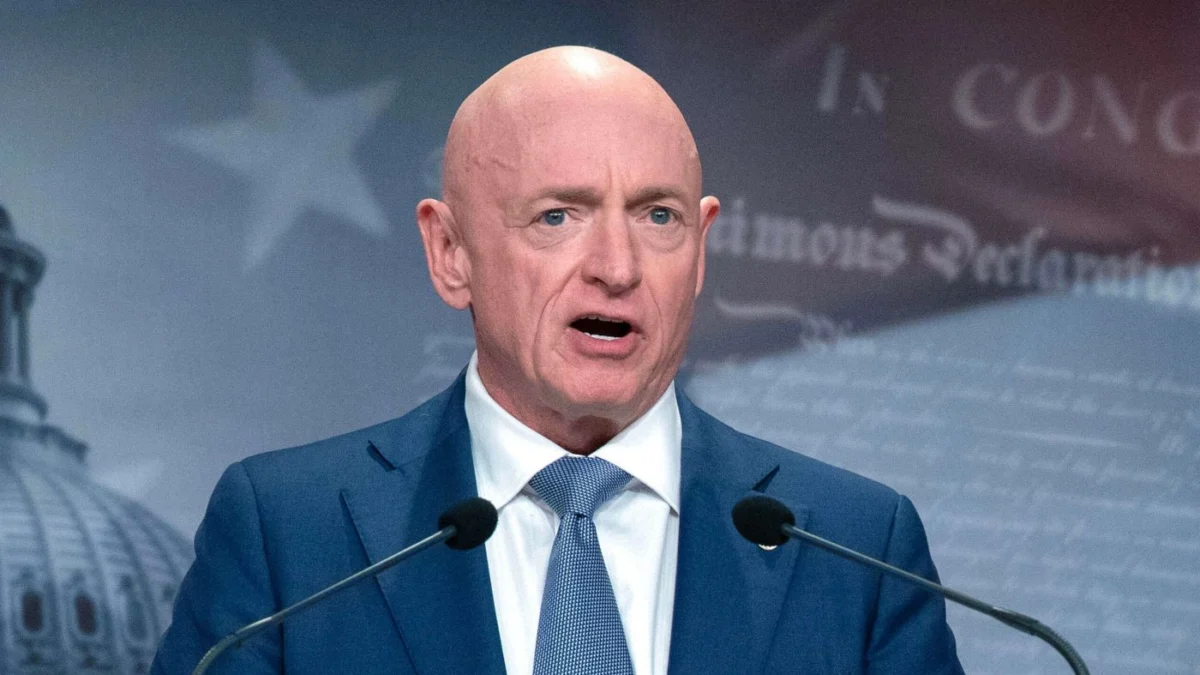
Senator Mark Kelly (D-Ariz.) on Wednesday reiterated his "undecided" stance regarding a potential 2028 presidential bid, a declaration made during the Semafor World Economy conference in Washington, D.C. The former astronaut and naval officer, who has garnered significant attention for his distinct background and recent clashes with the previous administration, acknowledged the ongoing speculation but maintained that a definitive decision remains in the future. His remarks come amidst months of heightened visibility and a growing chorus of Democratic strategists highlighting his unique appeal as a potential frontrunner in a future primary contest.
"I will make a decision about that, and so far I’m undecided," Kelly stated at the high-profile conference, addressing a question that has frequently followed him since his ascent to the Senate. He added, "I make all kinds of decisions every day — about a lot of things. Sometimes I go this way; sometimes I go that way." This measured response reflects a strategic ambiguity, allowing him to continue building his national profile and testing the political waters without committing prematurely to the arduous path of a presidential campaign. Kelly has previously signaled a serious consideration for the nation’s highest office, consistently emphasizing his non-traditional political journey and the "different perspective" his life experiences afford him.
The Astronaut’s Political Ascent: A Unique Profile
Mark Kelly’s trajectory into national politics is anything but conventional, setting him apart from many of his congressional colleagues and potential presidential rivals. Born in Orange, New Jersey, Kelly’s early life was shaped by public service, being the son of two police officers. His path led him to the U.S. Merchant Marine Academy, followed by a distinguished 25-year career in the U.S. Navy. During his time as a naval aviator, he flew A-6E Intruder attack aircraft, completing 39 combat missions during Operation Desert Storm. He further distinguished himself as a test pilot before being selected by NASA in 1996 to join its elite astronaut corps.
As a NASA astronaut, Kelly completed four space shuttle missions: STS-108 in 2001, STS-121 in 2006, STS-124 in 2008, and commanding STS-134, the final mission of Space Shuttle Endeavour, in 2011. His cumulative time in space totals over 54 days. This extraordinary career, marked by rigorous training, high-stakes missions, and unparalleled leadership responsibilities, profoundly shaped his worldview and leadership style.
His entry into the political arena was deeply personal. In January 2011, his wife, then-Congresswoman Gabby Giffords, was critically wounded in an assassination attempt in Tucson, Arizona. This traumatic event propelled Kelly and Giffords into advocacy for gun violence prevention, establishing the organization Americans for Responsible Solutions (now Giffords). This advocacy platform provided Kelly with a national voice and a clear policy focus, which he leveraged when he decided to run for the U.S. Senate in Arizona. In a special election in 2020, Kelly defeated incumbent Martha McSally, becoming the state’s junior senator. He was subsequently re-elected in 2022, solidifying his position as a prominent Democratic figure in a crucial swing state. His political success in Arizona, a state often seen as a bellwether for national political trends, further bolsters the argument for his broader electability.
Navigating the 2028 Landscape: An Undecided Calculus
The 2028 presidential election is still several years away, but the jockeying for position has already begun, particularly within the Democratic Party, which could face an open primary if the incumbent president does not seek re-election. Senator Kelly’s repeated "undecided" stance at the Semafor conference reflects a strategic approach common among potential candidates. This allows for continued media engagement, fundraising, and coalition-building without the immediate pressures and scrutiny that accompany an official campaign launch.
His emphasis on not being a "typical politician" resonates with a segment of the electorate increasingly weary of career politicians and partisan gridlock. Polling data from recent election cycles consistently indicates a significant appetite for political outsiders or individuals with diverse professional backgrounds. Kelly’s narrative — son of cops, naval officer, test pilot, astronaut — provides a compelling counter-narrative to traditional political biographies, potentially appealing to independent voters, moderate Republicans, and disaffected Democrats. This "outsider" appeal, combined with his proven ability to win competitive races in a purple state like Arizona, positions him as a potentially formidable contender capable of bridging ideological divides.
The Democratic field for 2028 is expected to be crowded and diverse, potentially featuring governors, other senators, and even members of the current administration. Kelly’s unique profile offers a distinct brand that could cut through the noise. His background in science and national security could be particularly attractive to voters seeking pragmatic, results-oriented leadership.
Space as the "Next High Ground": A Core Policy Vision
One of the most distinctive elements of Senator Kelly’s burgeoning political platform, and indeed a natural extension of his professional life, is his profound focus on space and its critical role in national security. At the Semafor conference, he articulated a vision where "Space is now the next high ground in any conflict with any kind of near-peer adversary. So I’m talking about Russia and China. If we were in a conflict with the Chinese, especially." This statement is not merely a reflection of his past profession but a serious policy commitment rooted in a deep understanding of geopolitical realities and technological advancements.
Kelly’s assertion highlights a growing consensus among defense and intelligence experts. Modern warfare and even daily civilian life are increasingly reliant on space-based assets. Satellites provide indispensable services, including GPS navigation, global communications, weather forecasting, intelligence gathering, missile warning systems, and precise timing for financial markets. The disruption or destruction of these assets would have catastrophic implications for military operations, economic stability, and societal functioning.
The Center for Strategic and International Studies (CSIS) and other defense think tanks have extensively documented the aggressive development of anti-satellite (ASAT) capabilities by rival nations, particularly China and Russia. These include direct-ascent anti-satellite missiles, which are ground-launched kinetic weapons designed to destroy satellites in low Earth orbit (LEO). Russia’s 2021 test of such a weapon against one of its own defunct satellites generated thousands of pieces of dangerous space debris, illustrating the threat these weapons pose to the entire space environment. Beyond kinetic attacks, adversaries are also developing co-orbital ASATs (satellites designed to rendezvous with and disable other satellites), electronic warfare capabilities (jamming and spoofing signals), and cyberattacks targeting satellite ground control systems.
For Kelly, a president with firsthand experience in space would bring an unparalleled strategic advantage to the White House. Such a leader would not only understand the technical complexities but also the operational implications of space dominance and defense. His administration, if elected, would likely prioritize investments in resilient space architectures, advanced satellite technologies, offensive and defensive space capabilities, and international norms for responsible behavior in space. This focus extends beyond military applications to encompass the economic opportunities of the burgeoning commercial space industry, fostering innovation in areas like satellite broadband, space tourism, and resource extraction, thereby ensuring American leadership in a critical 21st-century domain.
The "Illegal Orders" Controversy: A Test of Principle and First Amendment Rights
Senator Kelly’s public profile was significantly elevated last year due to a high-stakes confrontation with the Trump administration over the legality of military orders. The controversy stemmed from a video in which Kelly, alongside five other lawmakers, urged service members not to follow illegal orders. This video, released during a period of heightened political tension and questions surrounding military loyalty, sparked immediate and forceful condemnation from then-Defense Secretary Pete Hegseth and President Donald Trump.
The core of the dispute revolved around the Uniform Code of Military Justice (UCMJ), which explicitly states that service members have a duty to disobey unlawful orders. This fundamental principle is a cornerstone of democratic civilian control over the military, preventing the use of armed forces for unconstitutional or illegal purposes. Kelly and his colleagues argued that reminding service members of this duty was not an act of insubordination but a reaffirmation of their oath to the Constitution.
Defense Secretary Hegseth, however, viewed the video as an egregious breach of military discipline and an attempt to sow dissent within the ranks. He publicly called for Kelly’s censure and demotion of his military rank, leveraging his authority as the civilian head of the Pentagon. This move was unprecedented, as Kelly, a retired naval officer, had transitioned to civilian life and was serving as a U.S. Senator. The attempt to strip a sitting senator of his earned military rank was widely seen as politically motivated retaliation.
In February, a federal judge decisively blocked Hegseth’s push to demote Kelly’s military rank. Kelly’s 46-page complaint, which led to the judge’s ruling, powerfully argued that "The First Amendment forbids the government and its officials from punishing disfavored expression or retaliating against protected speech." It further asserted that "That prohibition applies with particular force to legislators speaking on matters of public policy." The court’s decision was a resounding victory for Kelly, upholding the First Amendment rights of elected officials and affirming the principle that military service members are bound by the Constitution, not blind obedience. This incident not only solidified Kelly’s image as a principled leader willing to stand up to executive overreach but also underscored his "not typical politician" brand, demonstrating a willingness to prioritize constitutional principles over political expediency.
Strategic Appeal and Fundraising Prowess
Democratic strategists have consistently highlighted Senator Kelly as a strong potential nominee, citing his diverse background and congressional experience as key assets. Matt Grodsky, an Arizona Democratic strategist, articulated this sentiment to Cronkite News, stating, "He can convert swing voters and raise a ton of money. That’s got to be attractive to not just the party establishment, but voters as well that are looking for an alternative."
Kelly’s ability to convert swing voters is rooted in his moderate political stance and his non-ideological appeal. His background as a decorated military officer and an astronaut lends him an aura of competence, patriotism, and scientific credibility that transcends traditional partisan divides. In an era of deep political polarization, a candidate perceived as a pragmatic problem-solver rather than a partisan warrior holds significant appeal, particularly in the general election. His success in Arizona, a state with a significant independent voter bloc, provides tangible proof of his cross-party appeal.
Furthermore, Kelly has demonstrated formidable fundraising capabilities. His national profile, compelling personal story, and unique background resonate with donors across various sectors, including technology, defense, and the burgeoning space industry. His existing network, cultivated through his Senate campaigns and advocacy work, provides a strong foundation for a national fundraising operation. The fact that former Vice President Kamala Harris reportedly considered him as a running mate during her 2024 campaign (before she became the incumbent VP in this hypothetical 2028 scenario) further underscores the perception of his strength and viability within the party. This consideration by a prominent national figure speaks volumes about his perceived electability and appeal.
Challenges and Opportunities on the Campaign Trail
While Senator Kelly possesses many attributes that make him an attractive presidential candidate, a potential campaign would also present significant challenges. One primary hurdle would be navigating a crowded and competitive Democratic primary field. While his "outsider" status is an asset, he would need to articulate a comprehensive policy platform that extends beyond space and national security, addressing critical issues such as healthcare, economic inequality, climate change, and social justice, which are central to the Democratic base. His relatively shorter tenure in traditional politics compared to career politicians might also be scrutinized.
Another challenge lies in maintaining his independent image while satisfying the demands of the party’s progressive wing. Striking the right balance between appealing to moderates and energizing the base will be crucial. Furthermore, the rigorous demands of a presidential campaign, including extensive travel, fundraising, and relentless media scrutiny, would test even the most seasoned politician.
However, Kelly’s opportunities are equally compelling. His unique biography offers a powerful narrative of service, innovation, and resilience. He can connect with voters on issues of national security with unparalleled credibility, drawing on his military and space background. His emphasis on science and technology could appeal to a forward-looking electorate, positioning him as a leader prepared to tackle 21st-century challenges. His ability to communicate complex ideas clearly and his calm demeanor could also stand in stark contrast to the often-heated rhetoric of political campaigns.
In conclusion, Senator Mark Kelly’s "undecided" status on a 2028 presidential bid sets the stage for a fascinating political dynamic. His remarkable journey from naval aviator and astronaut to U.S. Senator provides a compelling narrative and a distinct policy vision centered on national security and space. The challenges of a presidential campaign are formidable, but his proven electability in a swing state, his fundraising prowess, and his principled stand against executive overreach have clearly positioned him as a significant figure to watch in the evolving landscape of American politics. As the 2028 election cycle draws closer, the question of whether this unconventional leader will take the ultimate leap into the presidential arena will remain a central point of discussion and speculation.








Leave a Reply