
The correspondence between Sol LeWitt and Eva Hesse, specifically a five-page letter dated April 14, 1965, remains one of the most significant archival documents in the history of American post-war art. Written during a period of profound professional and personal transition for Hesse, the letter transcends simple personal advice, serving as a foundational text for understanding the shift from Minimalism to Postminimalism. At its core, the missive addresses a universal dilemma in the creative process: the paralyzing intersection of perfectionism, self-doubt, and the pressure of public expectation. By urging Hesse to abandon intellectualization in favor of raw production—summarized in the emphatic command to "DO"—LeWitt provided a psychological blueprint that would eventually catalyze some of the 20th century’s most innovative sculptural works.
Historical Context and the 1965 Crisis
To understand the weight of LeWitt’s advice, one must consider the biographical circumstances of both artists in the mid-1960s. Sol LeWitt, born in 1928, was already establishing himself as a central figure in the Conceptual Art and Minimalist movements. His work focused on the idea that the "concept" or "plan" was the most important aspect of the work, often delegating the actual execution to others. In contrast, Eva Hesse, born in Hamburg in 1936 and a survivor of the Kindertransport, was a pioneer of Postminimalism. Her work was deeply tactile, utilizing unconventional materials like latex, fiberglass, and industrial plastics to explore themes of absurdity and the human body.
In 1964, Hesse and her husband, sculptor Tom Doyle, moved from the vibrant art scene of New York City to Kettwig, Germany, for a year-long residency at the invitation of a textile industrialist. This return to her birth country—a land from which she had fled the Nazi regime as a child—triggered a period of intense emotional distress and creative paralysis. Hesse found herself struggling with the legacy of her teacher, Josef Albers, and the rigid constraints of the prevailing Minimalist aesthetic. She felt unable to reconcile her desire for order with her impulse toward the chaotic and the organic. It was in this state of "agonizing reappraisal" that she reached out to LeWitt, her close friend and confidant, seeking a way out of her stagnation.

The Anatomy of the "DO" Letter
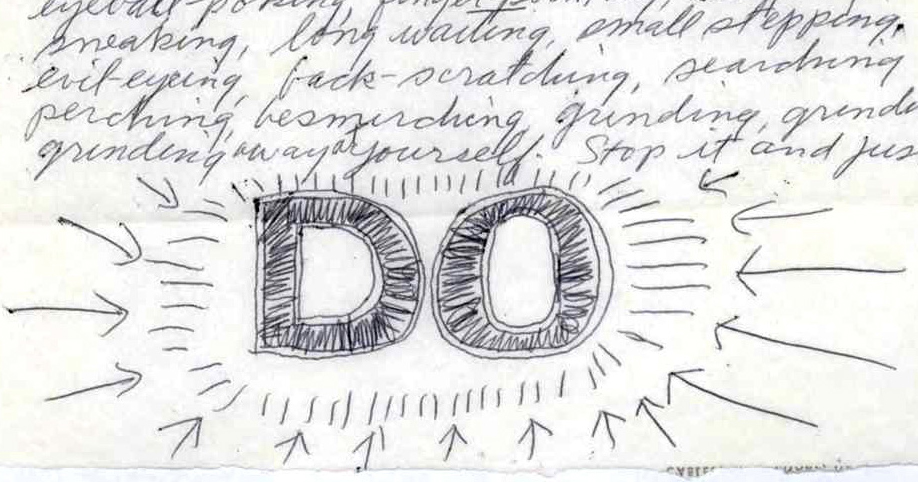
LeWitt’s response was a visceral rejection of the "hair-splitting" and "nit-picking" that he believed were stifling Hesse’s genius. The letter is famous for its rhythmic, almost litanic quality, where LeWitt lists the various ways artists sabotage themselves through overthinking. He famously commanded her to "stop thinking, worrying, looking over your shoulder, wondering, doubting, fearing, hurting, hoping for some easy way out."
The letter suggests that the path to greatness is not found through an "impulse alone," as Vincent van Gogh once suggested to his brother Theo, but through a "succession of little things brought together." LeWitt argued that the artist’s primary responsibility is not to the "world" or to "ART" in the abstract, but to the work itself. He encouraged Hesse to "practice being stupid, dumb, unthinking, empty," a state that parallels the Buddhist concept of shunyata, or emptiness. In this context, emptiness is not a void but a fertile ground where creativity can emerge without the burden of ego or preconceived forms.

LeWitt’s advice to "do some BAD work" is particularly noted by art historians as a revolutionary approach to creative block. By removing the requirement for "goodness," LeWitt aimed to lower the stakes of production, allowing Hesse to experiment with the "nonsensical" and the "crazy" without the anchor of perfectionism.
Chronology of the LeWitt-Hesse Creative Relationship
- 1960: Sol LeWitt and Eva Hesse meet in New York City and establish a close friendship based on mutual respect for their differing aesthetic approaches.
- 1964: Hesse and Doyle move to Germany. Hesse begins to struggle with the transition from painting to sculpture, feeling constrained by traditional forms.
- April 14, 1965: LeWitt sends the "DO" letter to Hesse in Germany.
- 1965 (Late): Hesse returns to New York. Influenced by LeWitt’s encouragement to embrace the "absurd," she begins working with cord and plaster, moving toward her signature style.
- 1966: Hesse completes Hang-Up, a large-scale frame wrapped in cloth and cord with a protruding steel rod. She describes it as the "most ridiculous structure" she ever made, signaling her breakthrough into Postminimalism.
- 1967–1969: Both artists reach the height of their influence. LeWitt publishes "Paragraphs on Conceptual Art" (1967), while Hesse is featured in the seminal "9 at Castelli" exhibition.
- May 29, 1970: Eva Hesse dies of a brain tumor at age 34.
- June 1970: LeWitt creates Wall Drawing 46 at the Museum of Modern Art in Paris, dedicated to Hesse. The work introduces non-straight, "not-straight" lines, a departure from his previous geometric rigidity and a direct tribute to Hesse’s organic influence.
Supporting Data and Critical Reception
The impact of the LeWitt-Hesse correspondence has been quantified through its enduring presence in cultural and academic circles. The letter was a centerpiece of Shaun Usher’s 2013 anthology, Letters of Note: Correspondence Deserving of a Wider Audience. This collection, which includes letters from figures such as Ernest Hemingway, Hunter S. Thompson, and E.B. White, brought LeWitt’s advice to a global mainstream audience.

In 2016, a video of actor Benedict Cumberbatch performing a dramatic reading of the letter at a "Letters Live" event went viral, garnering millions of views and introducing LeWitt’s philosophy to a new generation of creatives. Academic analysis of the letter often cites it as a primary source for the study of "process art." According to archival data from the Sol LeWitt Collection, the artist frequently revisited the themes of the 1965 letter in his later "Sentences on Conceptual Art" (1969), specifically Sentence 1: "Conceptual artists are mystics rather than rationalists. They leap to conclusions that logic cannot reach."
Furthermore, the market and museum valuation of the works produced immediately following this exchange highlight its significance. Hesse’s Hang-Up, now in the collection of the Art Institute of Chicago, is cited by critics as a pivotal moment where she successfully "crystallized a simpler, clearer version of life," as Georgia O’Keeffe once described the artist’s task.

Broader Impact and Implications for the Creative Arts
The LeWitt-Hesse letter serves as more than a historical artifact; it is a psychological case study in the efficacy of "action-oriented" therapy for creative professionals. Modern psychological research into "flow states" and "perfectionistic stasis" often echoes LeWitt’s 1965 sentiments. The letter advocates for what is now known as "productive failure"—the idea that producing a high volume of work, including "bad" work, is the only statistically viable path to producing "great" work.
The legacy of this exchange is also visible in the evolution of Sol LeWitt’s own career. While he is often categorized as a cold, rational Minimalist, his relationship with Hesse revealed a more emotive, supportive, and experimental side. His dedication of Wall Drawing 46 to her was an admission that his own rigid systems were improved by the "nonsense" and "crazy" lines she championed. The piece featured a multitude of textured, hand-drawn lines that lacked the mathematical precision of his earlier work, proving that the influence was mutual.

Official Responses and Institutional Legacy
Major art institutions, including the Whitney Museum of American Art and the Museum of Modern Art (MoMA), have frequently highlighted this correspondence in retrospectives of both artists. Curators note that the letter represents a rare moment of vulnerability and clarity in an era often defined by opaque art theory.
The Sol LeWitt Estate and the Eva Hesse Estate continue to cooperate on exhibitions that explore their creative kinship. These exhibitions emphasize that LeWitt’s "DO" was not just a command to work, but a command to exist authentically within one’s own "weird humor" and "secret parts."

In conclusion, the 1965 letter from Sol LeWitt to Eva Hesse stands as a testament to the power of artistic solidarity. It reminds the creative community that while "the great doesn’t happen through impulse alone," it also cannot happen when the mind is cluttered by the "piss-trickling" and "ass-gouging" of self-criticism. By championing the absurd and the nonsensical, LeWitt helped Hesse unlock a new language of sculpture, and in doing so, he provided an eternal remedy for the "agonizing reappraisals" that haunt the creative life. The final takeaway remains as relevant today as it was in 1965: to move beyond the unknown, one must simply stop worrying and "DO."








Leave a Reply