

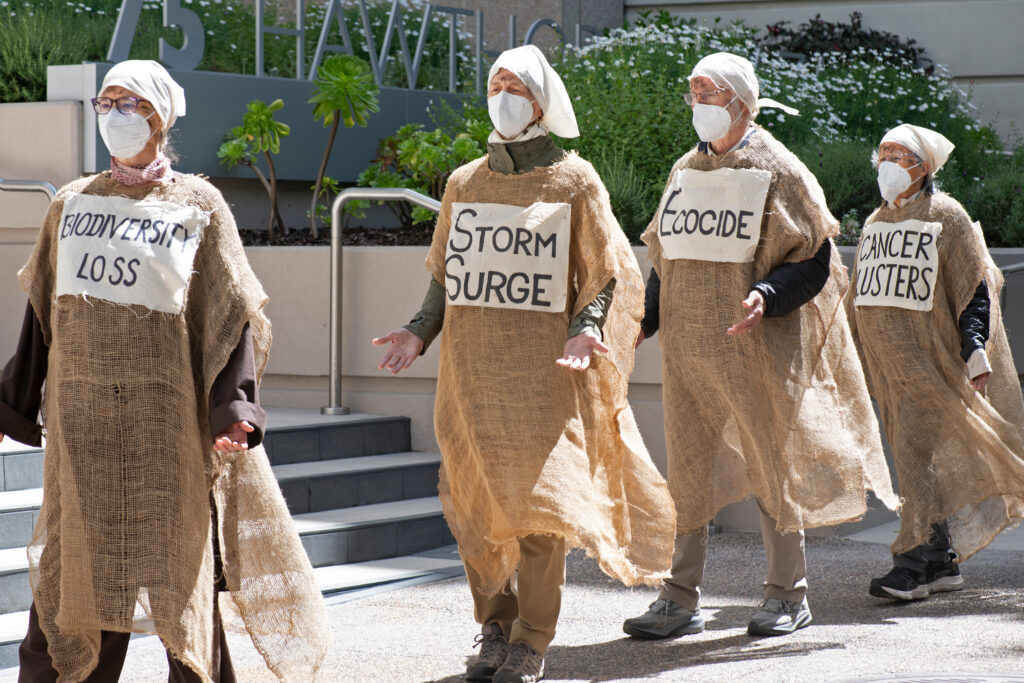
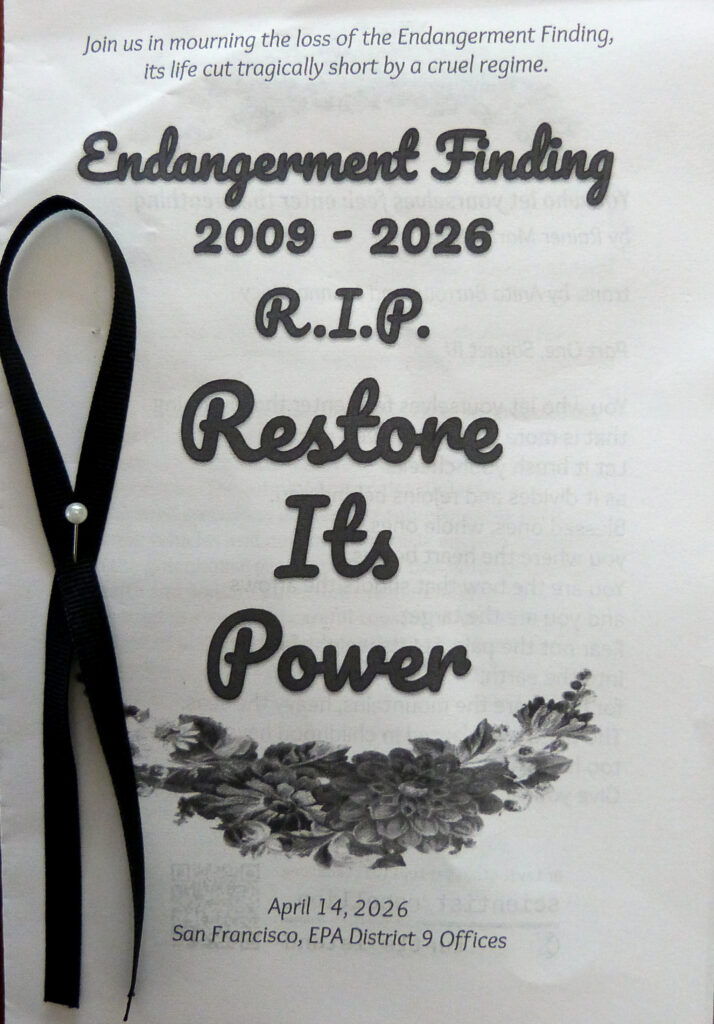
A somber procession of mourners, draped in sackcloth and marked with ash, gathered outside the Environmental Protection Agency’s Region 9 headquarters in downtown San Francisco on Tuesday to grieve what they described as a catastrophic blow to the planet’s future. The activists, representing a coalition of scientists and environmental advocates, staged a mock funeral for the "endangerment finding," a foundational climate policy that the federal government recently rescinded. The symbolic service was designed to highlight the gravity of a regulatory shift that legal experts and climatologists warn could dismantle the United States’ ability to curb the emissions driving global temperature increases.
The participants, who referred to themselves as "lamentors," embodied various climate-driven disasters, including rising sea levels, melting permafrost, and the concept of ecocide. By wearing sackcloth and ash—ancient symbols of mourning—the group sought to express a collective sense of loss for a policy they believe was the last line of defense against an accelerating environmental crisis. Michelle Merrill, an evolutionary anthropologist and lead organizer of the event, stood alongside members of Scientist Rebellion Turtle Island to pay respects to a rule she described as having been "taken from us too soon."
The Legal and Scientific Foundation of the Endangerment Finding
To understand the weight of the protest, one must look back to the origin of the policy being mourned. The endangerment finding was officially issued by the EPA in 2009, during the Obama administration. Its creation was not a mere administrative whim but a direct response to the 2007 Supreme Court ruling in Massachusetts v. EPA. In that landmark case, the Court determined that greenhouse gases (GHGs) fit the definition of "air pollutants" under the Clean Air Act. Consequently, the Court ruled that the EPA was required to determine whether these gases endangered public health and welfare.
After an exhaustive review of scientific data, the EPA concluded that six greenhouse gases—carbon dioxide, methane, nitrous oxide, hydrofluorocarbons, perfluorocarbons, and sulfur hexafluoride—posed a significant threat to the American people. This finding became the legal "trigger" that mandated the EPA to regulate these emissions from motor vehicles and, eventually, from stationary sources like power plants and industrial facilities. Without the endangerment finding, the Clean Air Act’s mechanisms for climate protection lose their primary legal justification.
The 2009 decision was anchored in a massive body of research. The EPA’s technical support document at the time relied on assessment reports from the Intergovernmental Panel on Climate Change (IPCC), the U.S. Global Change Research Program, and the National Research Council. Furthermore, the agency processed more than 380,000 public comments before finalizing the rule. For the scientists protesting in San Francisco, the repeal of this finding represents not just a policy change, but a rejection of decades of peer-reviewed evidence.
A Chronology of Deregulation
The path to the mock funeral in San Francisco began on the first day of the current administration’s return to power. President Donald Trump, in one of his initial executive orders titled "Unleashing American Energy," directed EPA Administrator Lee Zeldin to reconsider the "legality and continuing applicability" of the 2009 finding. By February 12, the EPA officially announced its intent to rescind the rule, a move that is set to take full legal effect on April 20.
The administration has framed this move as a restoration of economic sovereignty and a correction of executive overreach. At a press event in February, President Trump characterized the repeal as the "single largest deregulatory action in American history." He described the Obama-era policy as a "disastrous" hurdle that stifled American industry and energy production. EPA Administrator Lee Zeldin echoed these sentiments, stating that the agency would return to its "statutory obligations" using what he termed "gold standard science," rather than "doomsday models" intended to coerce public compliance.
This shift marks a total reversal of the Biden administration’s efforts, which had sought to strengthen the EPA’s hand in regulating pollutants. Joseph Goffman, who served as a top air official during the Biden years, described the repeal as "legally indefensible" and "morally bankrupt." According to Goffman, the move is "completely untethered from the scientific record," setting the stage for a protracted legal battle in the federal courts.
Scientific Outcry and the "Destruction of Science"
The San Francisco protest was notable for its high concentration of scientific professionals. Paul English, an environmental epidemiologist and member of Scientist Rebellion, warned that the absence of federal regulation would lead to an inevitable increase in heatwaves, wildfires, and extreme weather events. "The government will no longer have the right to regulate greenhouse gases," English noted. "That is going to contribute to the climate catastrophe… and ultimately affect public health in this country and the world."
Greg Spooner, a physicist who delivered a eulogy for the finding during the mock service, expressed a profound sense of alarm regarding the administration’s treatment of data. He argued that the repeal is part of a broader "catastrophic destruction of science of all kinds" within the federal government. Spooner’s eulogy urged citizens and policymakers to find ways to "revive the spirit" of the finding, even as the legal framework is dismantled.
The EPA’s current leadership, however, maintains that the previous administration’s models were flawed. An EPA spokesperson recently stated that even if the United States were to eliminate all greenhouse gas emissions from vehicles, it would not result in a "material impact on global climate indicators." This argument suggests that unilateral U.S. action is futile in the face of global emissions trends, a stance that climate activists argue is a recipe for international paralysis.
Supporting Data: The Stakes of Regulation
The debate over the endangerment finding is not merely academic; it has tangible implications for the U.S. economy and public health. According to data from the National Oceanic and Atmospheric Administration (NOAA), the U.S. experienced 28 separate billion-dollar weather and climate disasters in 2023 alone, with a total cost exceeding $92 billion. Proponents of the endangerment finding argue that by regulating emissions, the government can mitigate the long-term frequency and severity of such events.
Furthermore, the transportation sector remains the largest source of greenhouse gas emissions in the United States, accounting for approximately 28% of the national total. Under the 2009 finding, the EPA was able to implement Corporate Average Fuel Economy (CAFE) standards, which have saved consumers billions at the pump while significantly reducing carbon output. Critics of the repeal argue that without these standards, the U.S. will lose its competitive edge in the global transition to electric vehicles and clean energy technologies.
Official Responses and Impending Litigation
The repeal has triggered an immediate and robust legal response. In March, a coalition of 24 states, led by California and New York, along with a dozen major cities, filed a lawsuit in the U.S. Court of Appeals for the D.C. Circuit. The petition names both the EPA and Administrator Zeldin, arguing that the agency does not have the authority to simply ignore the scientific evidence of "endangerment" that was established in 2009.
Legal experts suggest the case will hinge on the "Administrative Procedure Act," which requires federal agencies to provide a reasoned explanation for changing long-standing policies. Because the scientific consensus on climate change has only strengthened since 2009—with record-breaking global temperatures recorded in each of the last several years—the EPA will face a high burden of proof to justify why carbon dioxide is suddenly no longer a threat to public welfare.
Simultaneously, a separate lawsuit has been filed by a coalition of health and environmental organizations, including the American Lung Association and the Sierra Club. These groups argue that the repeal directly violates the EPA’s core mission to protect human health. They point to the rising rates of asthma and heat-related illnesses as evidence that the "endangerment" is not a future projection, but a current reality.
Broader Impact and Global Implications
The international community is also watching the developments in San Francisco and Washington with concern. As the world’s second-largest emitter of greenhouse gases, the United States plays a pivotal role in the success of the Paris Agreement. The repeal of the endangerment finding signals a retreat from federal climate leadership, potentially encouraging other nations to scale back their own commitments.

The activists in San Francisco emphasized that their "funeral" was not just for a piece of paper, but for the principle of evidence-based governance. "I know, as a scientist, what it feels like to lose the ability to do the work that you’re doing when it feels important," said Michelle Merrill. She and her colleagues spent the day distributing condolence cards to EPA staff, many of whom are reportedly demoralized by the shift in the agency’s direction.
As the April 20 effective date approaches, the "lamentors" of San Francisco are transitioning from mourning to mobilization. They view the mock funeral as a wake-up call for the public, an attempt to translate complex regulatory changes into a visible, emotional narrative. While the legal battle plays out in the D.C. Circuit, the symbolic ashes left on the pavement outside the EPA Region 9 headquarters serve as a reminder of the deep divisions over the role of science in American law.
The long-term impact of this deregulatory action will likely be measured in parts per million of atmospheric carbon and the frequency of the "calamities" represented in the funeral procession. For now, the scientific community remains in a state of high alert, waiting to see if the courts will resurrect the policy they have already laid to rest in the court of public opinion. Regardless of the legal outcome, the events in San Francisco underscore a growing movement of scientists who are no longer content to stay in the lab, but are instead taking to the streets to defend the data they say is essential for human survival.










Leave a Reply