
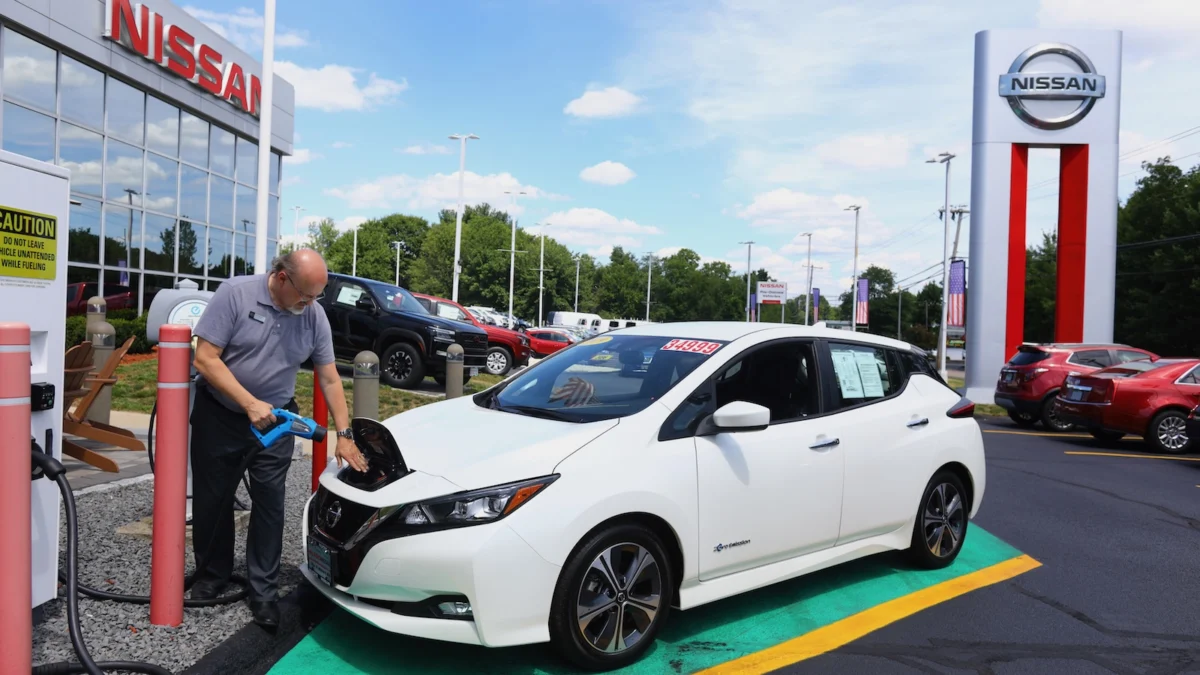
The American automotive landscape is currently navigating a period of significant transition, marked by a paradoxical shift in consumer behavior. Despite a steady increase in gasoline prices across the United States, sales of new electric vehicles (EVs) experienced a notable decline in April 2026. This trend stands in stark contrast to other major global markets, such as Europe and China, where high fuel costs have historically acted as a primary catalyst for EV adoption. Instead of making the leap to fully electric platforms, American drivers are increasingly gravitating toward hybrid powertrains, seeking a middle ground between traditional internal combustion engines and the zero-emission future.
According to the latest industry data, the momentum for EVs in the U.S. hit a significant speed bump in the second quarter. Research firm Edmunds reported that sales of new EVs fell by approximately 18 percent from March to April. While Cox Automotive provided a more conservative estimate, pegging the decline at closer to 6 percent, the consensus among industry analysts is clear: the correlation between high gas prices and EV sales has decoupled in the American market. For the first time in several years, the "pump pain" that usually drives consumers toward the electric plug is instead driving them toward the hybrid pump.
The Financial Barrier: Upfront Costs vs. Long-Term Savings
The primary obstacle preventing a mass migration to electric vehicles remains the significant price premium associated with new EV technology. While the narrative of lower long-term operating costs remains factually accurate, the initial "sticker shock" continues to deter the average consumer. Data from Cox Automotive reveals that the average transaction price for a new EV in April was $6,214 higher than for a comparable vehicle equipped with an internal combustion engine (ICE).
Industry experts suggest that this price gap creates a psychological and mathematical barrier that many households are unwilling or unable to cross. Stephanie Brinley, a principal automotive analyst at S&P Global Mobility, noted that the return on investment for an EV is often too abstract for a consumer focused on monthly budget constraints. "It’s still a cost hurdle," Brinley explained. "You don’t know how long it’s going to take to get that back."
To put the economics into perspective, with gasoline averaging $4.56 per gallon in late May, a consumer purchasing an EV would need to drive more than 40,000 miles to offset the initial $6,214 price premium, assuming they are comparing it to a standard gasoline car achieving 30 miles per gallon. While savings on maintenance—such as the elimination of oil changes and exhaust system repairs—can shorten this timeline, other factors frequently extend it. Higher insurance premiums for EVs and the necessary investment in home charging infrastructure, which can cost anywhere from $500 to $2,000 for installation, add layers of complexity to the financial "payback period."
Ivan Drury, director of insights at Edmunds, observed that while consumer interest remains high, it is not translating into transactions. "There was a lot of window shopping," Drury said, noting that online searches for electrified vehicles were robust throughout the spring. "It did not translate to tire-kicking and purchases. It requires a bit more math than most people want to go through."
The Hybrid Momentum: A Simpler Calculus for Consumers
As EV sales stalled, hybrid vehicles emerged as the primary beneficiary of the current economic climate. Hybrids, which utilize a combination of a gasoline engine and a battery-powered electric motor to improve fuel efficiency by 25 to 45 percent, offer a more palatable transition for the average driver. Unlike battery-electric vehicles (BEVs), hybrids do not require a change in refueling habits or the installation of specialized home equipment.
The sales data reflects this preference vividly. Edmunds reported that hybrid sales have surged by 20 percent year-over-year. More tellingly, since February 2026—when geopolitical tensions in the Middle East began to impact global oil supplies—hybrid sales have jumped by nearly 50 percent. In comparison, sales of traditional gasoline-powered vehicles rose by a more modest 11 percent during the same two-month window.
Automotive manufacturers have anticipated this shift by pivoting their product lineups. Toyota, a long-time proponent of hybrid technology, has been particularly aggressive. The company recently discontinued the gasoline-only version of its flagship Camry sedan, making the model exclusively hybrid for the 2025 and 2026 model years. The popular RAV4 SUV has followed a similar trajectory, with the 2026 models emphasizing hybrid and plug-in hybrid configurations. Similarly, the Honda CR-V Hybrid has become a cornerstone of its segment, offering 37 mpg compared to the 29 mpg of its non-hybrid counterpart.
"I think this is going to be a hybrid moment," said Stephanie Valdez Streaty, director of industry insights at Cox Automotive. "There are a lot of options now, and for many consumers, the math is just much simpler."
Geopolitical Tensions and the Impact on the Pump
The backdrop of this shift in consumer behavior is a volatile global energy market. Since early 2026, the ongoing conflict involving Iran has significantly disrupted oil transit through the Strait of Hormuz, a vital chokepoint for global energy supplies. This instability has kept upward pressure on fuel prices just as the United States enters the peak summer travel season.
With gas prices expected to continue their ascent, the economic incentive to move away from pure internal combustion engines is stronger than ever. However, the American response remains unique. In Europe, the same geopolitical pressures have led to a "leap" in EV sales, as governments there offer more aggressive subsidies and the charging infrastructure is more densely developed. China, too, has seen record-breaking figures, with EV exports reaching new heights in April according to BloombergNEF.
In the U.S., the "nudging" effect of high gas prices appears to only work on consumers who were already planning to purchase an EV. These "edge-case people," as described by Brinley, are being pushed toward the finish line by high pump prices, but the broader population of ICE owners remains hesitant to make a fundamental change based solely on fuel costs.
The Used EV Market: A Bright Spot in the Data
While the new EV market struggles with price premiums, the used EV segment is showing signs of healthy growth and more efficient turnover. From March to April, sales of used electric vehicles rose by 3 percent. Perhaps more importantly, the price premium for a used EV over a used gasoline vehicle was only $1,096—a fraction of the $6,214 gap seen in the new car market.
Valdez Streaty noted that used EVs are currently selling faster than their internal combustion counterparts. "They’re really selling efficiently," she said. The industry anticipates a "glut" of used EVs entering the market throughout the remainder of the year as three-year leases from the 2023 EV sales boom reach their conclusion. This influx of inventory is expected to keep prices competitive, potentially offering a more accessible entry point for budget-conscious consumers looking to go electric without the "new car" surcharge.
Chronology of the 2026 Automotive Shift
To understand the current state of the market, it is essential to look at the timeline of events that shaped the first half of 2026:
- February 2026: Conflict in the Middle East escalates, leading to threats against oil tankers in the Strait of Hormuz. Global crude prices begin a steady climb.
- March 2026: U.S. national average gas prices surpass the $4.20 mark. Search traffic for "EVs" and "Hybrids" on sites like Edmunds hits a two-year high.
- April 2026: Despite rising fuel costs, new EV sales drop between 6% and 18%. Conversely, hybrid sales continue a 50% upward trend from February levels.
- May 2026: The national average for gas reaches $4.56. Toyota and Honda report record-breaking hybrid delivery numbers, while used EV sales show increased velocity.
- Late May 2026: Analysts confirm a "hybrid moment" in the U.S., as the upfront cost of BEVs remains the primary deterrent for mainstream buyers.
Implications for the Future of the U.S. Auto Industry
The current data suggests that the transition to a fully electric fleet in the United States may take longer and follow a more circuitous path than previously projected by policymakers. The "hybrid bridge" is proving to be longer and more necessary than many EV advocates anticipated.
For manufacturers, the implication is a need for a balanced portfolio. While companies like Tesla remain focused exclusively on BEVs, legacy automakers like Toyota, Ford, and Honda are being rewarded for maintaining and expanding their hybrid offerings. The ability to offer a vehicle that mitigates gas price volatility without requiring a $6,000 premium or a lifestyle change is currently the winning strategy in the American heartland.
Furthermore, the strength of the used EV market suggests that the "demand" for electric technology exists, but it is highly price-sensitive. As the price gap between used EVs and used ICE vehicles continues to shrink, the second-hand market may become the primary driver of American electrification in the near term.
In conclusion, while the rest of the world may be surging toward an all-electric future in response to high energy costs, the American consumer is taking a more calculated, incremental approach. The "hybrid moment" of 2026 highlights a pragmatic shift where efficiency is valued, but not at the expense of immediate financial stability. As summer travel begins and gas prices remain elevated, the industry will be watching closely to see if the EV market can find a new equilibrium or if the hybrid reign will continue to dominate the American road.










Leave a Reply