
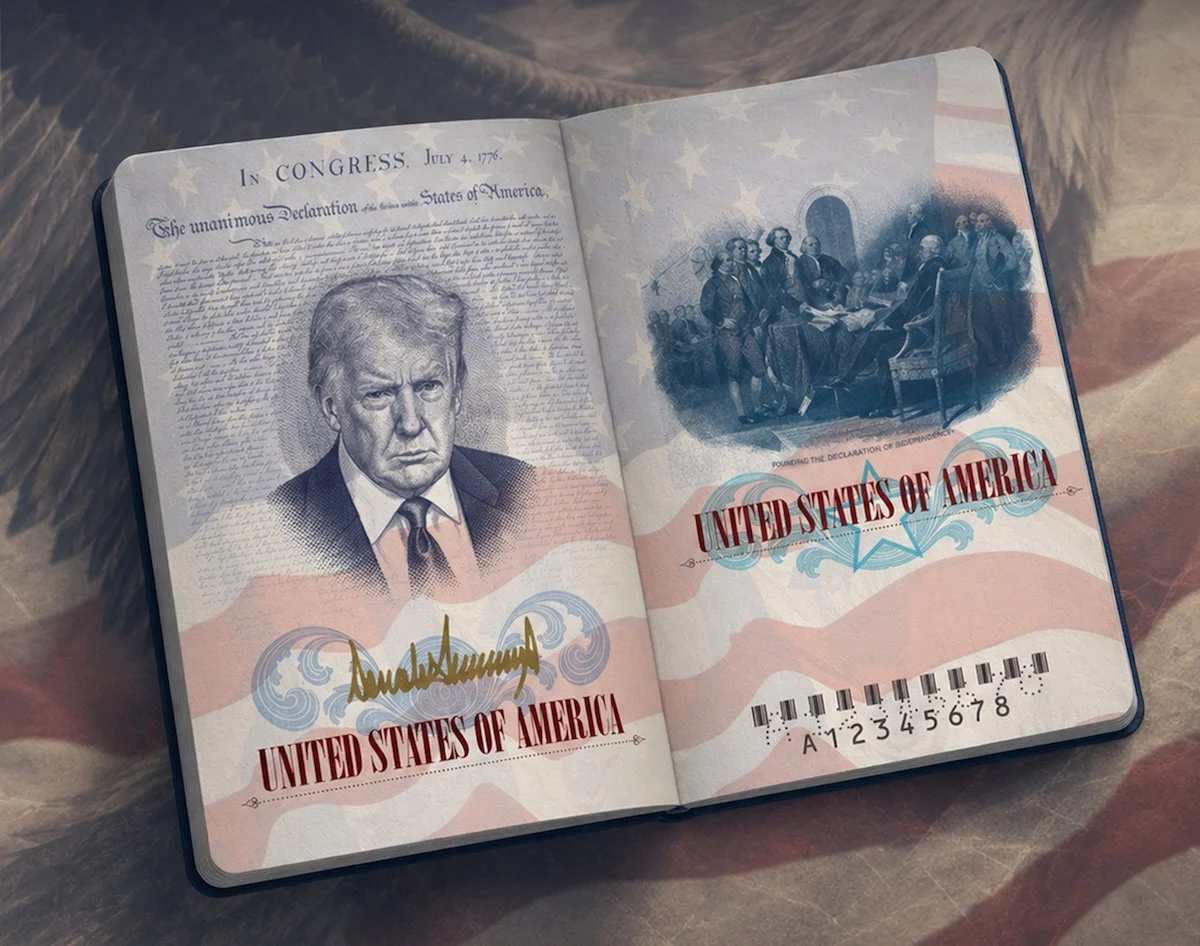
The United States Department of State has officially announced the introduction of a limited-edition passport design intended to celebrate the upcoming 250th anniversary of the signing of the Declaration of Independence. This commemorative travel document, which features significant aesthetic and structural deviations from the standard-issue "Next Generation Passport," has drawn immediate national attention due to its inclusion of the likeness and signature of President Donald J. Trump. While the State Department frequently issues updates to the security features and internal artwork of federal travel documents, the integration of a sitting or contemporary president’s image marks a historic shift in the visual identity of American sovereign documentation.
The rollout is part of a broader federal initiative to mark the United States Semiquincentennial, which will occur on July 4, 2026. According to administrative briefings, the design is intended to bridge the historical foundations of the country with its modern executive leadership. However, the move has sparked a robust debate regarding the intersection of national identity and political branding, as well as the logistical protocols for citizens seeking to renew their travel credentials in the nation’s capital.
Technical Specifications and Design Elements
The commemorative passport features several distinct modifications to both its exterior and interior pages. On the front cover, the words "United States of America" are rendered in a significantly larger typeface than previous versions and have been moved to the absolute top of the booklet, positioned above the Great Seal of the United States. The back cover introduces a nostalgic yet modified motif: an American flag centered with the number "250," surrounded by the 13 stars featured on the 1777 version of the national flag, often associated with the Revolutionary War era.
The most notable changes are found within the interior pages. The inside front cover, traditionally reserved for a message from the Secretary of State and various security motifs, now features a full-color image of President Trump. This portrait is flanked by the full text of the Declaration of Independence and an American flag. Beneath the image is the President’s signature, rendered in gold ink. Following this, the subsequent page depicts the Founding Fathers at the 1776 signing in Philadelphia, creating a visual parallel between the 18th-century origins of the republic and the current administration.
From a technical standpoint, the State Department confirmed that these passports maintain all the rigorous security standards of the Next Generation Passport (NGP) program. This includes the polycarbonate data page, which uses laser engraving to prevent tampering, and an embedded electronic chip that stores the holder’s biometric data. Despite the aesthetic changes, the document remains a fully valid travel instrument recognized by the International Civil Aviation Organization (ICAO).
Distribution and Availability
The availability of the commemorative passport is currently restricted by both location and quantity. At present, the design is being issued exclusively at the Washington Passport Agency, located in the nation’s capital. Officials have designated this as a "limited edition" run, though specific figures regarding the total number of booklets produced have not been disclosed.
A key point of contention for travelers is the lack of a "choice" mechanism at the point of issuance. Individuals who apply for an expedited passport in person at the Washington Passport Agency will receive the commemorative design as the default document until current stocks are exhausted. For citizens who prefer the standard-issue passport, which features more traditional imagery of American landscapes and historical quotes, the State Department has advised using the online renewal portal or visiting passport agencies and acceptance facilities outside of the District of Columbia. This geographical restriction suggests the program is being treated as a pilot or a localized commemorative event rather than a permanent nationwide overhaul of the U.S. travel document.
Historical Context and Precedents
To understand the gravity of this design shift, it is necessary to examine the history of U.S. passport aesthetics. For most of the 20th century, the American passport was a utilitarian document with minimal artistic flourishes. It was not until the 1976 Bicentennial that the passport underwent a significant redesign to include more patriotic imagery.
The standard "Blue Passport," which many Americans carry today, was last majorly updated in 2007 to include images of the 50 states, the lyrics to "The Star-Spangled Banner," and quotes from various historical figures, including George Washington, James Madison, and Martin Luther King Jr. Crucially, these figures have historically been deceased, as American civic tradition typically reserves the placement of individuals on currency and official documents for those who have passed away, thereby avoiding the appearance of a "cult of personality" often associated with authoritarian regimes.
The inclusion of a current president’s image on a passport is unprecedented in the history of the United States. While presidents are frequently featured on commemorative coins or inaugural medals, the passport is a functional legal document used for international identification. Critics have noted that even in many constitutional monarchies, such as the United Kingdom, the monarch’s image does not typically appear on the internal pages of the passport, though the document is issued in their name.
Responses and Political Discourse
The announcement has elicited a sharp divide in public and political reaction. Proponents of the new design argue that it serves as a bold statement of American leadership and a fitting tribute to the executive branch during a milestone anniversary. Supporters have pointed to the 250th anniversary as a unique moment that justifies breaking with tradition to celebrate the current era of the republic.
In response to online criticism regarding the "unprecedented" nature of the design, the White House’s official social media channels have defended the move by drawing comparisons to past commemorative items issued by previous administrations. Specifically, the White House X (formerly Twitter) account cited a commemorative MetroCard issued for President Barack Obama’s 2009 inauguration. However, political analysts have pointed out a significant difference between a local transit card and a federal travel document required for international border crossings.
Furthermore, the White House communication team has leaned into the "royal" comparisons that some critics have used as a pejorative. Following a meeting between President Trump and King Charles III, official social media posts referred to the encounter as a meeting of "two kings," a phrase that has fueled further debate over the intended symbolism of the new passport design and the administration’s view of executive stature.
Logistical and Legal Implications
The introduction of the Trump-centric passport raises several logistical questions for international travelers. While the document is legally valid, some foreign policy experts have raised concerns about how the passport might be perceived at international border crossings, particularly in nations where the current administration’s policies remain a subject of intense local debate.
"A passport is a tool of diplomacy as much as it is a tool of identification," noted one former State Department official who requested anonymity. "While the security features are the primary concern for border agents, the symbolic nature of the document can occasionally lead to increased scrutiny or political friction in certain jurisdictions."
From a legal perspective, the Secretary of State has broad authority under the Passport Act of 1926 to determine the design and specifications of United States passports. This authority allows for significant latitude in changing the artwork and layout of the document without requiring a specific act of Congress, provided the security requirements of the Department of Homeland Security and international standards are met.
The Road to 250: The Semiquincentennial Context
The 250th anniversary of the United States, branded as "America250," is expected to be one of the most significant cultural events in recent American history. A nonpartisan U.S. Semiquincentennial Commission was established by Congress in 2016 to plan the festivities. The commission’s mandate includes promoting "the ideas and history of the American Revolution" and fostering a sense of national unity.
The commemorative passport appears to be an independent initiative of the executive branch rather than a direct product of the Commission’s multi-year planning. As the July 2026 date approaches, more federal agencies are expected to roll out specialized branding, including the U.S. Mint, which is planning a series of circulating coins with new designs, and the U.S. Postal Service, which will issue a variety of commemorative stamps.
Conclusion and Analysis
The rollout of the limited-edition 250th-anniversary passport represents a significant departure from American bureaucratic tradition. By placing a contemporary political figure at the center of a primary identification document, the State Department has transitioned the passport from a neutral symbol of national sovereignty into a more personalized emblem of the current administration.
For the average citizen, the immediate impact is largely logistical. Those wishing to avoid the commemorative design must navigate their renewal process away from the Washington Passport Agency. For the broader public, the document serves as a case study in the evolving nature of American civic symbols. Whether this design remains a rare "limited edition" or signals a new era of presidential branding on federal documents will likely depend on the political climate as the nation approaches its 250th year of independence.
As the limited supply at the Washington Passport Agency begins to circulate, the international community will have its first opportunity to see this new iteration of American identity in practice. For now, the State Department maintains that the primary goal remains the secure and efficient facilitation of international travel, even as the "face" of that travel undergoes a historic transformation.










Leave a Reply