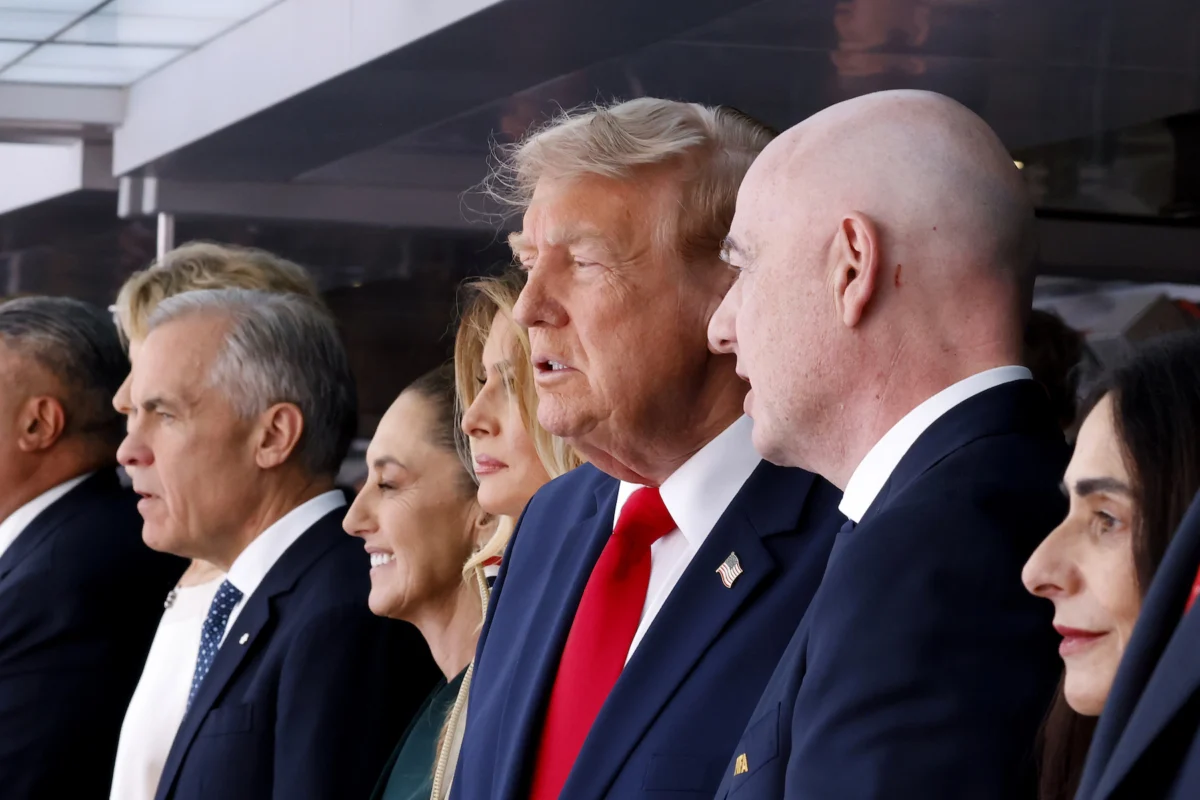
Spain may have hoisted the coveted 2026 World Cup trophy, but the global spectacle, held across North America, experienced its own peculiar moment of discord thanks to the appearance of former U.S. President Donald Trump. During a live broadcast on the jumbotrons at MetLife Stadium in New Jersey, a venue that co-hosted the final match between Argentina and Spain, the enthusiastic crowd erupted in boos as Trump made a brief on-screen appearance. This incident, occurring shortly after Jennifer Hudson’s rendition of the national anthem, cast a shadow over the pre-game festivities and highlighted a recurring theme of public disapproval for the former president at major sporting events. Trump, who was slated to present the World Cup trophy to the victorious team, was shown seated alongside his wife, Melania Trump, in a VIP box, appearing on screen multiple times throughout the highly anticipated final.
This unwelcome reception at the World Cup final is far from an isolated incident. A review of recent years reveals a consistent pattern of Trump facing audible dissent from sports enthusiasts across a spectrum of disciplines. From the roar of the crowd at the World Series and the U.S. Open to the more intimate settings of UFC fights and PGA Tour events, major sporting arenas have increasingly become venues where Trump has been met with jeers and chants, including the persistent "Lock him up" during some past events. This widespread reaction suggests a significant segment of the public views his presence at these events with disapproval, leading to awkward and often contentious moments.
Beyond the public’s vocal disapproval, Trump’s involvement in the 2026 World Cup campaign for the U.S. Men’s National Team (USMNT) also became a point of contention, albeit with a different outcome and impact. During a crucial Round of 16 match against Belgium, the USMNT’s star striker, Folarin Balogun, received a controversial red card that would have suspended him from a pivotal stage of the tournament. In an unprecedented move, reports indicated that Trump personally intervened, contacting FIFA President Gianni Infantino to advocate for the reversal of the decision. The red card was subsequently overturned, a development that initially seemed to benefit the U.S. team.
However, the narrative took a sharp turn. Rather than galvanizing the American squad, this intervention is widely believed by analysts and fans to have created a disruptive "vibe shift." The pressure and controversy surrounding the overturned call reportedly led to a stressed atmosphere within the team. This, in turn, coincided with what many observers considered the U.S. team’s weakest performance of the tournament, culminating in a decisive 4-1 defeat against Belgium and their elimination from the Round of 16. The sequence of events drew immediate comparisons to Trump’s controversial appearance at Game 4 of the NBA Finals, where the New York Knicks suffered a loss that contributed to their eventual 4-1 series defeat against the San Antonio Spurs. It is worth noting that Trump was also booed during his appearance at that NBA Finals game.
A Pattern of Unpopular Appearances at Sporting Events
The World Cup final marked yet another chapter in a series of public events where Donald Trump has been met with audible disapproval. His appearances at various sporting championships have frequently been accompanied by boos, underscoring a growing trend of public dissent directed at the former president within these typically apolitical arenas.
- World Series: In October 2019, Trump was notably booed by a significant portion of the crowd at Nationals Park in Washington D.C. during Game 5 of the World Series. The chants of "Lock him up" were particularly prominent, a stark contrast to the patriotic fervor usually associated with such events. This incident occurred during a moment of patriotic ceremony, further amplifying the disconnect between the former president and a segment of the audience.
- U.S. Open Tennis Championships: During the 2020 U.S. Open men’s final, Trump was again subjected to boos from spectators. While the crowd was significantly reduced due to COVID-19 protocols, the audible discontent was unmistakable, indicating that the sentiment was not confined to larger, more politically charged events.
- NBA Finals: As mentioned in the original report, Trump’s presence at Game 4 of the 2019 NBA Finals between the Toronto Raptors and the Golden State Warriors also elicited boos. This event, held in Oakland, California, mirrored the reception he received at the New York Knicks game, suggesting a broad geographical and sport-specific pattern of negative reactions.
- UFC and PGA Tour: Beyond the major team sports and championships, Trump’s attendance at UFC fights and various PGA Tour events has also been punctuated by negative crowd reactions. These events, while perhaps less politically charged on the surface, have still seen him become a focal point for audible disapproval.
The common thread across these instances is the immediate and often visceral negative reaction from the crowd, suggesting that for a significant portion of the public, Trump’s presence at these celebrated sporting occasions is unwelcome.
Background and Context of the 2026 World Cup
The 2026 FIFA World Cup was a landmark event, marking the first time the tournament was jointly hosted by three North American nations: the United States, Canada, and Mexico. This expansive hosting arrangement involved 16 host cities across the three countries, showcasing the global reach and appeal of the world’s most popular sporting event. The final, held at MetLife Stadium in East Rutherford, New Jersey, was the culmination of a month-long tournament that captivated billions worldwide.
The decision to award the 2026 World Cup to the North American bid was seen as a significant boost for soccer in the region. The tournament aimed to break attendance records and generate substantial economic benefits for the host nations. The final itself was a highly anticipated clash between two footballing powerhouses, Argentina and Spain, drawing a massive global audience and a packed stadium in New Jersey.
The FIFA Club World Cup Precedent
The World Cup trophy presentation was not the first time Trump had been involved in handing out a major soccer trophy. In February 2025, he presented the FIFA Club World Cup trophy to the winning team, Chelsea FC. This event, while a significant sporting occasion, also generated a peculiar moment. Reports indicated that Chelsea players, including prominent figures like Cole Palmer, appeared visibly confused by Trump’s presence and role in the trophy ceremony. This reaction suggested a disconnect between the ceremonial expectations of the sport and the political figure presenting the award, raising questions about the appropriateness and impact of such high-profile political endorsements in international sporting contexts. The fact that this was a "ceremonial decision that the players have any control over" further highlighted the unusual nature of the situation.
Geopolitical Undertones: Milei and Spain’s Stance
The geopolitical landscape surrounding the trophy presentation added another layer of complexity. Argentina’s President Javier Milei, an avowed ideological ally of Donald Trump, has cultivated a close relationship with the former U.S. president. Milei has actively participated in U.S. political events and has been a guest at Trump’s Mar-a-Lago resort, signaling a strong alignment between their political philosophies. This ideological kinship suggests that if Argentina were to have won, the trophy presentation by Trump to Milei might have been framed as a symbolic moment of alliance between two prominent right-wing leaders.
In contrast, Spain’s government has maintained a more distant and less overtly friendly relationship with Trump. This divergence in diplomatic ties between the potential finalists and the man presenting the trophy introduced an element of political intrigue. The crowd’s reaction to Trump at the final, and the subsequent presentation of the trophy, could have been interpreted through the lens of these differing international relationships, adding a subtle geopolitical dimension to the sporting event.
Analysis of Implications and Broader Impact
The repeated instances of Trump being booed at sporting events raise several questions about the intersection of politics and sports. While sports are often viewed as a unifying force, the public’s reaction to Trump’s presence suggests that for a significant portion of the population, these events are not immune to political sentiment. The booing can be interpreted as a form of political protest, a way for fans to express their disapproval of his policies, actions, or public persona, even in a setting traditionally reserved for athletic competition.
The intervention in the USMNT’s game, while seemingly aimed at supporting the national team, ultimately appeared to have a detrimental effect. This highlights the potential pitfalls of political interference in sporting matters, even when intended to be beneficial. The psychological impact on a team, the disruption of established routines, and the added pressure of a politically charged situation can have unforeseen and negative consequences on performance.
Furthermore, the act of presenting the World Cup trophy, a symbol of global sporting achievement, to a figure who has faced such widespread public criticism, can be seen as a complex statement. It underscores the sometimes-awkward fusion of political power and international sporting prestige. The confusion expressed by Chelsea players at the Club World Cup and the boos at the World Cup final suggest a growing disconnect between the established norms of sporting ceremonies and the political figures involved.
As Donald Trump continues to remain a prominent figure in American politics, his appearances at major public events, including sporting spectacles, are likely to remain under scrutiny. The pattern of boos and dissent suggests that his presence is often a polarizing factor, capable of overshadowing the intended celebration of athletic achievement. The 2026 World Cup, therefore, served not only as a showcase for global football but also as a stage for a recurring public sentiment regarding a former U.S. president’s place in the arena of popular culture and sports. The implications of these recurring events point towards a continuing dialogue about the role of politics in sports and the public’s right to express their views, even in spaces traditionally set aside for entertainment and athletic prowess. The World Cup’s narrative, in this regard, became intertwined with the ongoing political discourse surrounding Donald Trump.